
Disclaimer: Some of the links on this page are affiliate links. As an Amazon Associate and affiliate for other networks, we may earn a commission from qualifying purchases at no additional cost to you.
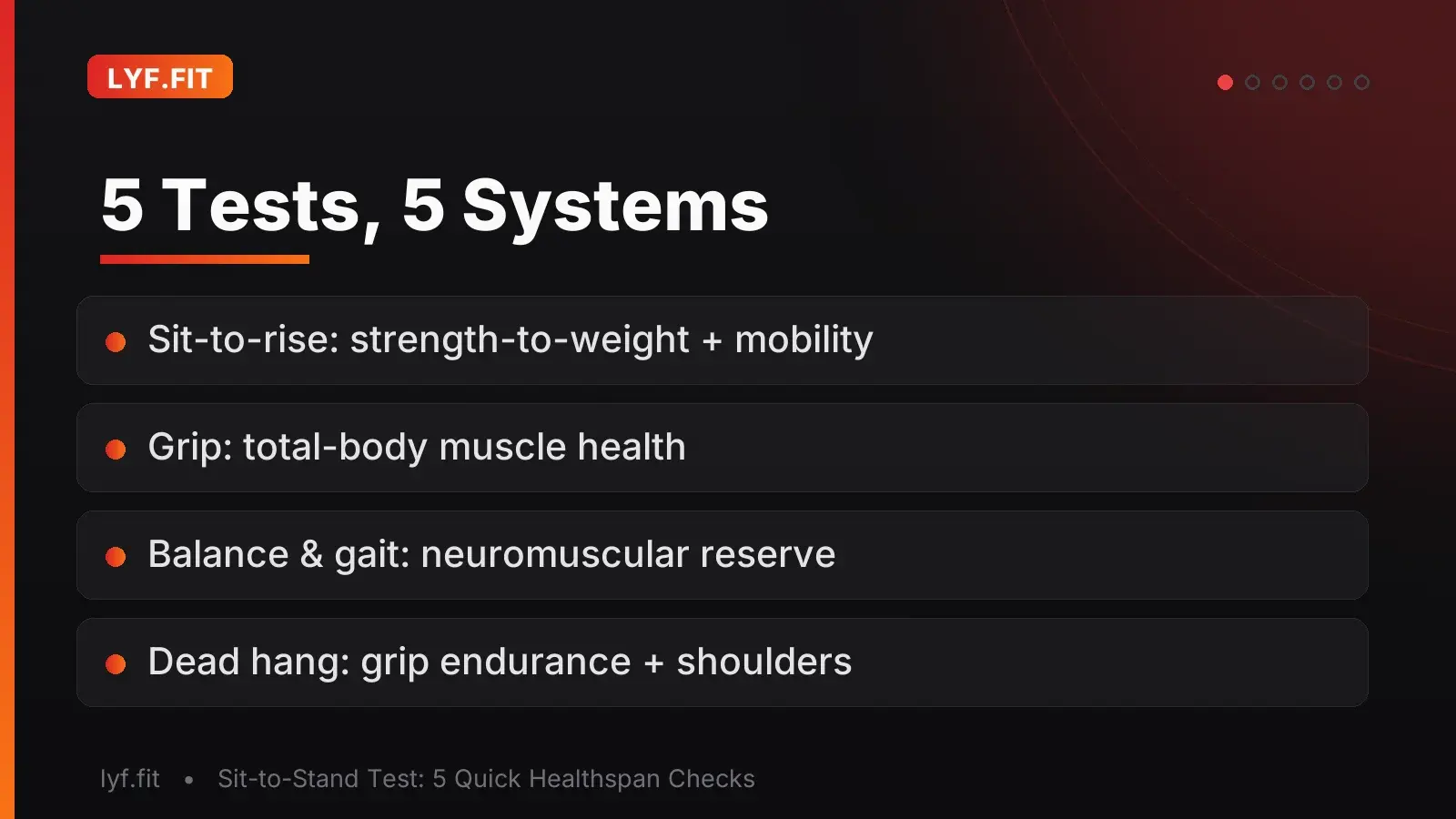
A handful of tests you can run on your living-room floor in under a minute correlate surprisingly well with how long and how well you will live. The sitting-rising test, grip strength, single-leg balance, gait speed, and the dead hang each proxy a different pillar of functional capacity: full-body strength-to-weight, muscular strength, balance, mobility, and power endurance. None of them diagnoses anything on its own, but in large cohort studies each one independently tracks with all-cause mortality, which makes them useful, cheap, repeatable checkpoints for your own healthspan.
Why do 60-second movement tests predict longevity?
These tests work because they compress several biological systems into one observable output. Rising from the floor demands leg power, core stability, joint mobility, and the coordination to sequence them under your own bodyweight. Grip strength is a readout of total-body muscle and neuromuscular integrity. When any of these decline, it usually reflects sarcopenia, reduced physical activity, or subclinical changes long before symptoms appear. That is why researchers keep finding the same pattern: people who score poorly on a simple physical task tend to die earlier, even after adjusting for age, sex, and body mass index. The tests are proxies, not verdicts, but they are honest proxies you can track over time.
What is the sitting-rising test and what does it measure?
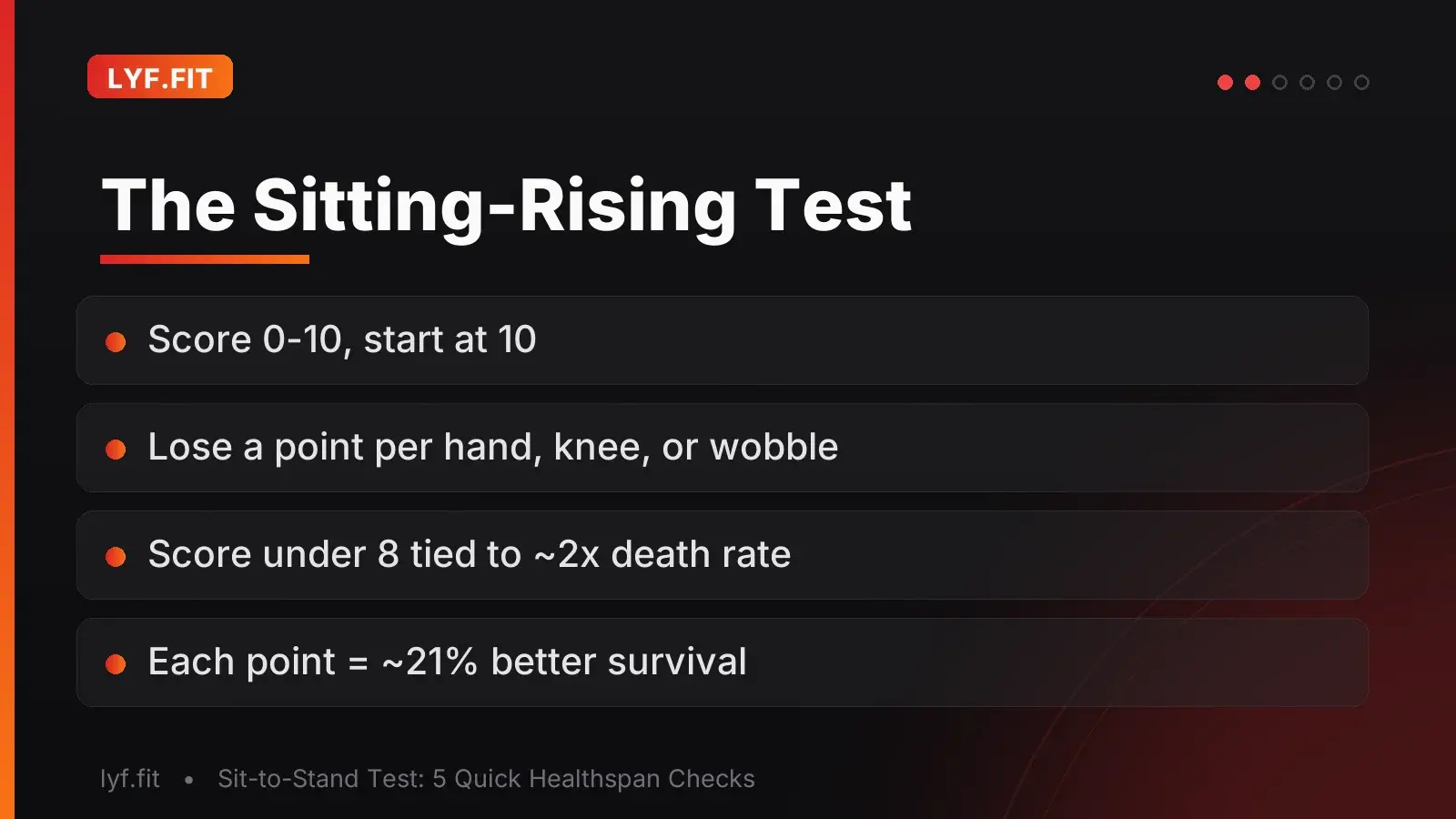
The sitting-rising test (SRT) asks you to lower yourself from standing to a cross-legged seat on the floor, then stand back up, using as little support as possible. You start with 10 points, five for sitting and five for rising, and subtract one point each time you use a hand, forearm, knee, or the side of your leg, plus half a point for wobbling. In a 2012 study of 2,002 adults aged 51 to 80, each additional point was associated with about 21% better survival, and scores below 8 were tied to roughly double the death rate over the 6.3-year follow-up. It proxies strength-to-weight ratio, flexibility, and balance in a single movement.
How does grip strength forecast mortality?
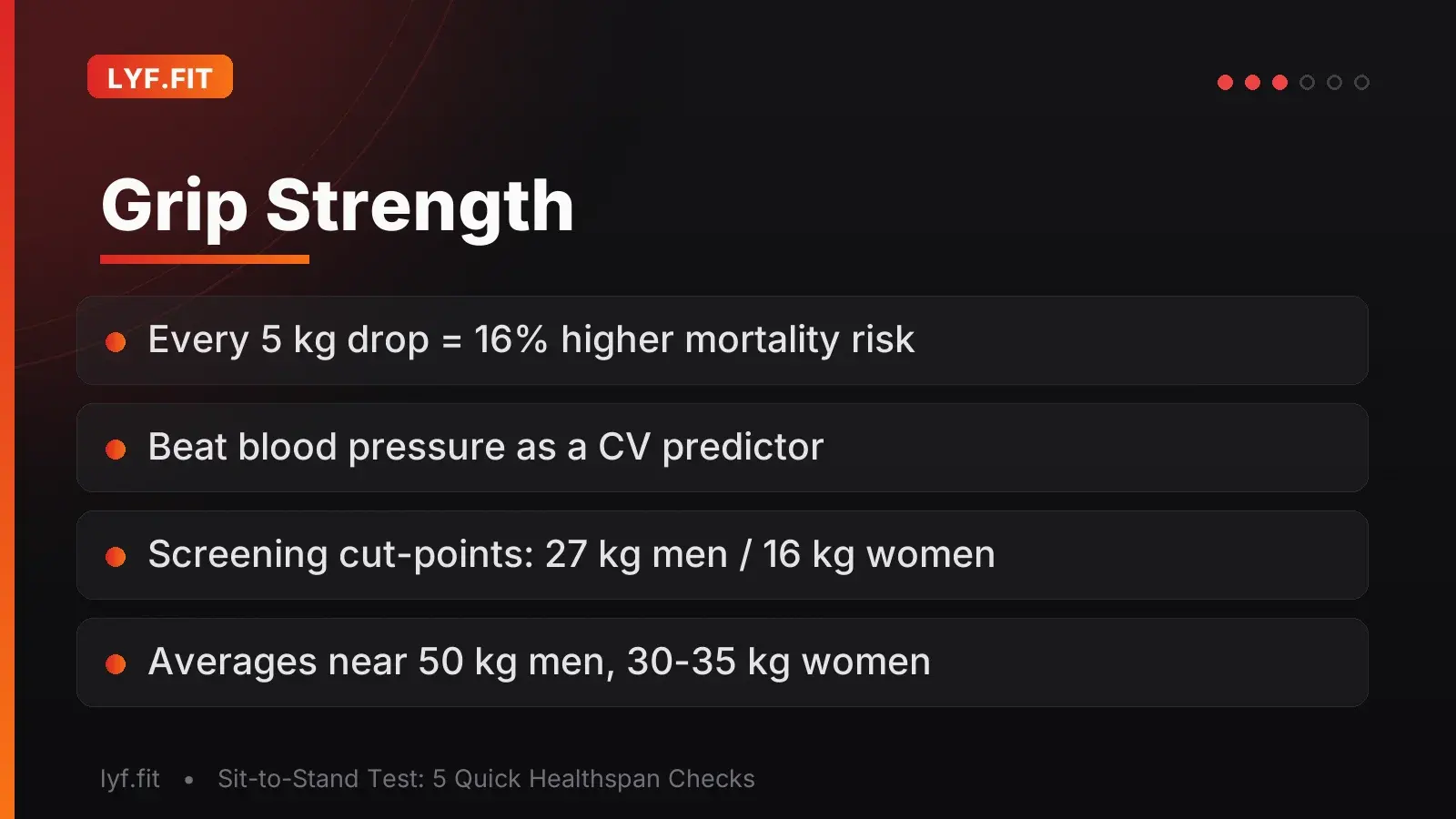
Grip strength is the most-studied of these markers, and it is a startlingly strong one. In the PURE study, an international cohort of nearly 140,000 adults reported in 2015, every 5-kilogram drop in grip strength was associated with a 16% higher risk of all-cause mortality, a 17% higher cardiovascular death rate, and a 9% higher stroke risk. Notably, grip strength outperformed systolic blood pressure as a predictor of cardiovascular death in that dataset. Clinically, the European Working Group on Sarcopenia uses screening cut-points of under 27 kg for men and under 16 kg for women, values that flag the need for further assessment rather than a diagnosis. Average peak grip runs near 50 kg for men and 30 to 35 kg for women.
What do single-leg balance and gait speed tell you?
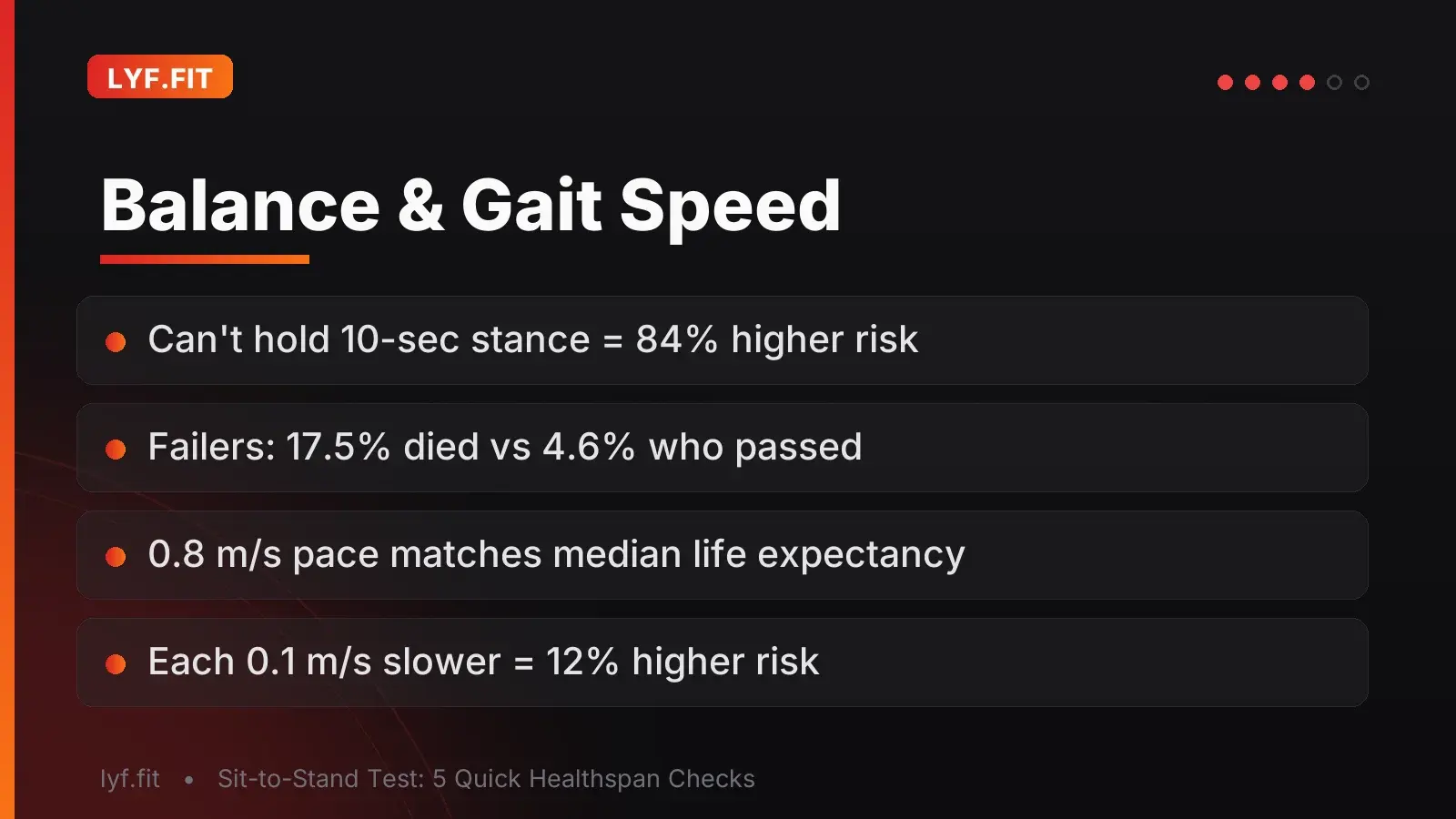
Balance and walking speed capture the neurological side of aging. In a 2022 study of 1,702 Brazilians aged 51 to 75, people who could not hold a 10-second single-leg stance had an 84% higher risk of dying within the next decade; 17.5% of those who failed died during follow-up versus 4.6% of those who passed. Gait speed is equally telling. Across a pooled analysis of roughly 34,000 older adults, a usual walking pace of about 0.8 meters per second matched the median life expectancy for a person's age and sex, and each 0.1 m/s slower was tied to a 12% higher mortality risk. Both proxy balance, power, and neuromuscular reserve.
How does the dead hang fit in?
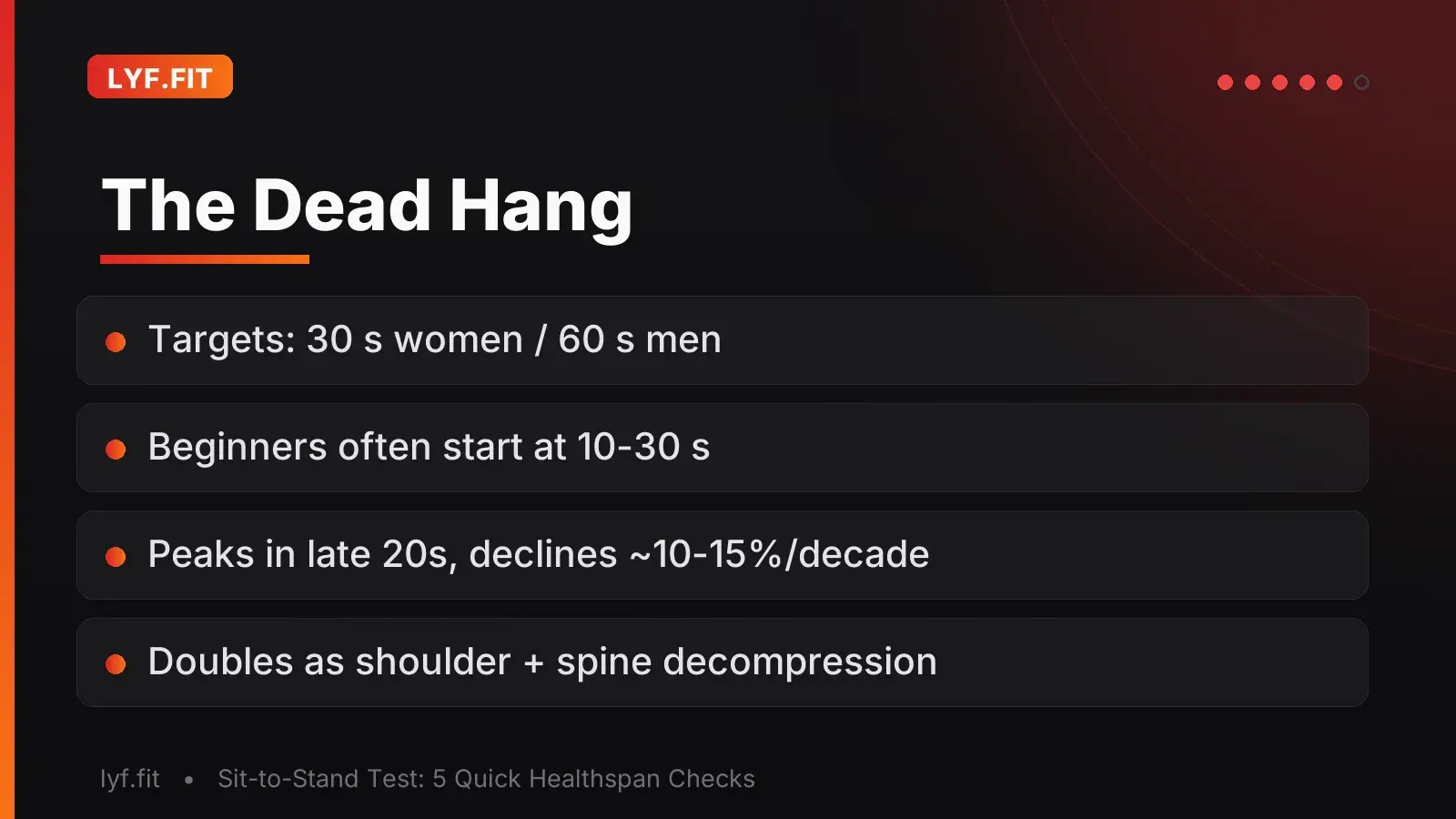
The dead hang, simply hanging from a pull-up bar with straight arms, tests grip endurance, shoulder integrity, and upper-body resilience rather than a single squeeze. It complements the dynamometer grip test by measuring how long you can sustain force, which is closer to real-world demands like carrying groceries or catching yourself in a fall. General benchmarks put a solid target at around 30 seconds for women and 60 seconds for men, with beginners often starting in the 10-to-30-second range. Hang times peak in the late twenties and decline roughly 10 to 15% per decade after 40. Because it loads the spine in traction and challenges the whole posterior chain, the dead hang doubles as a mobility and shoulder-health drill.
How do the five tests compare?
Each test isolates a different capacity, so treat them as a panel rather than picking one. The table below summarizes what each proxies, a rough benchmark framed for self-tracking rather than diagnosis, and the fastest way to move the needle. Retest every 8 to 12 weeks; the trend line for you matters far more than any single population cutoff.
| Test | What it measures | Simple benchmark (not diagnostic) | How to improve |
|---|---|---|---|
| Sitting-rising test | Strength-to-weight, mobility, balance | Score 8+ out of 10 | Goblet squats, Cossack squats, floor get-ups |
| Grip strength | Total-body strength, neuromuscular health | Above ~27 kg (men) / ~16 kg (women) | Farmer carries, deadlifts, dead hangs |
| Single-leg balance | Balance, proprioception, power | Hold 10+ seconds eyes open | Single-leg stands, tandem walks, step-ups |
| Gait speed | Aerobic and lower-body reserve | ~0.8 m/s or faster usual pace | Brisk walking, lunges, calf and glute work |
| Dead hang | Grip endurance, shoulder integrity | 30 s (women) / 60 s (men) | Bar hangs, scapular pulls, rows |
Test Your Knowledge
1 / 4In the 2012 study, each additional point on the sitting-rising test was associated with roughly how much better survival?
How should you train the weak links?
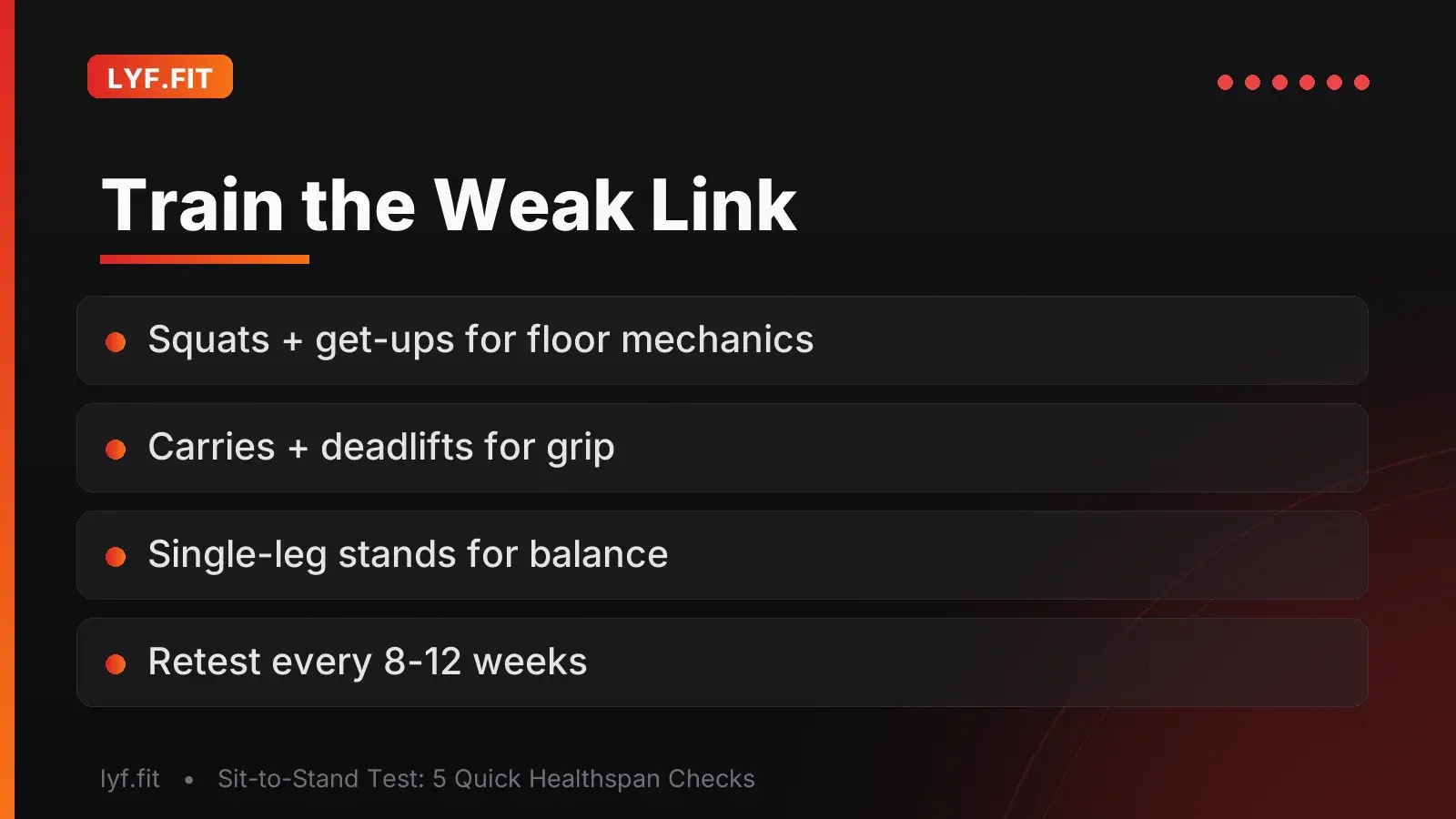
The encouraging part is that every one of these markers responds to training, often within weeks. Strength-to-weight and floor mechanics improve with goblet squats, Cossack squats, and deliberate get-ups off the ground; grip responds to farmer carries, heavy deadlifts, and dead hangs; balance sharpens with single-leg stands and tandem walking; gait speed climbs with brisk walking intervals and lower-body strength work. Aim for two to three resistance sessions weekly plus daily balance practice while brushing your teeth. Our exercise library maps movements to the muscles and patterns each test stresses, and the mobility generator builds a short routine for the hips, ankles, and shoulders that limit floor work and hanging.
Interactive Tools
Save these contextual tools to your profile for quick access.
Mobility Routine Generator
Select a tight muscle group and instantly generate a 5-minute stretching routine to relieve tightness and improve range of motion.
Frequently asked questions
For most healthy adults, yes, but use judgment. Do the sitting-rising and balance tests near a wall or sturdy chair, on a non-slip surface, and skip the floor tests if you have a recent hip, knee, or back injury. If you feel dizzy, have osteoporosis, or are recovering from surgery, check with a physician first. These are self-tracking tools, not a substitute for medical evaluation.
Every 8 to 12 weeks is a practical cadence. That is long enough for a training block to produce a measurable change but short enough to catch a downward trend early. Test under similar conditions each time, same time of day, same footwear or barefoot, so the comparison is fair. Your personal trajectory matters more than any population benchmark.
No. These tests are population-level correlations, not individual prophecies. A below-benchmark score is a signal to investigate and train, not a diagnosis. Many factors the tests cannot see influence longevity, and scores improve with practice. Treat a weak result as useful information and a reason to strengthen that link.
Grip strength has the deepest evidence base and needs only an inexpensive dynamometer, so it is a strong single choice for tracking. That said, the sitting-rising test requires zero equipment and captures strength, mobility, and balance together, making it the best free option. Ideally, run all five as a quick quarterly panel.
These 60-second checks turn abstract "healthspan" into something you can measure on your floor and improve on purpose. Pick a day, run all five, write down the numbers, and pick the weakest link to train first. Build your routine with the exercise library and loosen the joints that hold you back with the mobility generator.
Stop completely guessing.
Use our interactive PWA tools to calculate your exact macros, 1RM, and running pace offline.