
Disclaimer: Some of the links on this page are affiliate links. As an Amazon Associate and affiliate for other networks, we may earn a commission from qualifying purchases at no additional cost to you.
Grip strength — how hard you can squeeze — is one of the simplest and most powerful measures of overall health. It is not really about your hands. It is a proxy for whole-body strength and muscle quality, and in large studies it predicts the risk of early death more accurately than blood pressure does. Doctors and researchers increasingly treat it as a vital sign — as informative, in its own quiet way, as your pulse or your weight.
This guide explains what grip strength reveals, what counts as normal, and how to build it.
What is grip strength, and why does it matter?
Grip strength is the maximal force your hand and forearm muscles produce when you squeeze. It is measured in kilograms with a hand dynamometer — a small device you crush as hard as you can.
Its real value is as a shortcut. Measuring whole-body strength properly is slow and expensive, but grip strength tracks closely with the strength of your legs, back, and core. It also reflects muscle mass, nervous-system function, nutrition, and the cumulative wear of aging. That is why researchers have described it as a "biomarker of ageing": a single, 10-second test that captures how well your body is holding up. It needs no lab, no blood draw, and no waiting for results, which is part of why it has become so widely studied.
Can grip strength really predict how long you live?
The evidence is striking. The largest study, known as PURE, tracked 139,691 adults aged 35 to 70 across 17 countries, measuring grip with a Jamar dynamometer.
Published in The Lancet in 2015 by Darryl Leong and colleagues, the study found that every 5-kilogram drop in grip strength was linked to a 16% higher risk of death from any cause, a 17% higher risk of cardiovascular death, and measurably higher rates of heart attack and stroke. Most remarkably, grip strength predicted all-cause and cardiovascular mortality more accurately than systolic blood pressure. A weak grip does not cause these outcomes — but it is an honest signal of underlying health.
What is a normal grip strength for your age?
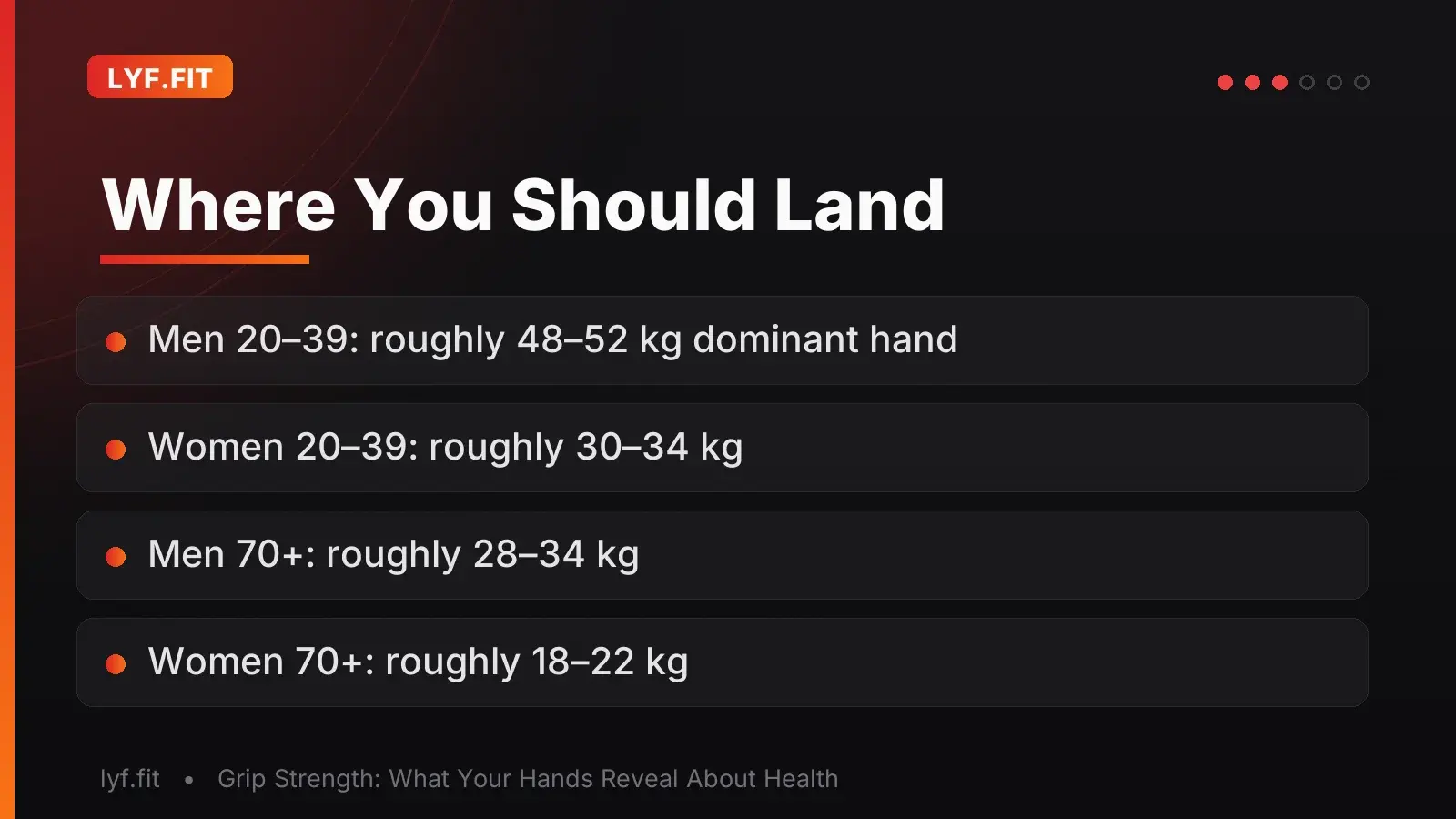
Grip strength rises through early adulthood, holds roughly steady through midlife, and then declines. Men are typically stronger than women, and the dominant hand usually outperforms the other by a few kilograms.
| Age group | Men (approx.) | Women (approx.) |
|---|---|---|
| 20–39 | 48–52 kg | 30–34 kg |
| 40–59 | 40–47 kg | 26–31 kg |
| 60–69 | 34–40 kg | 22–26 kg |
| 70 and over | 28–34 kg | 18–22 kg |
These are approximate average values for the dominant hand, drawn from large normative datasets. Individual results vary widely, so treat them as a rough reference rather than a strict target.
What is sarcopenia, and how does grip strength detect it?
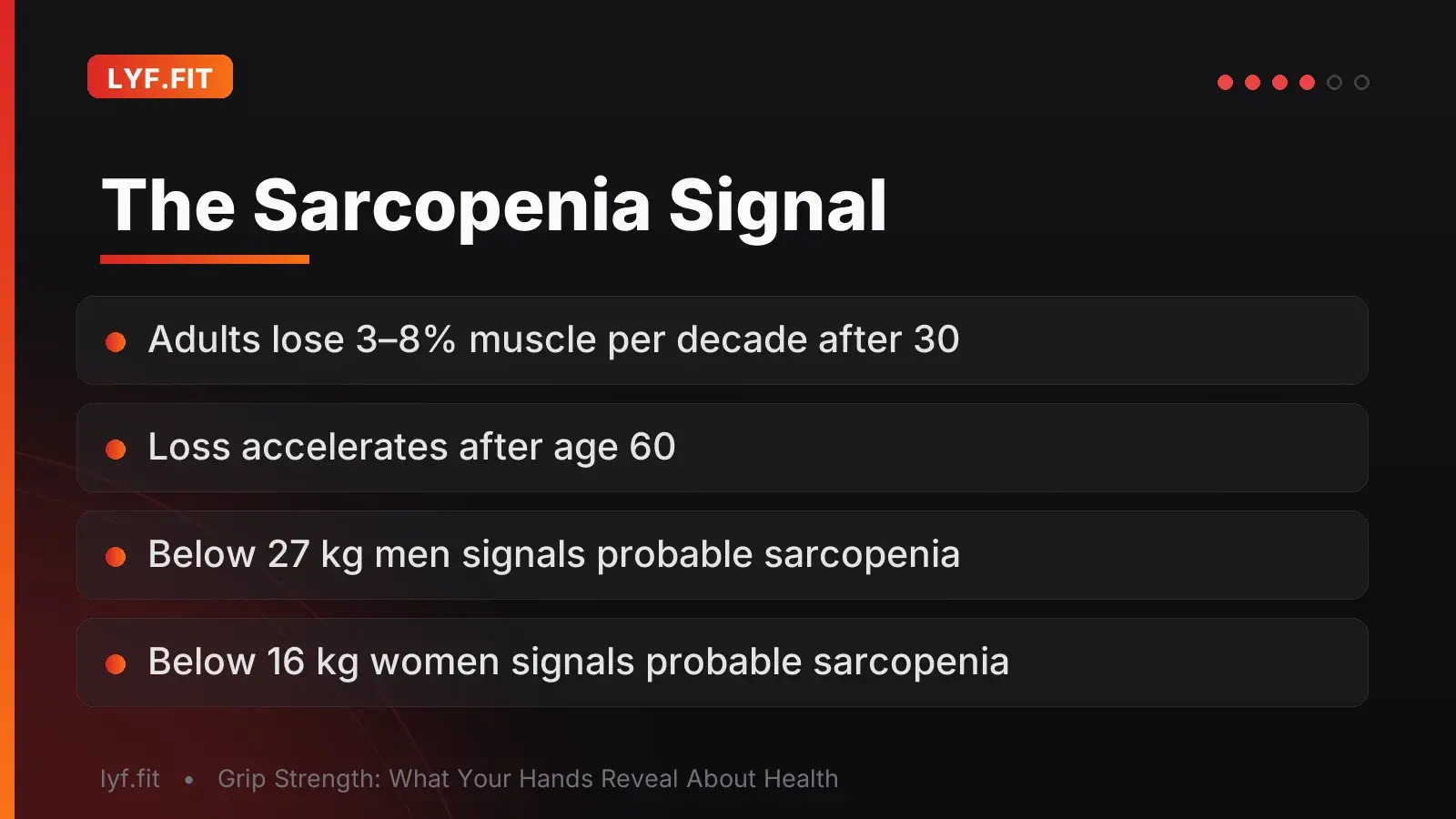
Sarcopenia is the age-related loss of muscle mass and strength. After age 30, adults lose roughly 3 to 8% of their muscle mass per decade, and the loss speeds up after 60. Left unchecked, it leads to frailty, falls, and lost independence.
Grip strength is the frontline screening tool for it. The European Working Group on Sarcopenia in Older People set practical cut-off points: a grip below about 27 kilograms for men or 16 kilograms for women signals probable sarcopenia and a need for closer assessment. Because the test is so quick and cheap, clinicians can flag muscle loss long before it becomes disabling.
Is grip strength only a concern for older adults?
No — it matters at every age. While the headlines focus on aging, the grip strength you carry in your 30s and 40s sets the baseline you will draw down from later in life. Researcher Taina Rantanen and colleagues followed middle-aged men for more than two decades and found that grip strength measured in midlife predicted physical disability and functional limitations decades later.
The practical message is simple: the stronger you are now, the more reserve you bank for later. Younger adults rarely think about muscle loss, but the habits built in early adulthood — regular resistance training and an active lifestyle — largely determine how far above the frailty threshold you remain decades from now. Grip strength is a long-term investment, not a retirement-age repair job.


Why does grip strength decline — and is it reversible?
Grip strength falls with age for two main reasons: the muscles themselves shrink, and the nervous system loses some of the motor units that drive them. Modern life accelerates the problem, because few daily tasks now demand a hard, sustained grip.
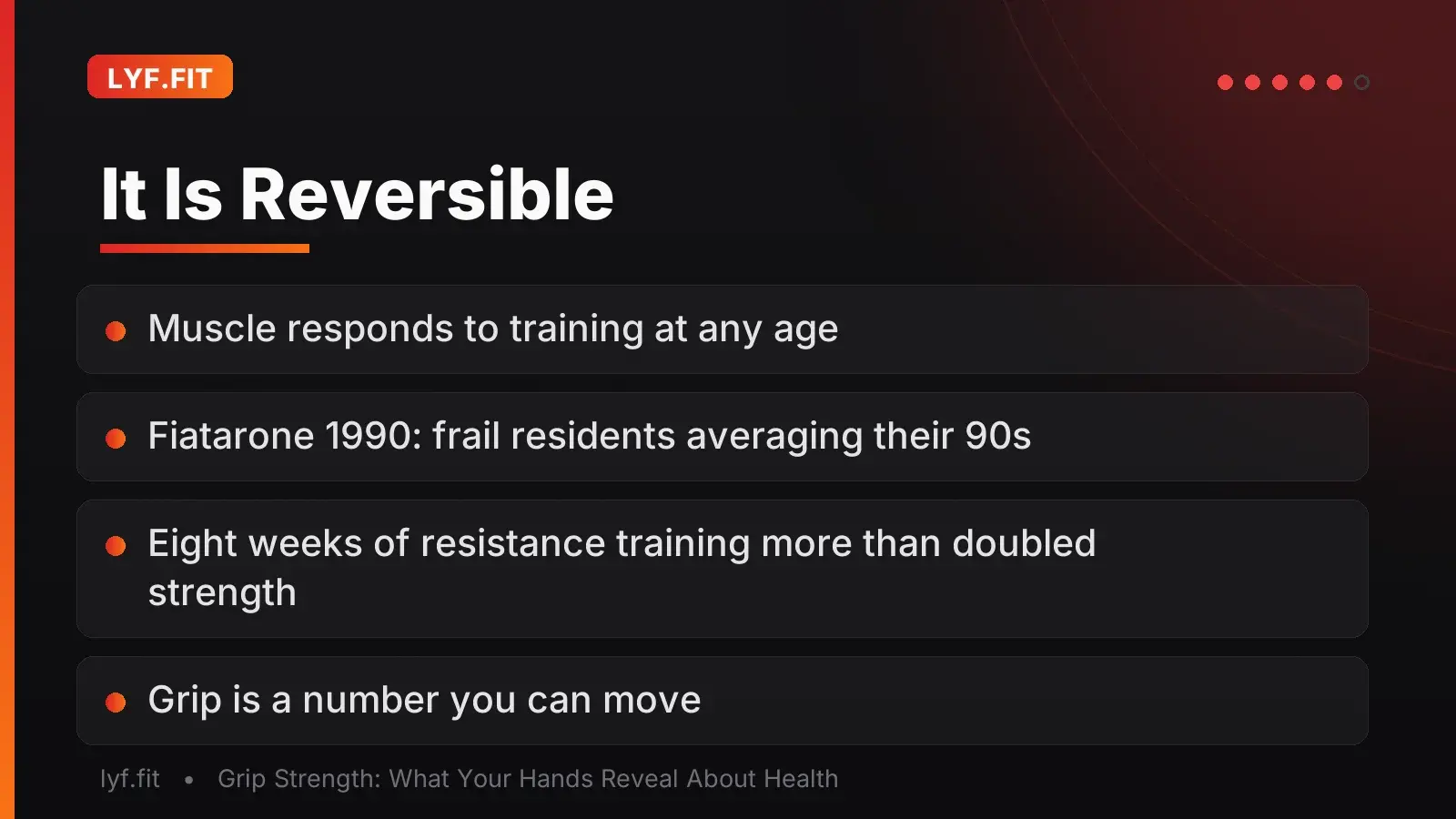
The encouraging part is that the decline is largely reversible. Muscle responds to training at any age. A landmark 1990 study led by Maria Fiatarone trained frail nursing-home residents with an average age in their 90s; after just eight weeks of resistance exercise, their strength more than doubled. Grip strength is not a fixed verdict — it is a number you can move.
How do you test your grip strength?
The clinical standard is a hand dynamometer. You squeeze it as hard as possible, test each hand a few times, and record the best result, then compare it against age and sex norms.
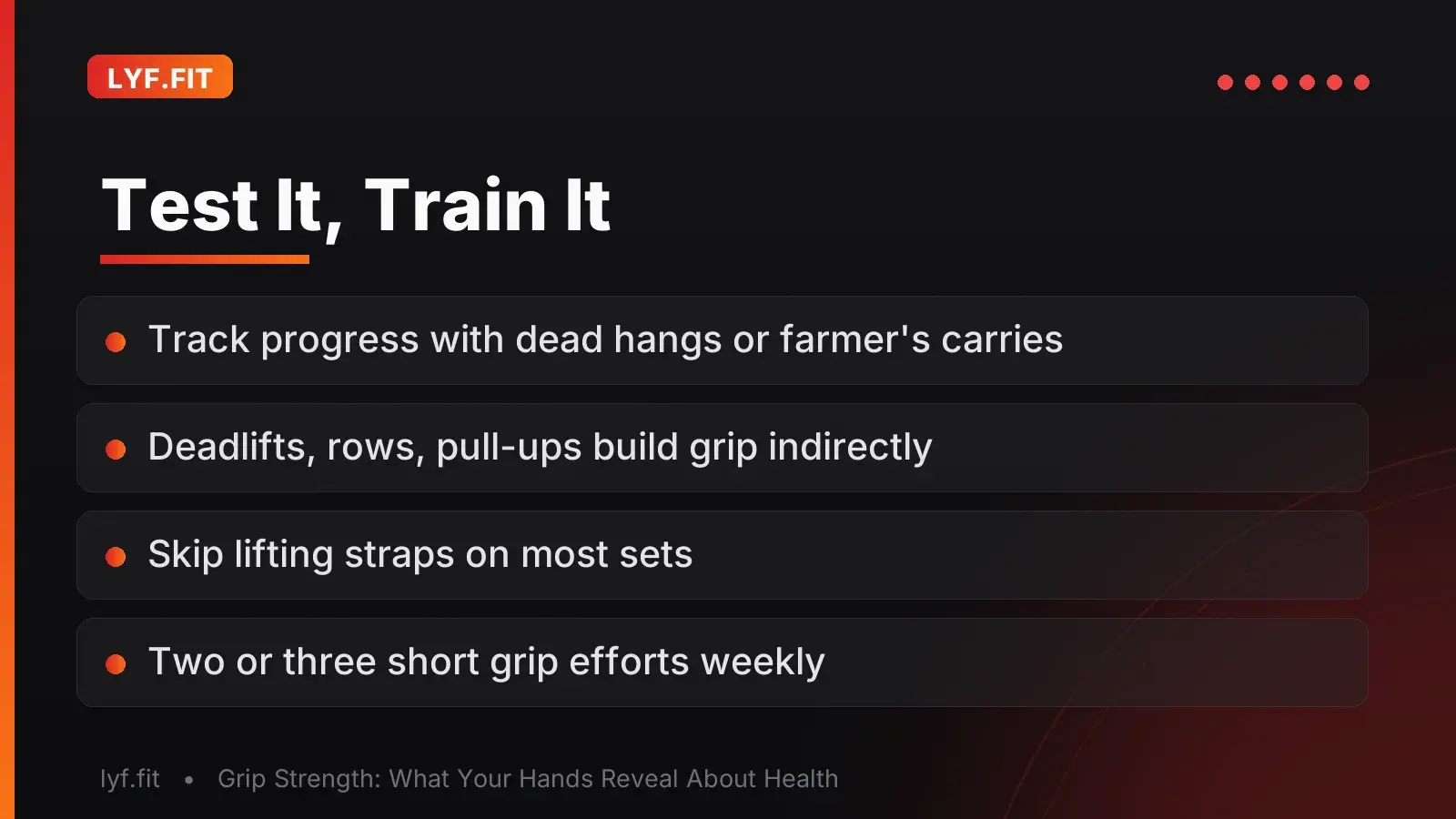
You do not need equipment to track progress, though. A dead hang from a pull-up bar is a good home proxy: time how long you can hold on. A heavy farmer's carry — walking while holding a dumbbell in each hand — works the same way. Whatever method you choose, the key is to retest the same way every few months so you can see the trend rather than a single snapshot. Many gyms and physiotherapy clinics also keep a dynamometer on hand, and a formal reading takes under a minute.
How can you improve your grip strength?
Grip responds quickly to training, both directly and indirectly. Direct work includes hand grippers, dead hangs, and pinching weight plates, performed a few times a week. Even everyday choices help: carrying groceries by hand instead of using a cart, or twisting open jars without a gadget, all add small doses of grip work.
The bigger gains often come indirectly. Heavy pulling exercises — deadlifts, rows, pull-ups — and loaded carries all force your hands to hold significant weight. The single most important rule is to skip lifting straps for most sets, since straps remove the demand on your grip. Two or three short grip-focused efforts a week are usually enough; like any muscle, the forearms need recovery between hard sessions, and most people notice a firmer, more confident grip within a month or two. Build the work into a structured routine using our Programs tool, and record your sessions in the Workout Log so progress stays visible.
The bottom line
Grip strength is a free, fast, and honest vital sign. It is not about crushing handshakes; it is a readout of your whole-body strength, your muscle health, and your biological age. A weak grip is a warning worth heeding, and a strong one reflects a body that is aging well. Best of all, it responds to training at any age. Few health metrics are this easy to measure or this responsive to effort. Test it, train it with carries and pulling work, and recheck it every few months — and speak with a doctor before starting if you have a hand injury or heart condition.
Interactive Tools
Save these contextual tools to your profile for quick access.
Core Concepts
1 / 6Test Your Knowledge
1 / 4What does grip strength measure?
Frequently asked questions
Grip work splits into three types. Crush grip is squeezing something shut, like a hand gripper or a firm handshake. Support grip is holding on — a dead hang, a farmer's carry, or a heavy deadlift. Pinch grip is holding weight between your thumb and fingers with no wrap-around, such as pinching two plates together. Most everyday function and lifting carryover comes from support and crush grip, so build those first and add pinch work for balance.
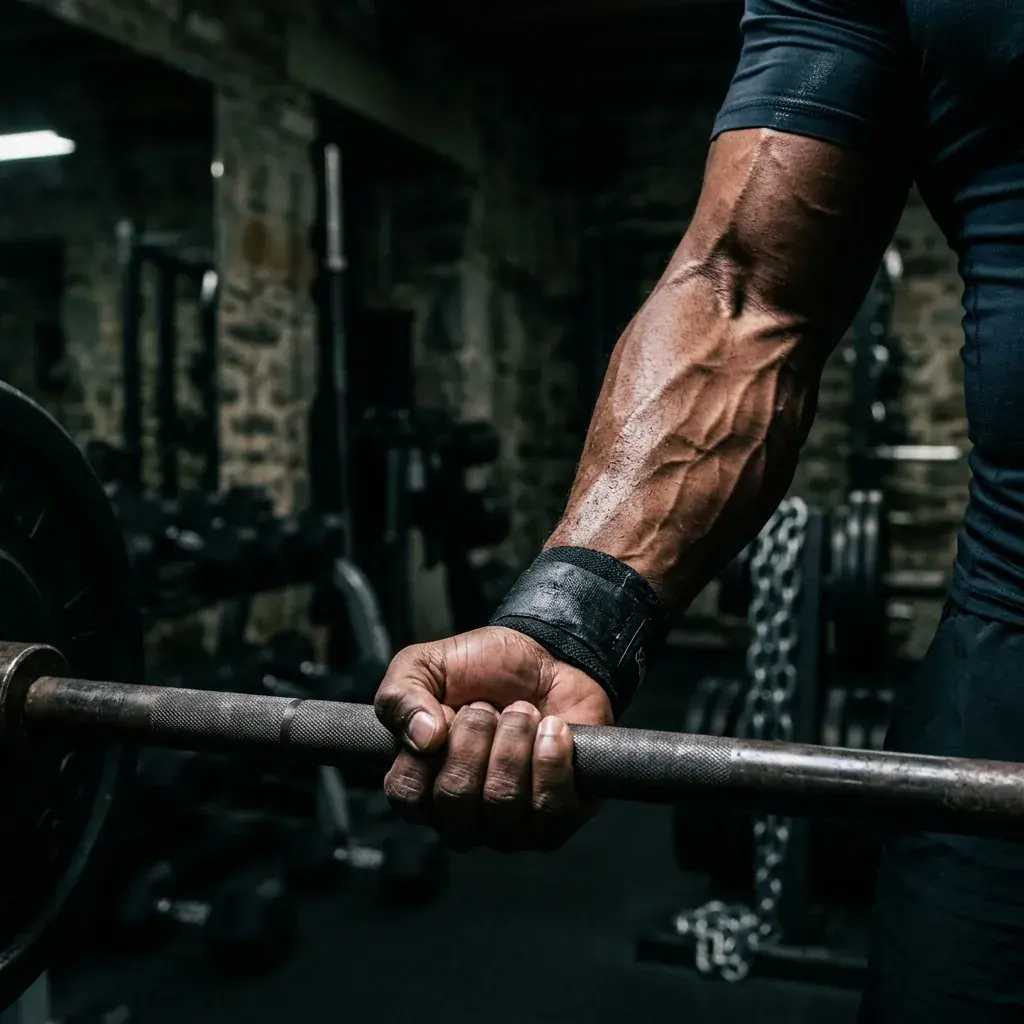
Lifting straps wrap your wrists to the bar and take your grip out of the equation, letting you pull more weight on heavy back and pulling work. They help when your grip fails before the target muscle does. The trade-off is that a strapped grip never gets trained. A practical rule: keep most of your sets strapless so your hands keep working, and save straps for your heaviest or highest-rep pulling where grip would otherwise cut the set short.
Two or three short grip-focused efforts a week are plenty for most people, especially on top of the grip demand from deadlifts, rows, and carries. The forearms recover fairly quickly but still need rest between hard sessions, so avoid maxing out a gripper every day. One caution: if you notice wrist or hand numbness, tingling, or persistent pain — possible signs of carpal tunnel or another issue — stop and see a qualified professional rather than training through it.
Large studies link a weaker grip to a higher risk of early death, but that is an association, not proof that grip itself is the cause. Grip acts as a mirror of overall strength, muscle quality, and biological aging, so a weak grip tends to flag underlying issues. Training your grip alone will not add years to your life, but the broader habits that build it — resistance training and staying active — are consistently tied to healthier aging.
Stop completely guessing.
Use our interactive PWA tools to calculate your exact macros, 1RM, and running pace offline.