

Disclaimer: Some of the links on this page are affiliate links. As an Amazon Associate and affiliate for other networks, we may earn a commission from qualifying purchases at no additional cost to you.
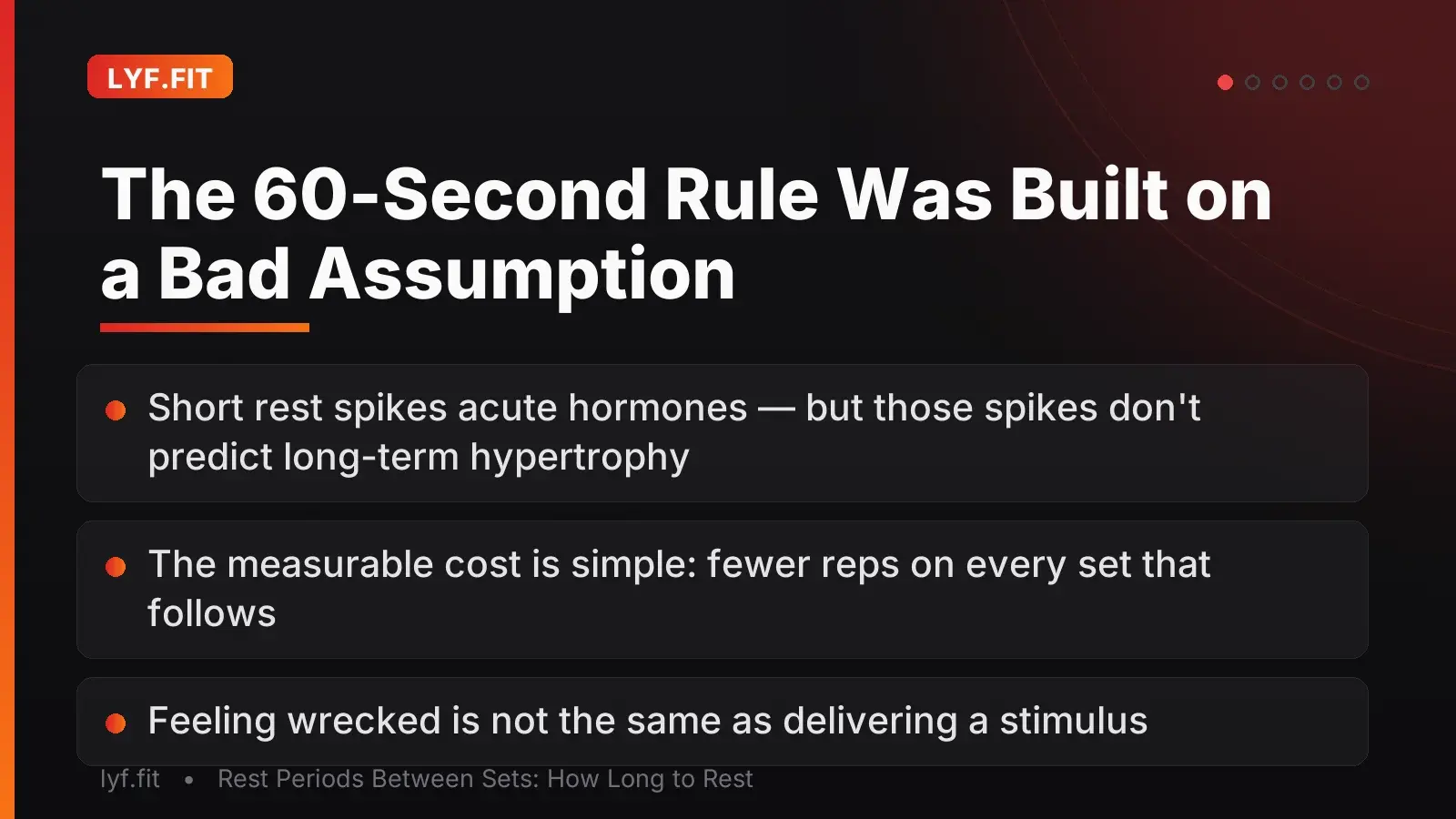
Most lifters rest far too little between sets of serious work. For heavy compound lifts, the research points toward 2-3 minutes or more, not the 60 seconds that dominated gym advice for two decades. Short rest does not create a special growth stimulus — it mostly costs you reps on your next set, and those lost reps are the training volume that drives adaptation.
Where did the 60-second rule come from?
The one-minute prescription grew out of a reasonable-sounding hypothesis: short rest spikes acute growth hormone and testosterone, raises "metabolic stress," and should therefore build more muscle. That hypothesis has not held up well. Research published over the past 15 years has repeatedly failed to show that post-exercise hormone surges predict long-term hypertrophy in trained lifters. Meanwhile, the cost of short rest is trivially easy to measure: fewer reps at the same load, set after set. The rule survived because it feels productive. You're breathing hard, the session is short, the pump is real. But sensation and stimulus are different variables, and only one of them shows up on the bar in eight weeks.
What did the head-to-head rest trials actually find?
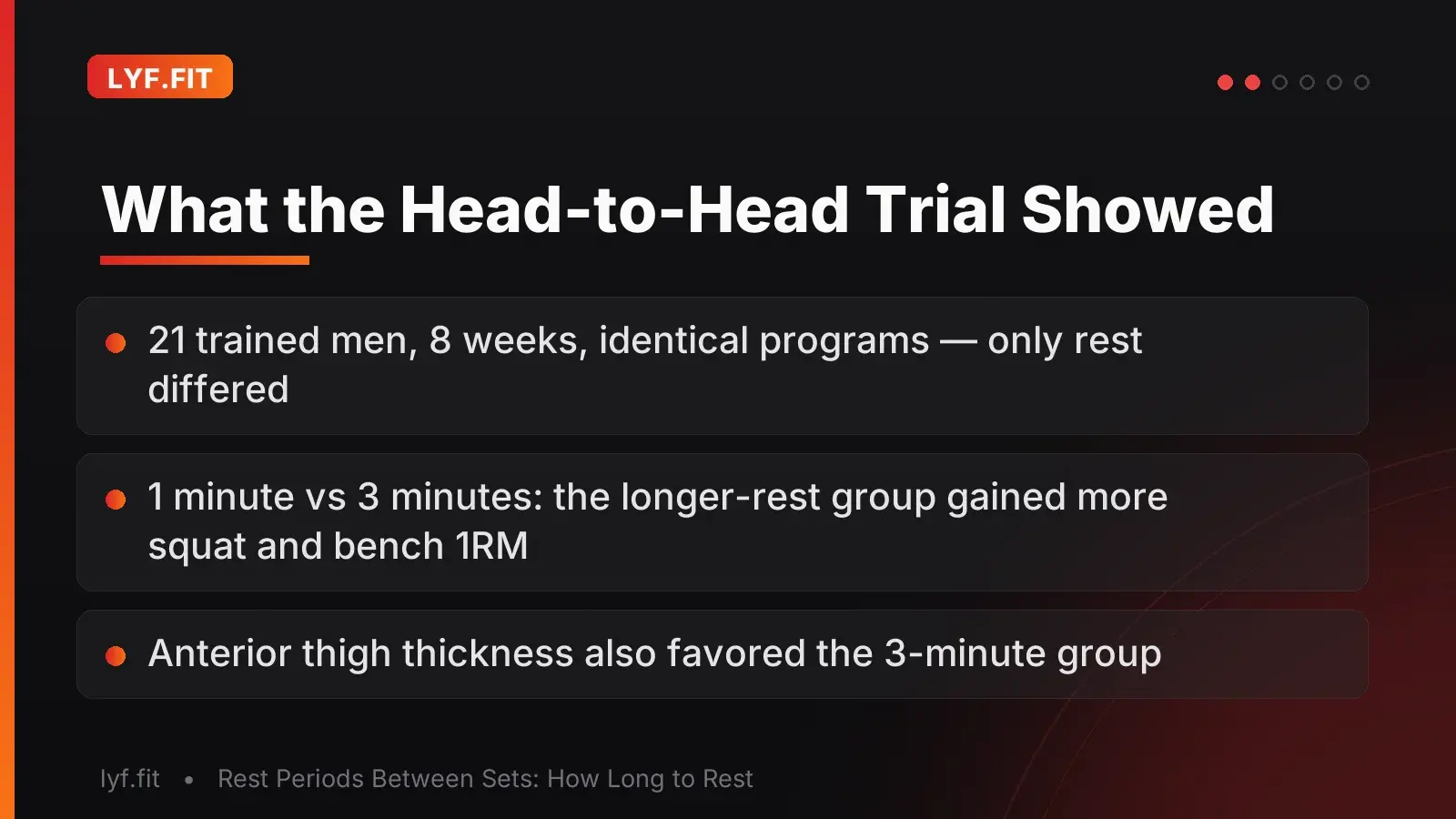
The most-cited direct comparison randomized 21 resistance-trained men to identical 8-week programs — three full-body sessions a week, 3 sets of 8-12RM across 7 exercises — differing in one variable: 1 minute versus 3 minutes of rest between sets. The longer-rest group gained significantly more on both squat and bench press 1RM, and gained significantly more anterior thigh thickness, with a near-significant trend toward more triceps growth. The mechanism wasn't mysterious: they completed more total work under the same prescription.
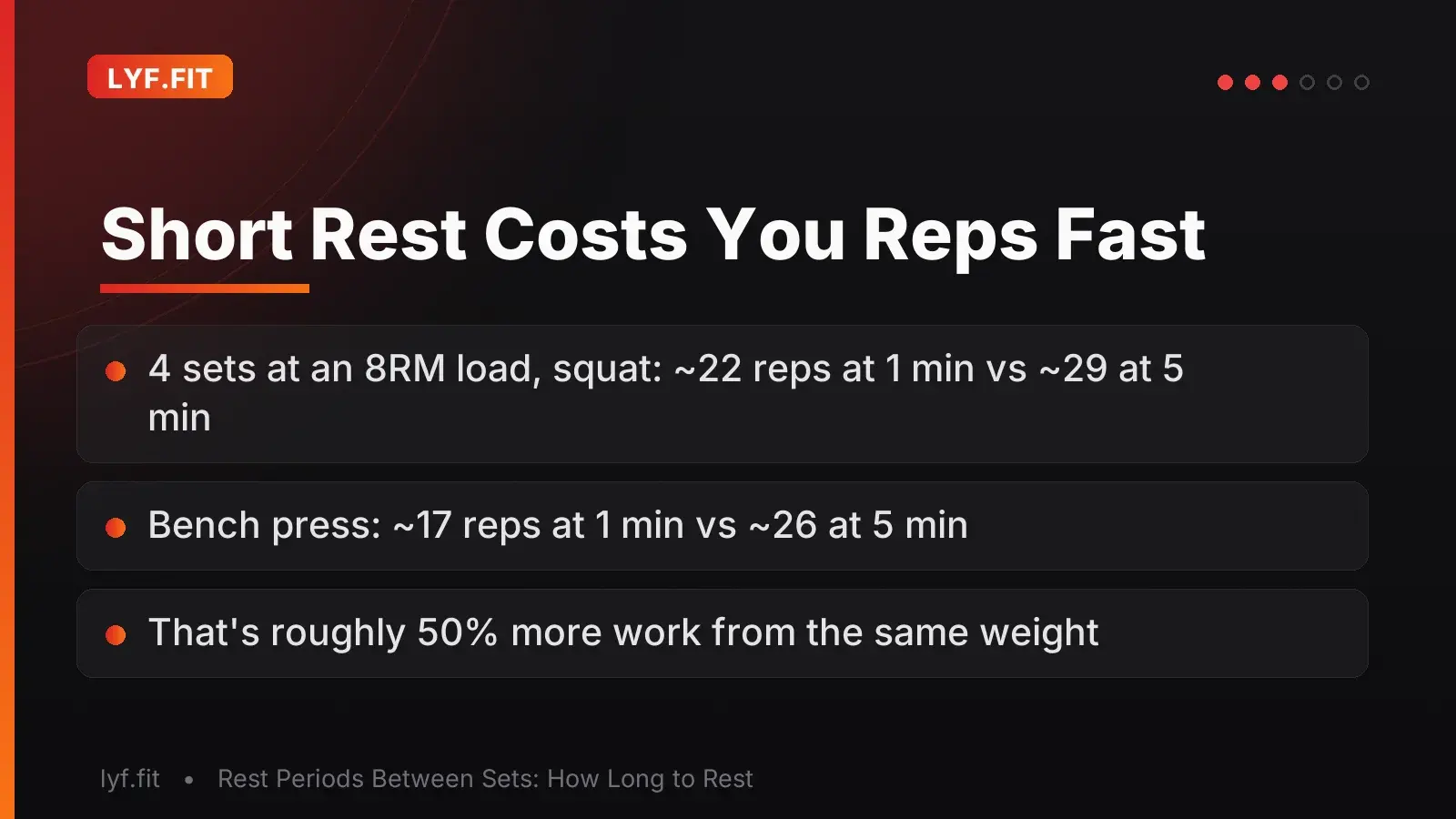
Acute volume data lines up cleanly. In a classic protocol using 4 sets at an 8-rep-max load, trained lifters completed roughly 22 total squat reps with 1-minute rest, about 26 with 2 minutes, and close to 29 with 5 minutes. Bench press degraded harder: roughly 17 reps at 1 minute versus 26 at 5 minutes — about 50 percent more work from the same sets and the same weight.
Slide 1 of 6
What does your body actually need between sets?
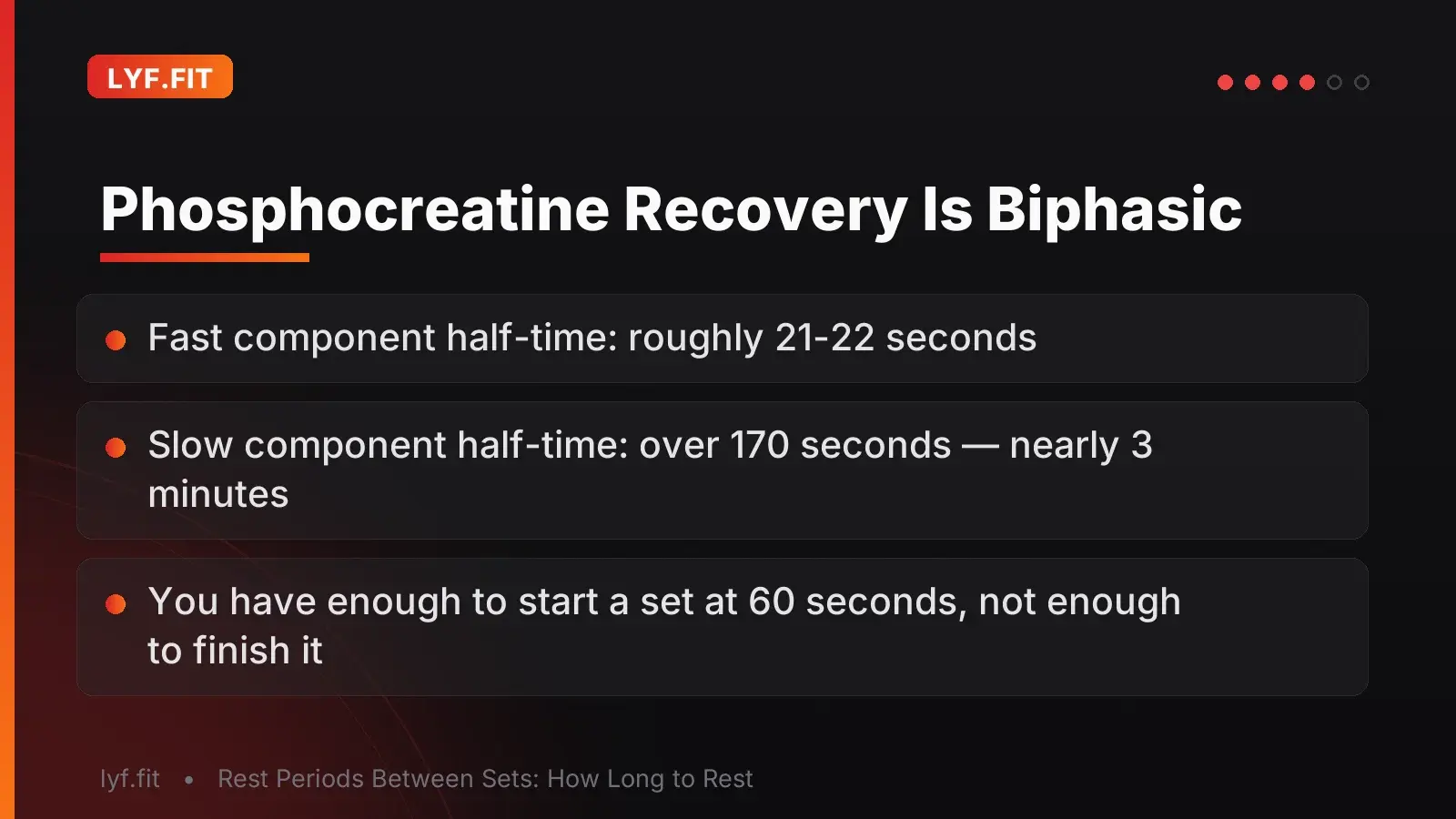
Heavy sets of 1-6 reps run largely on stored phosphocreatine, and refilling that tank is biphasic. The fast component has a half-time of roughly 21-22 seconds; the slow component's half-time exceeds 170 seconds — nearly three minutes. Practically, you recover most of your capacity in the first 60-90 seconds, then claw back the last stubborn fraction slowly. That's exactly why the difference between 60 and 180 seconds shows up in reps 5 through 8 of your next set rather than rep 1: you have enough to start, not enough to finish.
Substrate is only part of it. Central and peripheral fatigue, ventilation, and blood pressure all lag behind how recovered you subjectively feel — which is why a hard set of five squats leaves you compromised well after your breathing settles.
Does short rest hurt muscle growth, or only strength?
Here's the honest version, because the two outcomes behave differently.
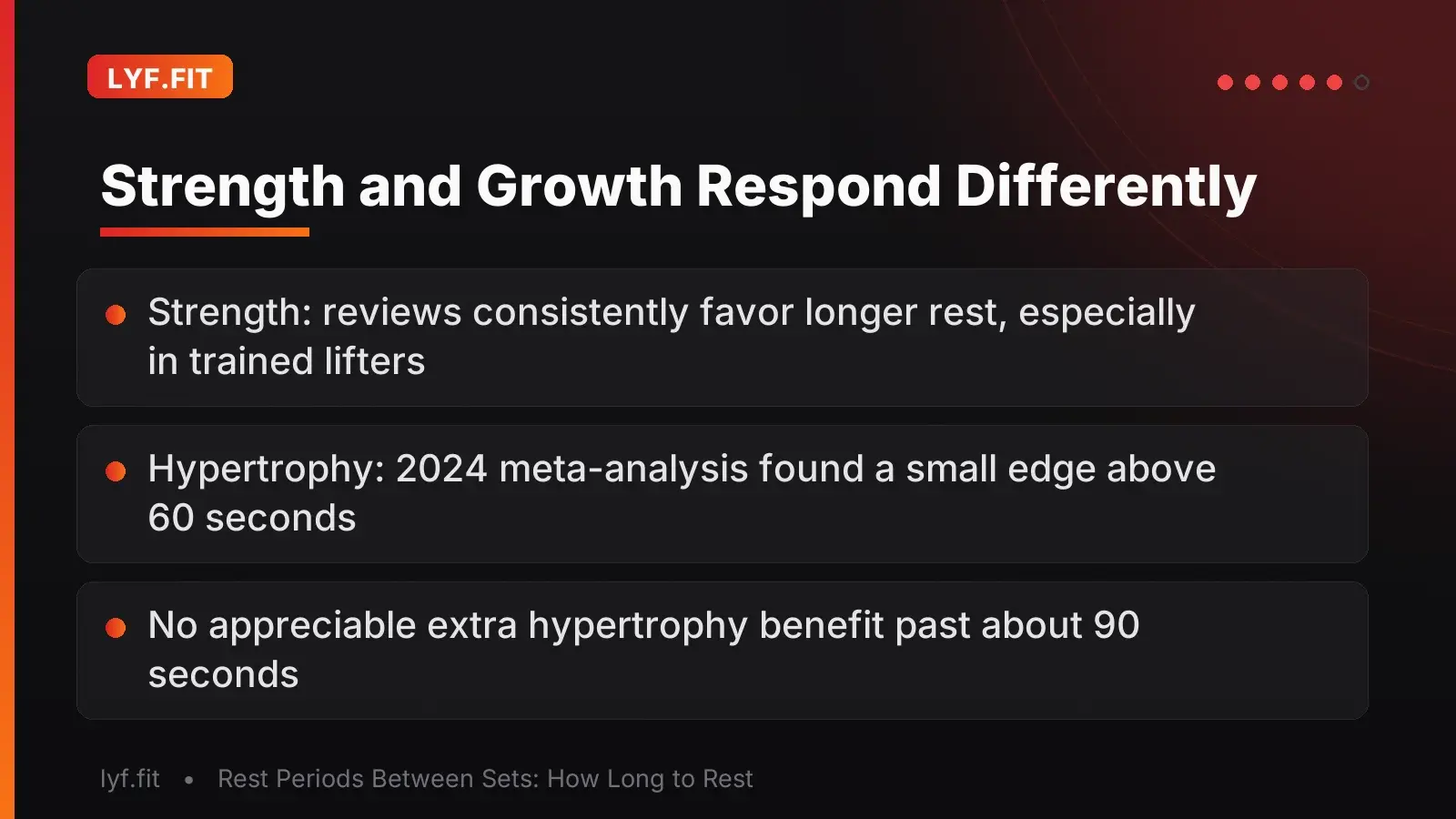
For maximal strength, the evidence is fairly consistent: systematic reviews of controlled trials find longer rest favors 1RM gains, particularly in people with training experience. The 2009 ACSM position stand on resistance training already recommended at least 2-3 minutes for core exercises and 1-2 minutes for assistance work.
For hypertrophy, the effect is smaller and noisier. A 2024 Bayesian meta-analysis pooling 9 studies and 19 site-specific measurements found a small edge for resting longer than 60 seconds — standardized mean differences of 0.17 for the thighs and 0.13 for the arms, with roughly 88 and 74 percent posterior probability of favoring longer rest respectively, though both credible intervals crossed zero — but no appreciable additional benefit past about 90 seconds. Translation: for growth, the floor matters more than the ceiling. Don't drop under a minute; stretching a lateral raise from 90 seconds to 3 minutes buys you very little.
How much rest do you need, by goal and exercise type?
| Goal / exercise type | Rest between sets | Why |
|---|---|---|
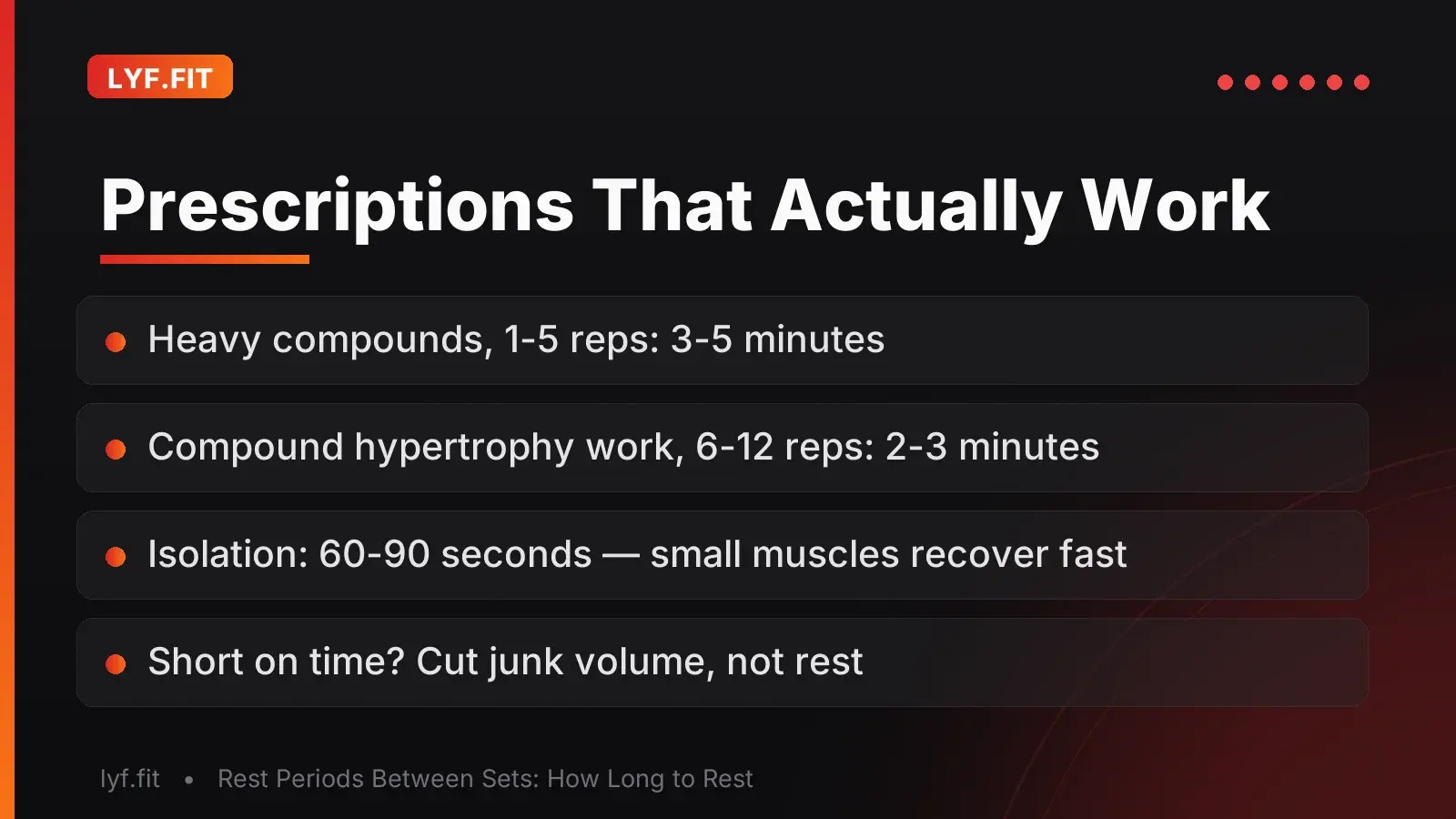
| Maximal strength, 1-5 reps (squat, deadlift, bench, overhead press) | 3-5 min | Phosphocreatine and central fatigue both need minutes; the goal is a maximal-quality set, not fatigue |
| Heavy compound hypertrophy, 6-12 reps | 2-3 min | Preserves reps across sets, which preserves the volume load that drives growth |
| Power and speed work (jumps, cleans, speed singles) | 2-5 min, quality-gated | Bar speed is the entire point; a slow rep is a wasted rep |
| Secondary compounds and machine presses/rows | 90 sec - 2 min | Lower systemic cost, but still multi-joint enough that reps bleed under a minute |
| Single-joint isolation (curls, lateral raises, extensions) | 60-90 sec | Small muscle mass, fast local recovery, minimal drop-off past 90 sec |
| Antagonist supersets (row paired with press) | 60-90 sec per station | Each muscle gets over 2 min of local recovery while the other works |
| Conditioning and metabolic finishers | 30-60 sec | Here, incomplete recovery is the training target |
Two notes on using this table. First, these are floors for your top sets, not maximums — nobody has ever regressed from an extra 30 seconds before a heavy triple. Second, rest for the demand, not the label: a 20-rep leg press set is more systemically taxing than a set of five on the leg extension, so let the effort decide.
How do you auto-regulate rest instead of watching a clock?
A timer is a floor, not a law. Three signals let you tune it in real time.
Bar speed. If the first rep of your next set is visibly slower than the first rep of the previous set, you started too soon. This is the most reliable field cue for strength work.
Rep drop-off. On straight sets, bleeding more than about two reps from set 1 to set 3 usually means the rest is short, not that the load is wrong. Add 30-60 seconds before you touch the weight.
RPE drift. If a set programmed at RPE 8 arrives feeling like 9.5 by the third set, that's a recovery problem masquerading as a programming problem.
A 2024 study split 13 trained lifters into self-selected and fixed-rest groups for 5 sets of 4 at 80 percent of 1RM. The self-selected group waited about 97 seconds before the second set versus the fixed group's 120, with comparable bar velocity. Self-selection works — but only when you're gating on readiness rather than on boredom or your phone.
Test Your Knowledge
1 / 4In the 8-week trial comparing 1-minute and 3-minute rest intervals in trained men, what did the longer-rest group show?
What if you only have 45 minutes?
The objection to long rest is legitimate: three minutes across 20 working sets is an hour of standing around. But the fix is fewer, better sets — not shorter rest. Cut junk volume first: the fourth chest variation, the fifth set of curls, the machine you use because it happened to be open. A 2021 review on time-efficient training concluded that techniques like supersets, drop sets, and rest-pause can cut session duration substantially at comparable volume, though they appear better suited to hypertrophy than to maximal strength.
Antagonist pairing is the cleanest of those options, because it shortens the clock without shortening local recovery: your bench sets still get well over two minutes of pec recovery while you row. Priority order when time is tight — protect full rest on your one main compound, superset the accessories, delete the redundancy.
What's the honest tradeoff?
Resting longer is the cheapest strength upgrade available, because it costs nothing but patience and it improves every set that follows. It is not free, though. Sessions get longer, you get colder between sets (keep moving lightly — a few easy reps or a walk beats sitting), and there's more dead time to lose to your phone. If your goal is genuinely conditioning or work capacity, short rest is the point and this article doesn't apply. And if you're brand new to lifting, the evidence gap between short and long rest is narrower — you'll grow on either, so pick the one you'll actually do.
For everyone lifting for strength or size with a few years under the bar, though: stop treating the rest interval as the variable to sacrifice. It's the one that protects everything else.
Interactive Tools
Save these contextual tools to your profile for quick access.
1RM Calculator
Estimate your one-rep max, compare common formulas, and export practical training loads.
Daily Lifting Log
A distraction-free tracker to log your exercises, sets, reps, and weights. Works offline; syncs to your account when you sign in.
Workout Rest Timer
A customizable countdown timer designed specifically for your rest periods between lifting sets.
Frequently asked questions
Yes, and that's fine — lifting is a poor cardio stimulus regardless of rest length. If cardiovascular fitness is a goal, train it separately with dedicated aerobic work rather than compressing your strength sessions. Trying to make one session do both usually blunts both. Check with a physician before starting new conditioning work if you have a cardiovascular history.
No. Warm-up sets are submaximal by design, so 30-60 seconds is usually plenty until you reach your final ramp-up sets. Once you're within roughly 85-90 percent of your working weight, start treating rest like a working set — 2-3 minutes — so your first real set isn't your most fatigued one.
For a single heavy top set, no meaningful downside beyond time — powerlifters routinely rest 5-10 minutes between maximal attempts. Past that, you begin to cool down, and the practical cost is a session too long to sustain week to week. If you consistently need 6 minutes or more to repeat a set, the load or the set count is probably too aggressive for the current block.
Recovery between sets tends to be somewhat slower with age, so erring toward the longer end of each range is sensible — closer to 3 minutes on compounds rather than 2. The training principles themselves don't change. Anyone with a medical condition or on medication that affects heart rate or blood pressure should talk to a physician about appropriate intensity and recovery.
Rest is the least glamorous variable in your program and one of the highest-leverage. Set a real interval for your compounds instead of guessing, then hold it for a training block and watch what happens to your working weights. Use the rest timer to enforce it between sets, and log your sets in the workout log so you can see whether rep drop-off actually shrinks.
Stop completely guessing.
Use our interactive PWA tools to calculate your exact macros, 1RM, and running pace offline.