

Disclaimer: Some of the links on this page are affiliate links. As an Amazon Associate and affiliate for other networks, we may earn a commission from qualifying purchases at no additional cost to you.
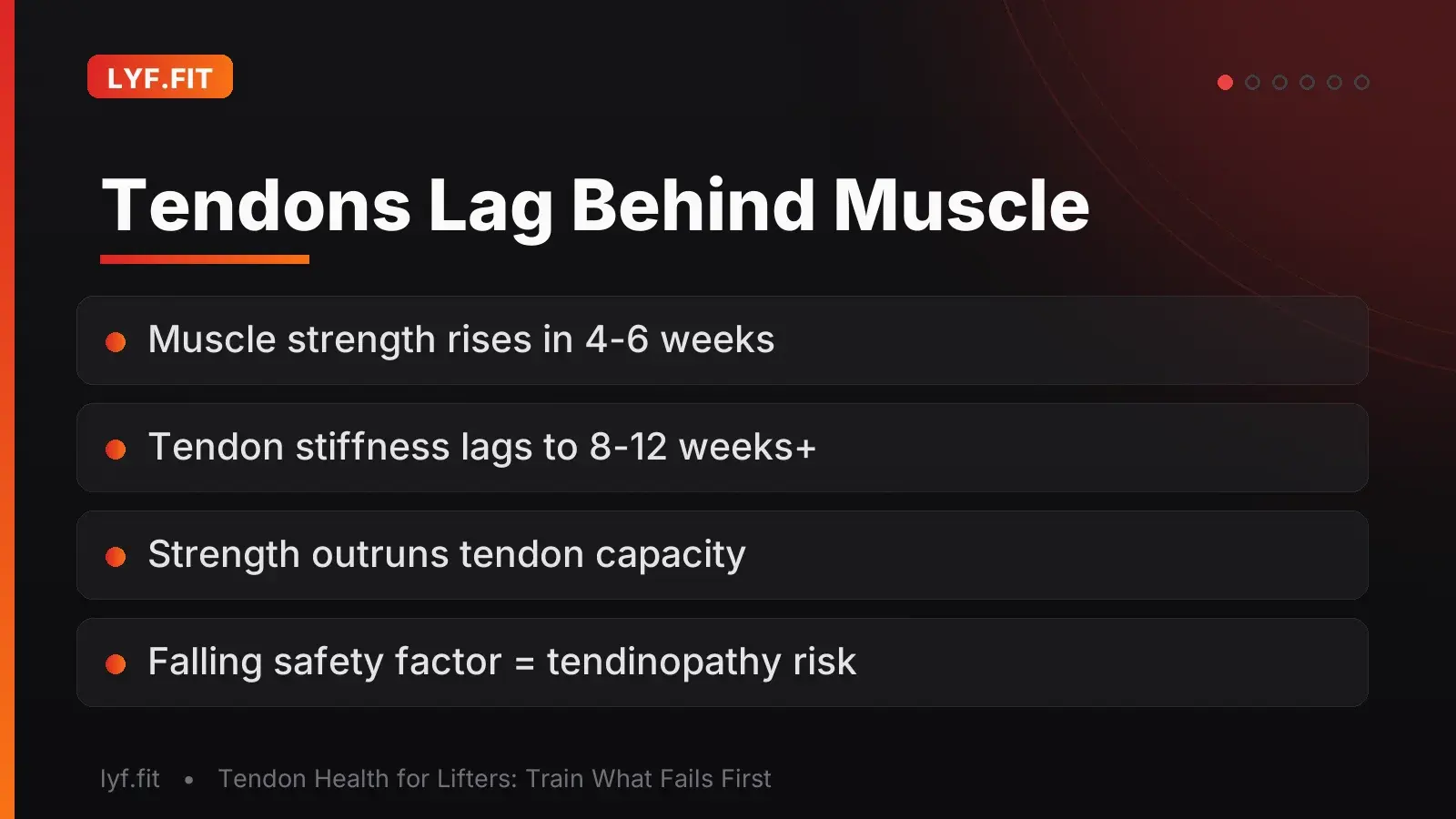
Your tendons are the weak link, and the fix is loading them on purpose. Muscle strength climbs within the first 4–6 weeks of a program, but measurable tendon stiffness usually lags until 8–12 weeks or longer. That gap is where tendinopathy lives: when a strong muscle drags a still-adapting tendon through higher strain than it can tolerate, the tissue starts to break down faster than it rebuilds.
The good news is that tendons respond to deliberate, heavy, slow loading — the same currency that builds them takes patience to spend. This is education, not medical advice: if you already have tendon pain that is sharp, swelling, or worsening, see a physiotherapist before self-programming.
Why do tendons fail before muscles do?
Tendons are metabolically quiet tissue. They have limited blood supply and a low rate of collagen turnover, so they remodel far slower than the muscle pulling on them. When you add weight aggressively, muscle force output rises first, increasing the mechanical strain the tendon must absorb every rep.
Researchers describe this as a drop in the tendon "safety factor" — the ratio of the tendon's ultimate strength to its everyday operating strain. Push that ratio down by outpacing tendon adaptation, and repeated high strain nudges the tissue toward the disorganized, painful state of tendinopathy. The lifter feels great in week 5 and blown up in week 9. The tendon was always the constraint.
What actually makes a tendon stronger?
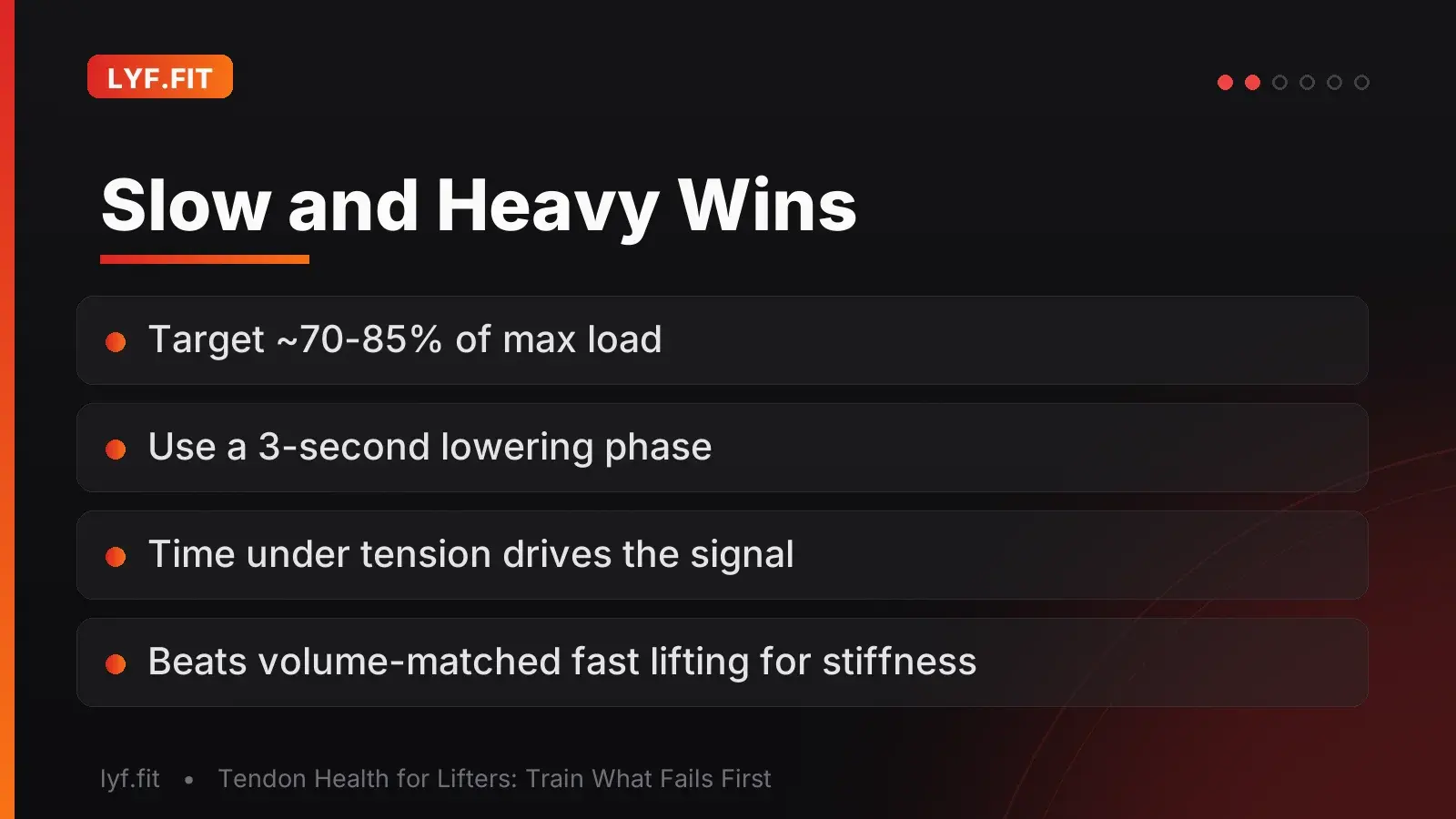
Tendons respond to high strain held long enough to matter. Two variables dominate: load magnitude and time under tension. Ballistic, bouncy reps spike force briefly; slow reps keep meaningful strain on the collagen for seconds at a time, which is the signal tenocytes read as "build."
A practical target from the tendinopathy literature is high load (roughly 70–85% of your max) paired with a deliberate 3-second lowering phase. Reviews of tendon loading report greater tendon stiffness gains from slow-tempo resistance work than from volume-matched fast lifting. Speed feels productive, but for the tendon, slow and heavy wins.
How does the collagen synthesis window work?
Loading a tendon does not instantly build it — it first breaks it down, then rebuilds. Tracking studies show that in roughly the first 24–36 hours after a hard session, tendon collagen is in net degradation. Net synthesis takes over around 36–72 hours, so peak rebuilding sits well after you leave the gym.
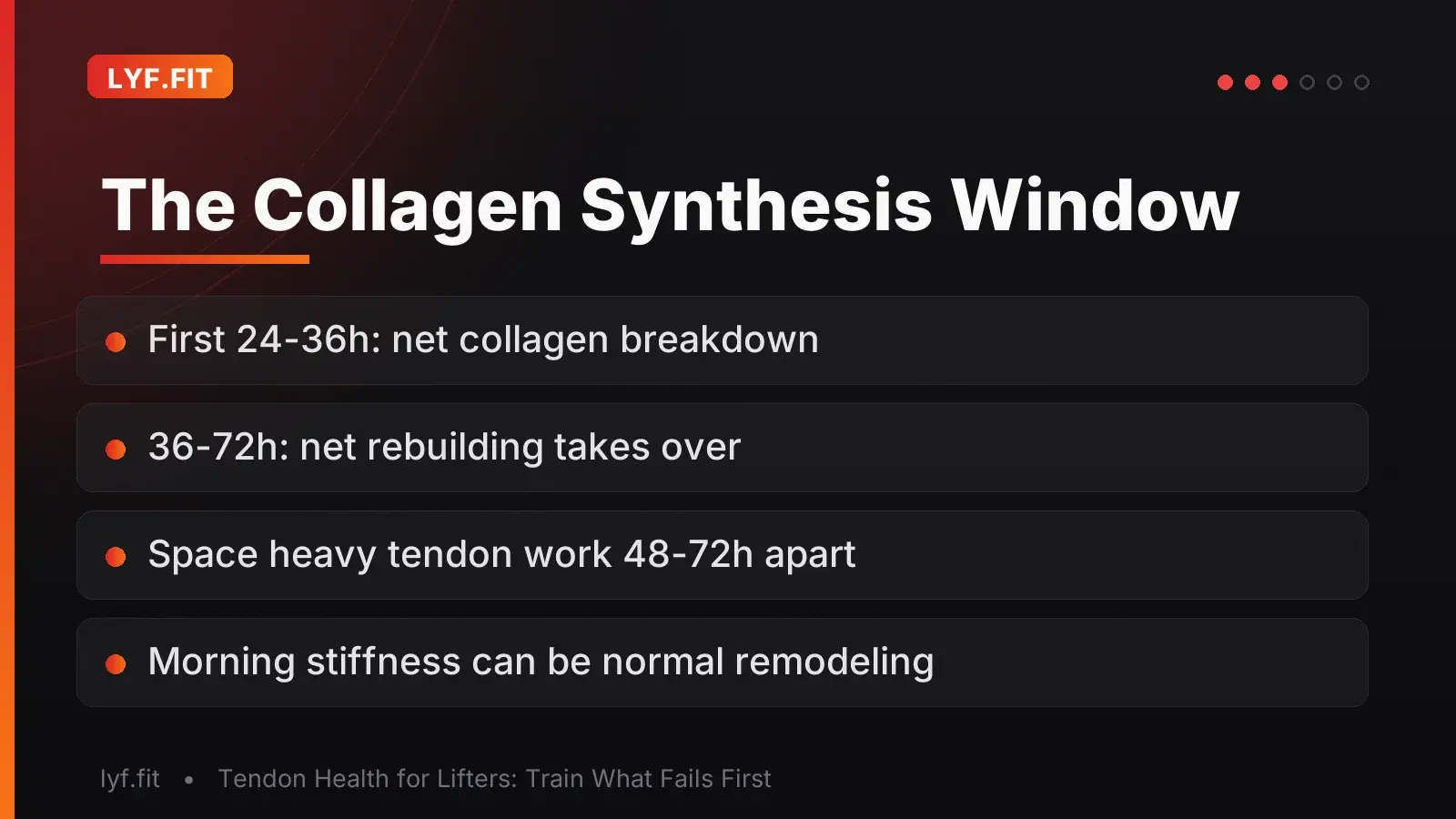
This has a blunt programming implication: the same tendon should not get maximal heavy strain every day. Spacing dedicated tendon work by roughly 48–72 hours lets the synthesis phase finish before you tear the tissue down again. It also reframes soreness — a tendon that feels stiff the morning after loading may simply be mid-degradation, not injured. The rebuild is scheduled; give it the calendar space.
Which loading tool builds which adaptation?
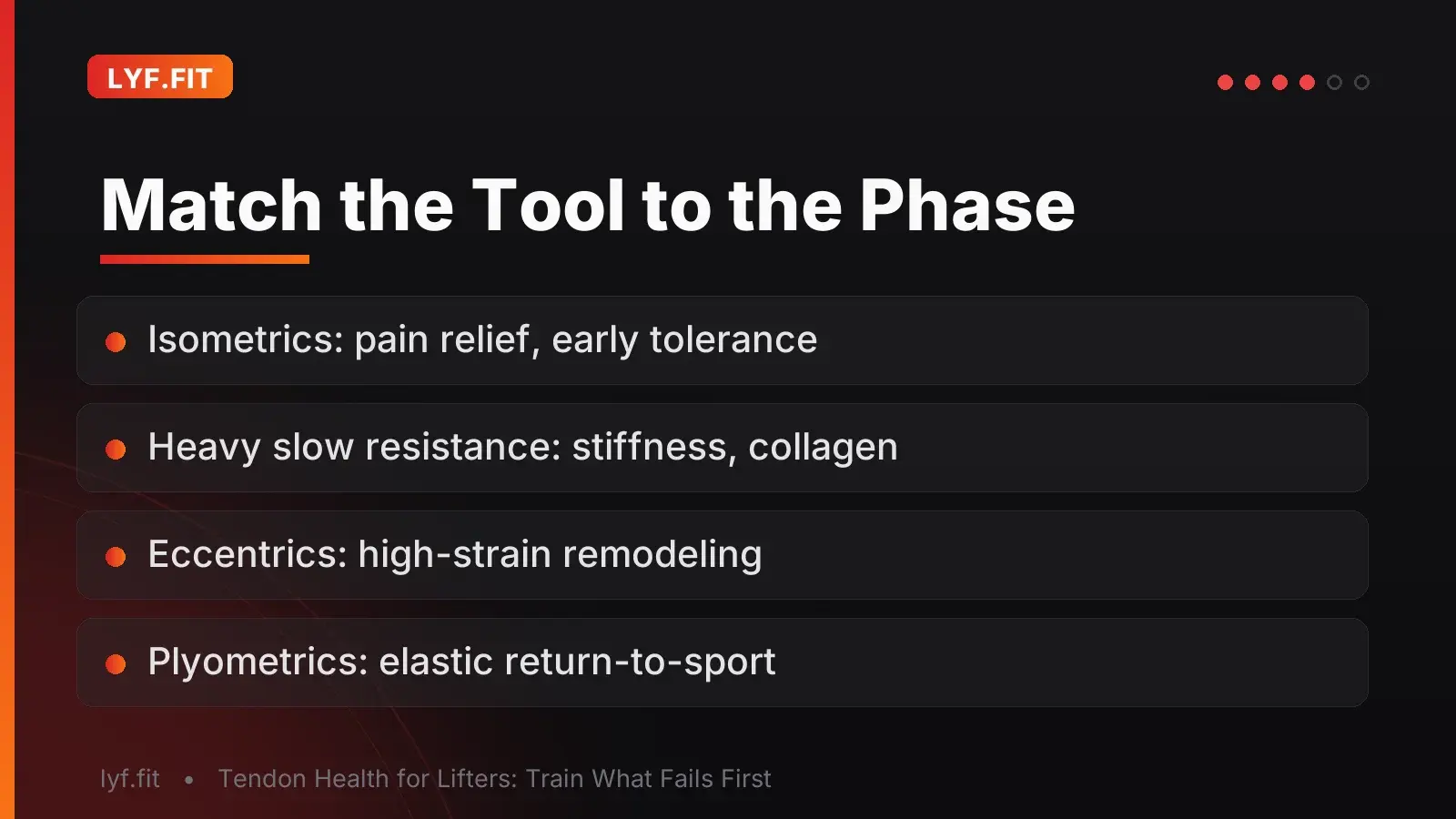
Not every tool does the same job. Isometrics shine for pain modulation and building tolerance; heavy slow resistance is the workhorse for stiffness and collagen turnover; eccentrics and plyometrics sit further along the capacity ladder. Match the tool to your phase rather than chasing whichever feels hardest.
| Training tool | Primary tendon adaptation | When to use it |
|---|---|---|
| Isometrics (long holds) | Pain reduction, early load tolerance, stiffness | Painful or irritable tendon; in-season pain management |
| Heavy slow resistance | Collagen synthesis, tendon stiffness, cross-sectional area | Main rebuilding phase; off-season strength base |
| Eccentrics | High-strain loading, tissue remodeling | Progressing past isometrics once pain settles |
| Plyometrics | Elastic energy storage, stretch-shorten capacity | Final return-to-sport; jumping/sprinting athletes |
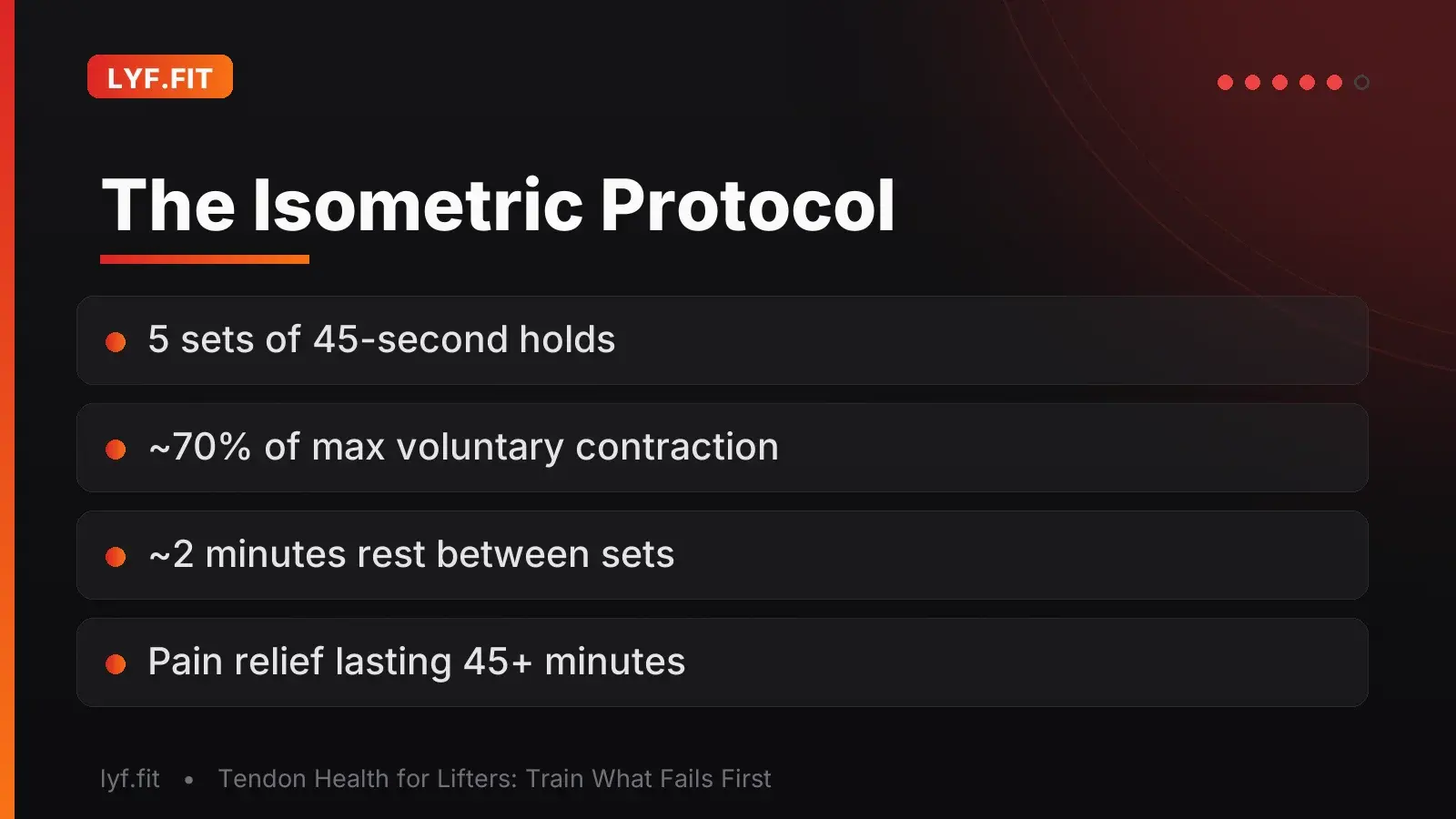
The classic isometric prescription studied for patellar tendinopathy is 5 sets of 45-second holds at about 70% of maximal voluntary contraction, roughly 2 minutes of rest between sets. In volleyball players, a single heavy isometric bout dropped reported pain from around 7/10 to near zero, with relief lasting 45 minutes or more — useful before you train.
Can nutrition speed tendon repair?
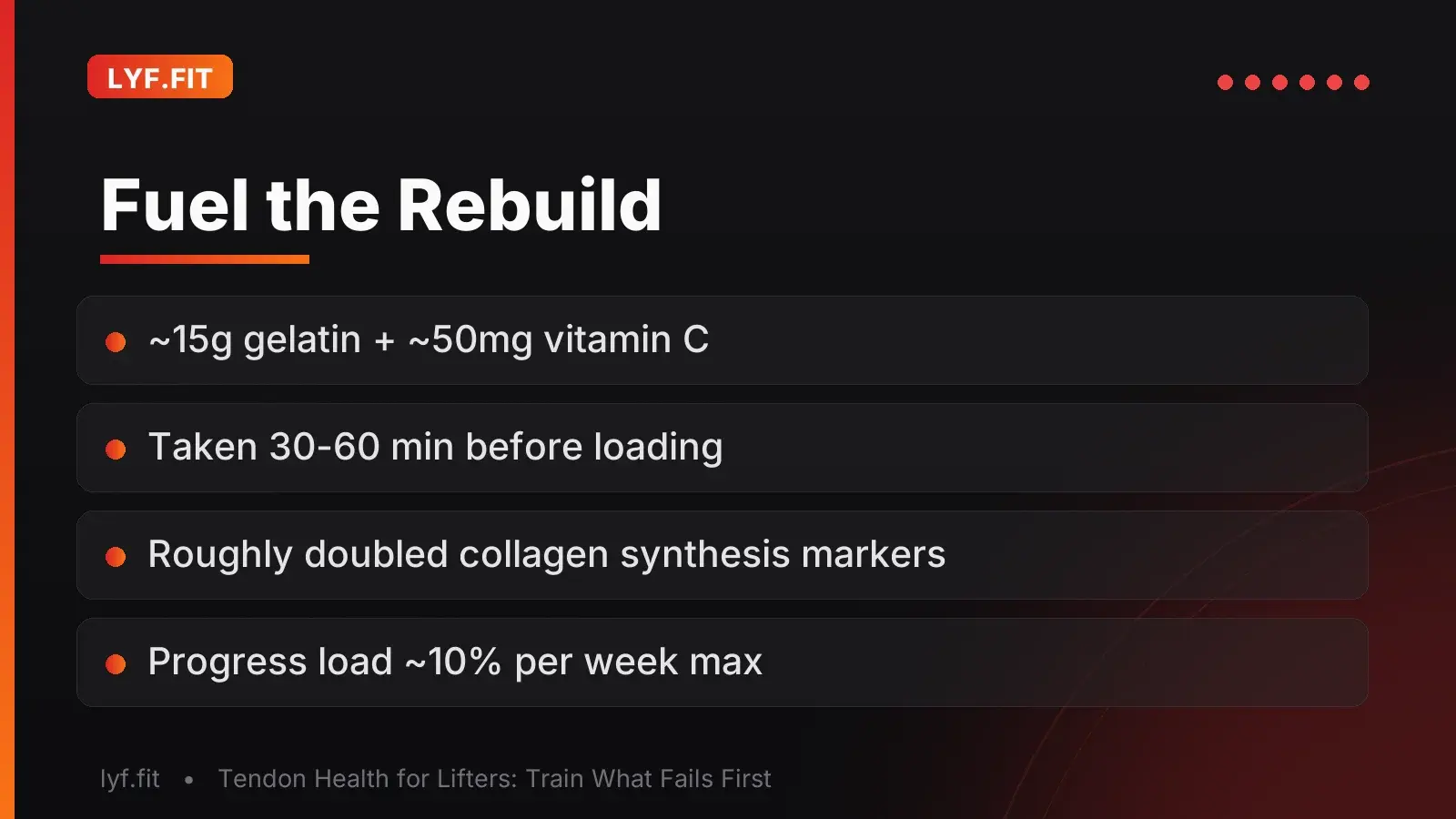
Loading is the driver, but the tendon needs raw material to rebuild collagen during that synthesis window. Work from Keith Baar's lab at UC Davis (Shaw et al., American Journal of Clinical Nutrition, 2017) found that about 15 grams of gelatin plus roughly 50 mg of vitamin C, taken 30–60 minutes before loading, roughly doubled markers of collagen synthesis compared with placebo.
The mechanism is clean: gelatin floods the blood with glycine, proline, and hydroxyproline about an hour after ingestion, and vitamin C is a required cofactor for the enzyme that stabilizes the collagen triple helix. Because tendon blood flow is poor, timing the amino acids to arrive with the loading stimulus is the point. This may support connective-tissue repair; it does not treat a diagnosed injury.
How do I manage load without backsliding?
Progress the tendon slower than you progress the muscle. A common conservative guideline is to raise training load by no more than about 10% per week, watching how the tendon responds over 24 hours rather than how the set felt in the moment. The tendon's report card arrives the next morning.
Use the "24-hour rule" many physios apply: if pain the day after loading is higher than your baseline and stays elevated, you overshot — hold or reduce load rather than pushing through. Warning signs worth respecting include morning stiffness that takes longer to warm out, pain that sharpens under load, and swelling. None of those are a green light to add plates.
Test Your Knowledge
1 / 4Why do tendons commonly get injured before muscles in a progressing lifter?
Build the base with slow, heavy reps, gate your progression by how the tendon feels 24 hours later, and give collagen 48–72 hours to rebuild before you hammer the same tissue again.
Interactive Tools
Save these contextual tools to your profile for quick access.
Frequently asked questions
Neither extreme is ideal, and this is where a physiotherapist earns their fee. Complete rest de-conditions the tendon and often makes it more fragile, while pushing through sharp or escalating pain can worsen the tissue. Many clinicians allow controlled loading up to a tolerable pain level (often described as staying at or under a mild ache) provided symptoms settle within 24 hours. If pain is sharp, swelling, or climbing week over week, get it assessed rather than self-managing.
Longer than your muscles. Muscle strength gains show up in 4–6 weeks, but meaningful tendon stiffness and cross-sectional changes generally take 8–12 weeks or more of consistent heavy slow loading. The slow timeline is exactly why patience with progression protects you — the tissue is remodeling on its own clock, not yours.
They do different jobs, so it is rarely either/or. Isometric holds are excellent for reducing pain and building early tolerance in an irritable tendon, which is why they are often used in-season or in a painful phase. Heavy slow resistance is the primary driver of collagen turnover and stiffness for the rebuilding phase. A common approach starts with isometrics, then transitions to heavy slow resistance as pain settles.
The evidence points to timing plus loading, not the powder in isolation. In the studied protocol, gelatin or collagen with vitamin C was taken 30–60 minutes before a bout of tendon loading, so the amino acids arrived during the synthesis window created by the exercise. Collagen sipped on a rest day with no loading stimulus has far weaker support. Treat it as a supplement to smart training, not a substitute for it.
Tendons are the tissue that fails first, but they are also trainable — slow tempo, heavy load, and 48–72 hours of rebuilding space turn your weakest link into a resilient one. Program the loading deliberately and let the 24-hour response, not your ego, set the pace. Plan your slow-tempo tendon work with the exercise library and structure a progressive block with our programs tool.
Stop completely guessing.
Use our interactive PWA tools to calculate your exact macros, 1RM, and running pace offline.