


Disclaimer: Some of the links on this page are affiliate links. As an Amazon Associate and affiliate for other networks, we may earn a commission from qualifying purchases at no additional cost to you.
The three most-cited interval protocols are built for different jobs. Tabata (eight rounds of 20 seconds on, 10 seconds off) came from an extremely demanding anaerobic protocol at an intensity most people cannot hold. The Norwegian 4x4 (four rounds of 4 minutes hard, 3 minutes easy) is a well-studied format for raising VO2max. And 30-20-10 uses much shorter hard bouts; in one small runner study, it improved performance while cutting weekly training volume roughly in half. Pick the protocol for the adaptation you want, then program the work and recovery before you start.
What actually makes an interval protocol work?
All interval training exploits the same loophole: your body can tolerate far more time at high intensity when that time is broken into pieces. Ride at 95 percent of your max heart rate continuously and you might last five minutes; split it into 4-minute blocks with recovery between and you can accumulate 16 minutes per session. Time near VO2max is the primary driver of aerobic ceiling improvements, so the protocols that accumulate the most quality minutes tend to move that ceiling the most.
The variables that define any protocol are the work duration, the work intensity, the work-to-rest ratio, and the number of rounds. Change any one and you change the adaptation. That's why "I did HIIT" is about as informative as "I lifted weights" — the dose defines the drug.
Slide 1 of 6

What is the Tabata protocol really?
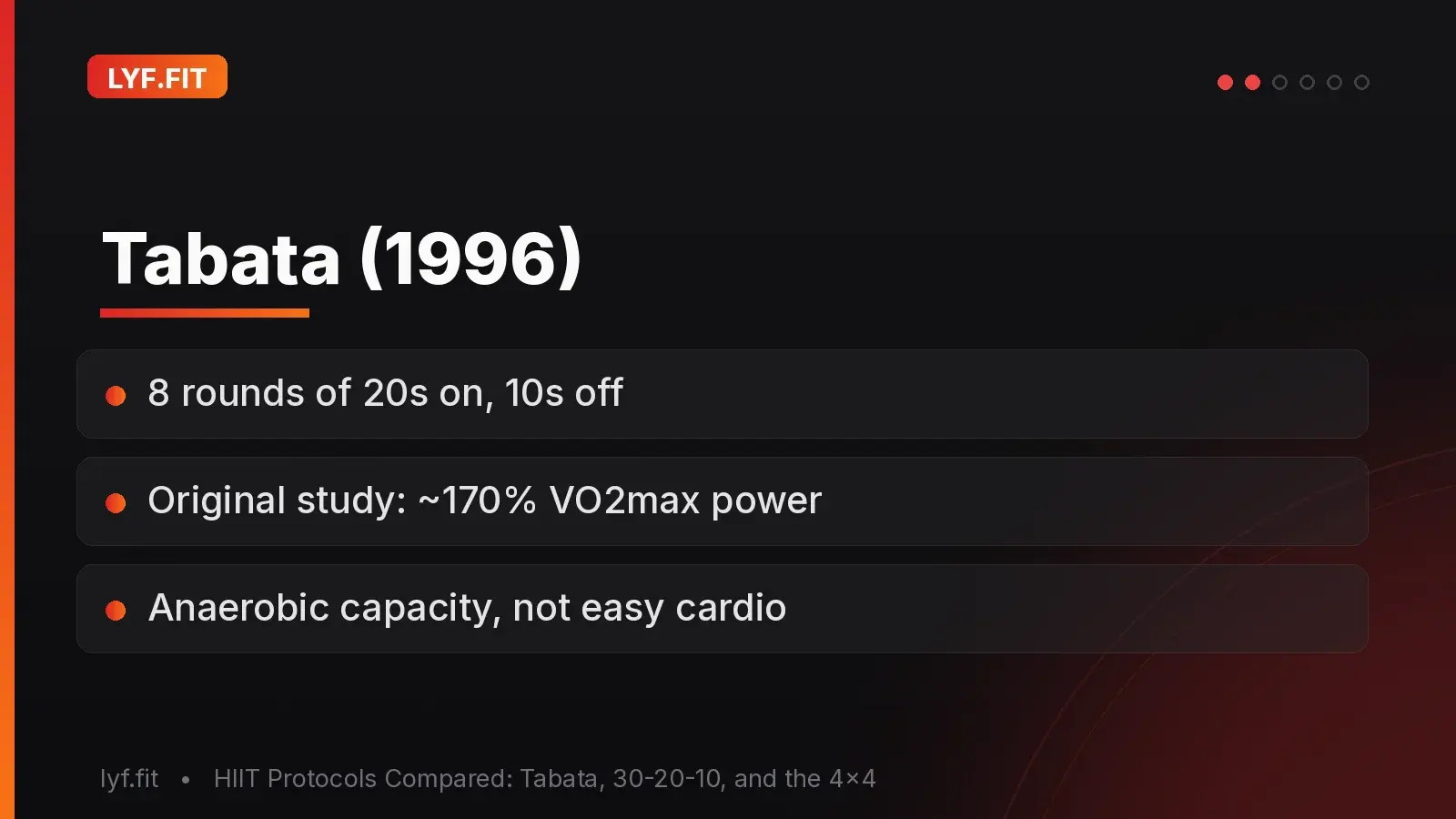
The original 1996 study had seven participants perform 7-8 rounds of 20 seconds at roughly 170 percent of VO2max power on a cycle ergometer, with 10-second rests, five days per week for six weeks. Both VO2max and anaerobic capacity improved, but the tiny sample and extreme, cycling-specific dose matter. The bodyweight-circuit "Tabata" classes that borrowed the timing structure keep the clock but not the studied stimulus.
That does not make 20-10 timing useless, but intensity changes the adaptation. A later cycle-ergometer study questioned whether eight bouts at the often-cited 170 percent load are feasible and found lower supramaximal intensities produced more time above 90 percent of VO2max. Used on an air bike or rower, 20-10 remains a hard conditioning format; just do not assume every four-minute circuit reproduces the original protocol.
Why is the Norwegian 4x4 the VO2max benchmark?
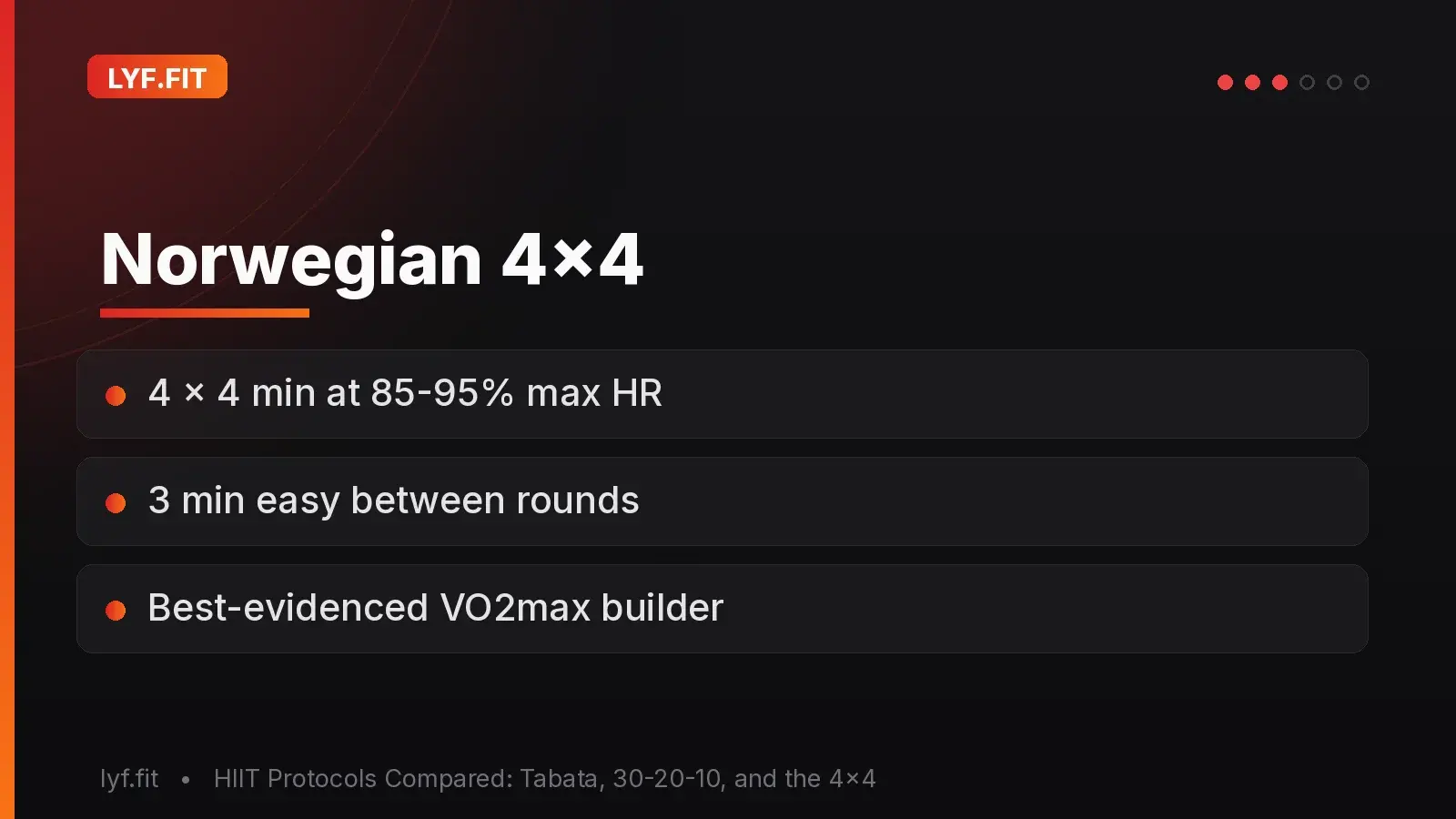
The 4x4 — 4 minutes at 90-95 percent of max heart rate, 3 minutes of active recovery near 70 percent, repeated four times — is a well-studied interval prescription. In a 2007 randomized trial of 40 healthy, moderately trained men, it improved VO2max more than matched-work training at lactate threshold or 70 percent of max heart rate over eight weeks. That specific result should not be assumed to apply unchanged to every age or clinical population.
Its strength is repeatability. Four minutes is long enough that you can't sprint your way through on anaerobic credit; you settle into a hard, sustainable rhythm just below your lactate threshold's ugly side. With a warm-up and cool-down, the session takes about 40 minutes, done once or twice a week on top of an easy aerobic base — the same division of labor covered in our Zone 2 guide.
What does 30-20-10 do differently?
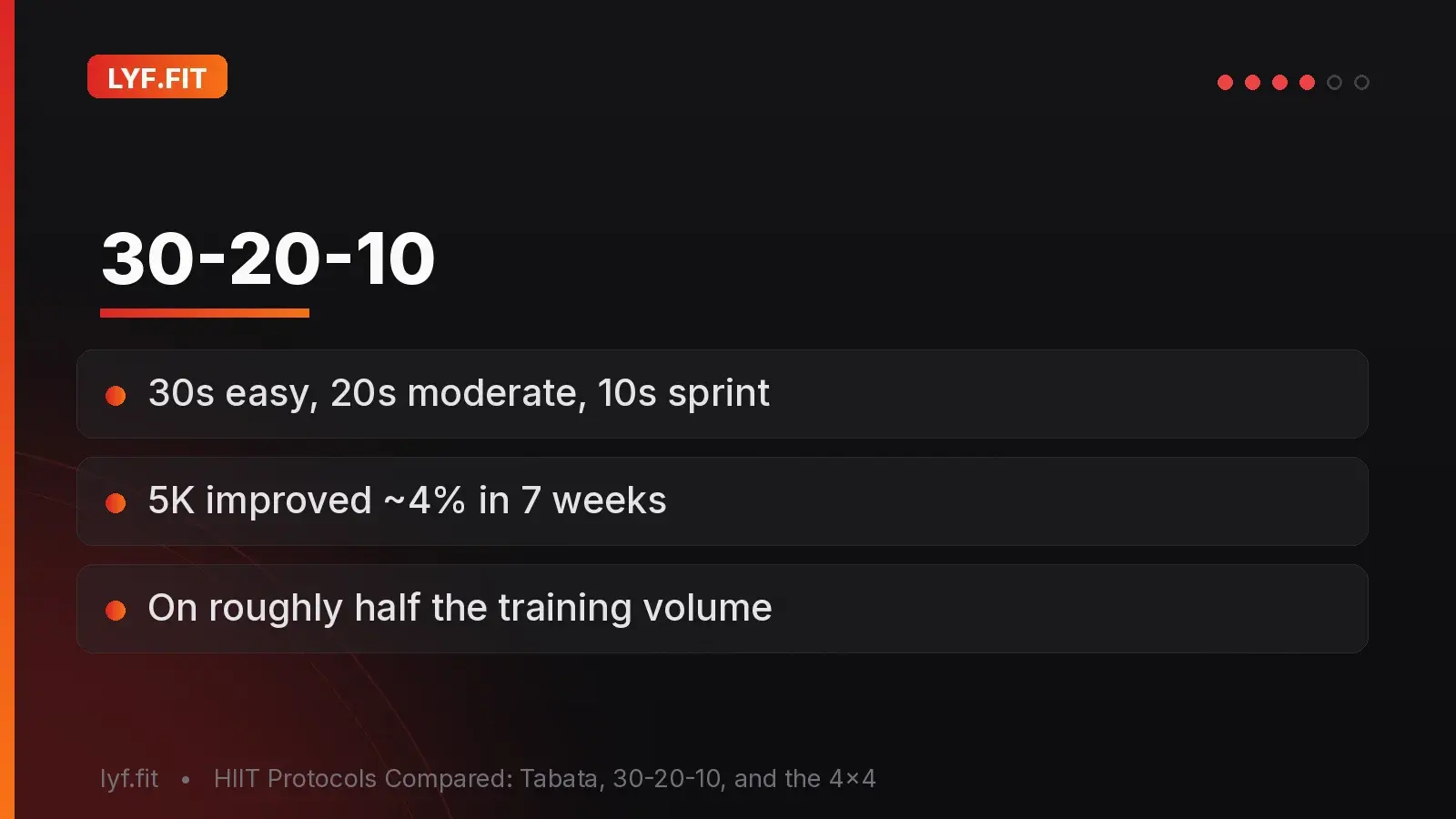
The 30-20-10 format flips the usual structure: each 5-minute block is five consecutive rounds of 30 seconds easy, 20 seconds moderate, 10 seconds near-sprint, and a session is 3-4 blocks with 2 minutes rest between them. In the 2012 study that introduced it, 18 moderately trained runners were split into intervention and control groups; after seven weeks, the interval group improved VO2max by 4 percent and 5K time by 48 seconds while reducing weekly distance by 54 percent. The sample was small, so treat the exact gains as an example rather than a promise.
The genius is psychological as much as physiological. Only 50 seconds of each 5-minute block is truly hard, and each sprint lasts just 10 seconds, so the format stays approachable for people who find 4-minute efforts demoralizing. It's the protocol we'd hand to a runner in a motivation slump or anyone bored stiff by steady-state — a gentler cousin of the formats compared in HIIT vs. LISS.
How do the three protocols compare?
| Protocol | Structure | Work : rest | True intensity | Session time | Best for |
|---|---|---|---|---|---|
| Tabata | 8 x (20s on / 10s off) | 2:1 | All-out (supramaximal) | ~4 min/block + warm-up | Anaerobic capacity; time-crunched finishers |
| Norwegian 4x4 | 4 x (4 min on / 3 min off) | ~1.3:1 | 90-95% max HR | ~40 min | Raising VO2max; measurable aerobic progress |
| 30-20-10 | 3-4 x [5 x (30s easy / 20s mod / 10s sprint)] | Built-in | Mixed, brief sprints | ~30 min | Runners; HIIT beginners; volume reduction |
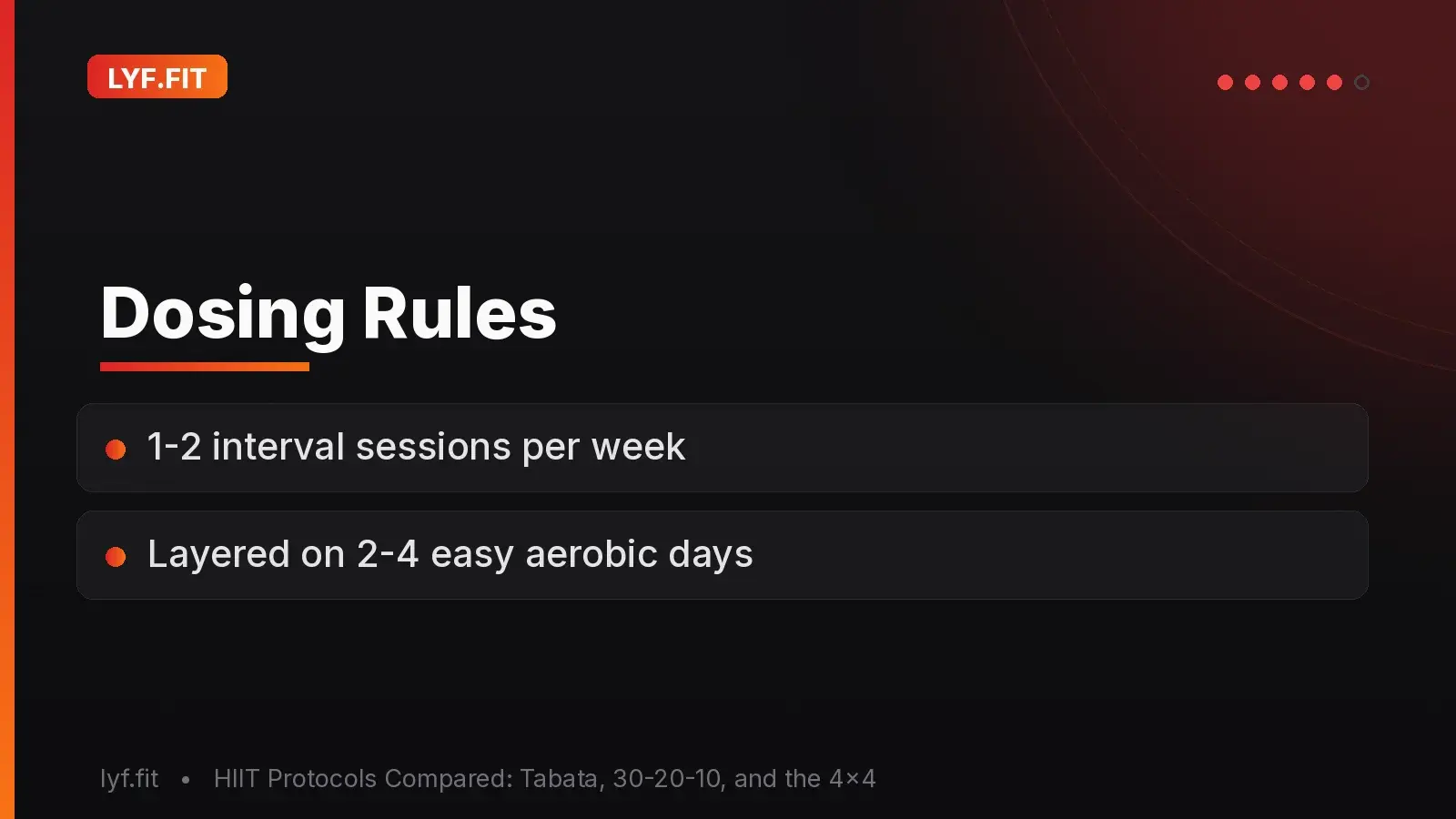
A conservative starting point is one interval session per week, with a second added only when sleep, easy training, and strength work remain on track. That is a programming example rather than a universal ceiling: appropriate frequency depends on training history, the protocol's true intensity, other exercise, and health status. More sessions do not automatically produce more adaptation if the quality of each hard effort falls.
Test Your Knowledge
1 / 4What intensity did the original 1996 Tabata study actually use?
Which protocol should you actually start with?
Match the protocol to your goal and tolerance, not to whichever one sounds toughest. The 4x4 emphasizes sustained high-intensity aerobic work; 30-20-10 uses brief surges within a longer block; 20-10 intervals create a short, demanding conditioning dose. Choose one, scale it to your current capacity, and reassess the same pace, power, or heart-rate response after several weeks.
Whatever you pick, precision beats enthusiasm. Program the work and rest durations into the interval timer so the clock stays consistent when fatigue makes pacing harder. Stop or scale the session for chest pain, dizziness, or unusual shortness of breath rather than treating those symptoms as proof that the workout is effective.
Sunny Health & Fitness Indoor Cycling Bike Sponsored
A friction-resistance indoor bike handles all three protocols at home — 4x4s, 30-20-10 blocks, and genuinely all-out Tabata rounds that would be unsafe to run.
Interactive Tools
Save these contextual tools to your profile for quick access.
Workout Rest Timer
A customizable countdown timer designed specifically for your rest periods between lifting sets.
Running Pace Calculator
Calculate pace and splits, compare distances, and export a practical race-day pace card.
Interval Timer
A programmable HIIT and Tabata timer that automatically loops between work and rest phases.
Frequently asked questions
The formats can be scaled, but there is no fixed number of prerequisite weeks that makes high-intensity work safe for everyone. Beginners can first practice short, controlled efforts with generous recovery and add rounds gradually instead of chasing the original research intensity. Anyone with cardiovascular symptoms, known disease, or relevant risk factors should seek individualized medical guidance before starting vigorous intervals.
They can coexist, but the best arrangement depends on goals and recovery. Separating demanding intervals from hard lower-body lifting can help preserve session quality, while high volumes of both may compete for recovery. Start with the minimum effective dose, monitor performance, and adjust the weekly layout rather than assuming one schedule fits everyone.
Energy expenditure varies widely with body size, fitness, modality, true intensity, and session length, and watches or machines can be imprecise. None of these protocols has a universal calorie number. HIIT's clearer value is a concentrated fitness stimulus; for total weekly expenditure, longer easy sessions and daily movement may be easier to accumulate and recover from.
The trials discussed above measured changes after roughly 6-8 weeks, but that is a study window rather than a promised deadline. Baseline fitness, protocol, adherence, and measurement all affect when a change becomes detectable. Retest the same route or interval settings after a consistent block rather than relying only on how a single session feels.
The protocol menu isn't a difficulty ranking — it's a toolbox. Decide whether you're buying anaerobic capacity, a higher VO2max, or a sustainable way to keep intensity in your week, then run one format for 6-8 weeks before judging it. Set the exact work-rest structure in the interval timer and use the pace calculator to convert your improving fitness into target paces.
Stop completely guessing.
Use our interactive PWA tools to calculate your exact macros, 1RM, and running pace offline.
Sources
- Effects of moderate-intensity endurance and high-intensity intermittent training on anaerobic capacity and VO2max
- Aerobic high-intensity intervals improve VO2max more than moderate training
- The 10-20-30 training concept improves performance and health profile in moderately trained runners
- Defining the number of bouts and oxygen uptake during the Tabata protocol performed at different intensities