

Disclaimer: Some of the links on this page are affiliate links. As an Amazon Associate and affiliate for other networks, we may earn a commission from qualifying purchases at no additional cost to you.
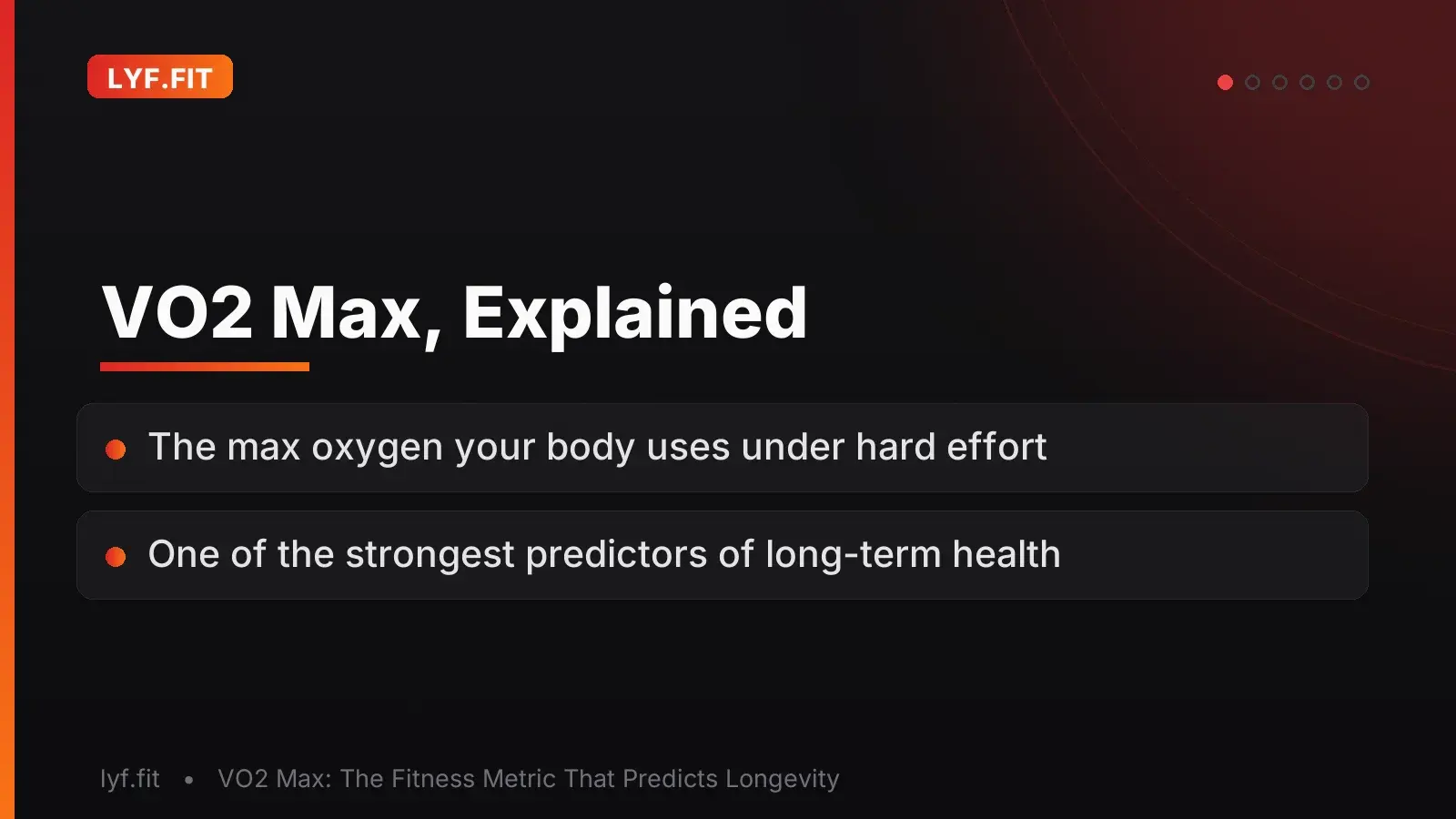
VO2 max is the maximum rate at which your body can take in and use oxygen during intense exercise. Measured in millilitres of oxygen per kilogram of body weight per minute (ml/kg/min), it is the single best laboratory measure of aerobic fitness — and one of the strongest predictors of long-term health and lifespan.
This guide explains what the number means, what counts as good, and how to raise it.
What is VO2 max?
VO2 max is your body's aerobic ceiling. It marks the point during hard exercise where oxygen consumption plateaus even as effort keeps rising.
The number reflects an entire chain of systems working together: your lungs pulling in air, your heart pumping blood, your blood vessels delivering it, and your muscle mitochondria extracting and burning oxygen for fuel. Physiologically, VO2 max is the product of cardiac output — heart rate multiplied by stroke volume — and how much oxygen your muscles pull from that blood. Because it captures the whole system at once, a higher VO2 max means a more capable heart, circulation, and metabolism.
Why is VO2 max linked to longevity?
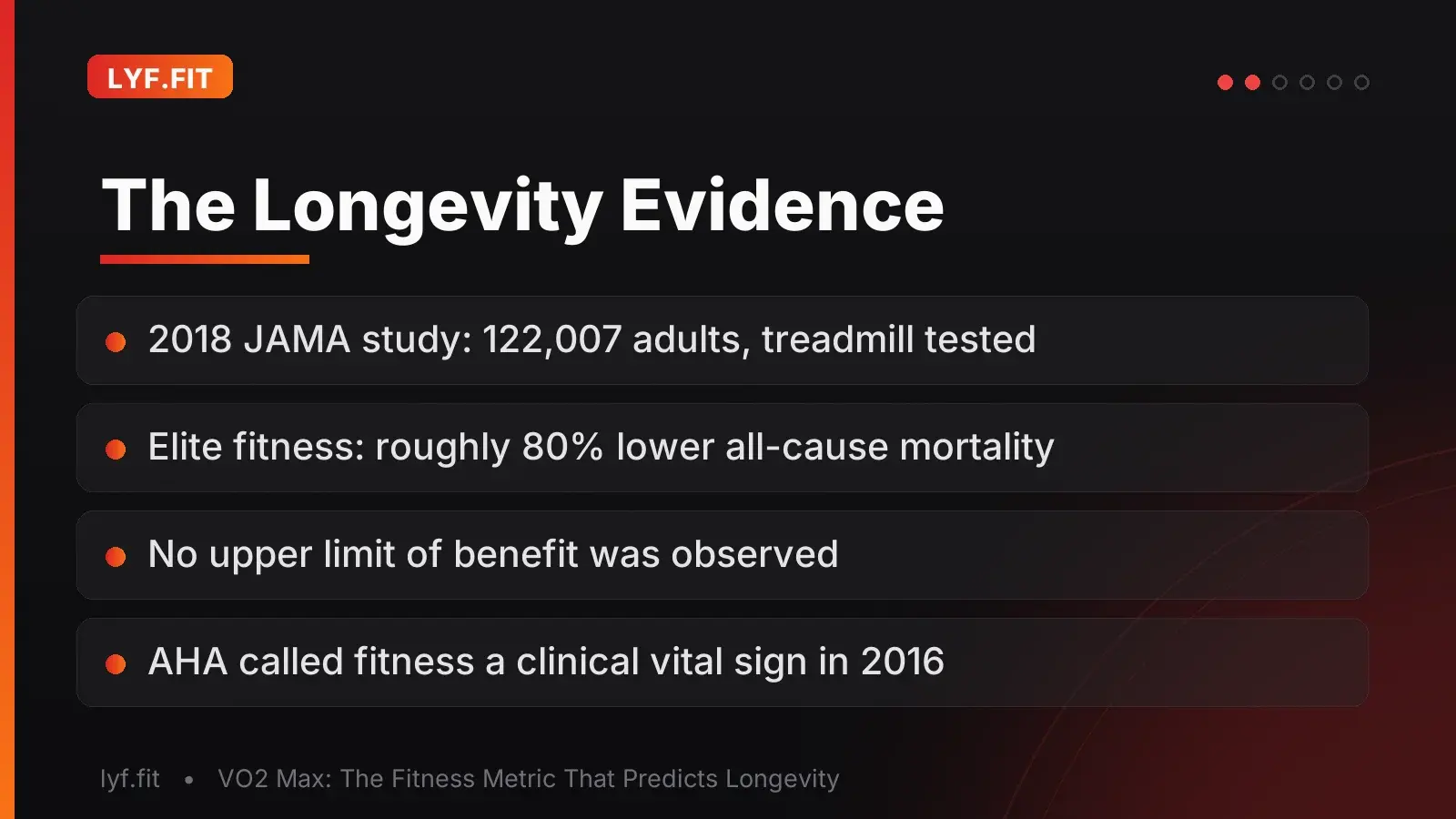
Because fitness tracks survival closely. The landmark evidence comes from Mandsager and colleagues, whose 2018 study in JAMA Network Open followed 122,007 adults who completed treadmill testing at the Cleveland Clinic.
Higher cardiorespiratory fitness was linked to lower death rates — with no upper limit of benefit. Elite performers, scoring two standard deviations above the average for their age and sex, had roughly 80% lower all-cause mortality than the least-fit group. The researchers reported that poor fitness carried a mortality risk comparable to, or greater than, smoking, diabetes, or coronary artery disease. In 2016, the American Heart Association recommended treating cardiorespiratory fitness as a clinical vital sign.
Why does a high VO2 max help everyday life?
Longevity statistics are abstract; the daily payoff is not. Everyday tasks — climbing stairs, carrying shopping, hurrying for a bus, playing with children — each demand a fixed amount of oxygen.
If your VO2 max is high, those tasks use only a small slice of your capacity, so they feel easy and leave you with reserve. If it is low, the same tasks consume a large fraction of your ceiling, which is why they feel exhausting. Raising your VO2 max effectively lowers the relative effort of everything you do. It also builds a buffer for illness, recovery from surgery, and the natural decline of ageing — the higher you start, the longer it takes for lost capacity to limit your independence.
What is a good VO2 max for your age?
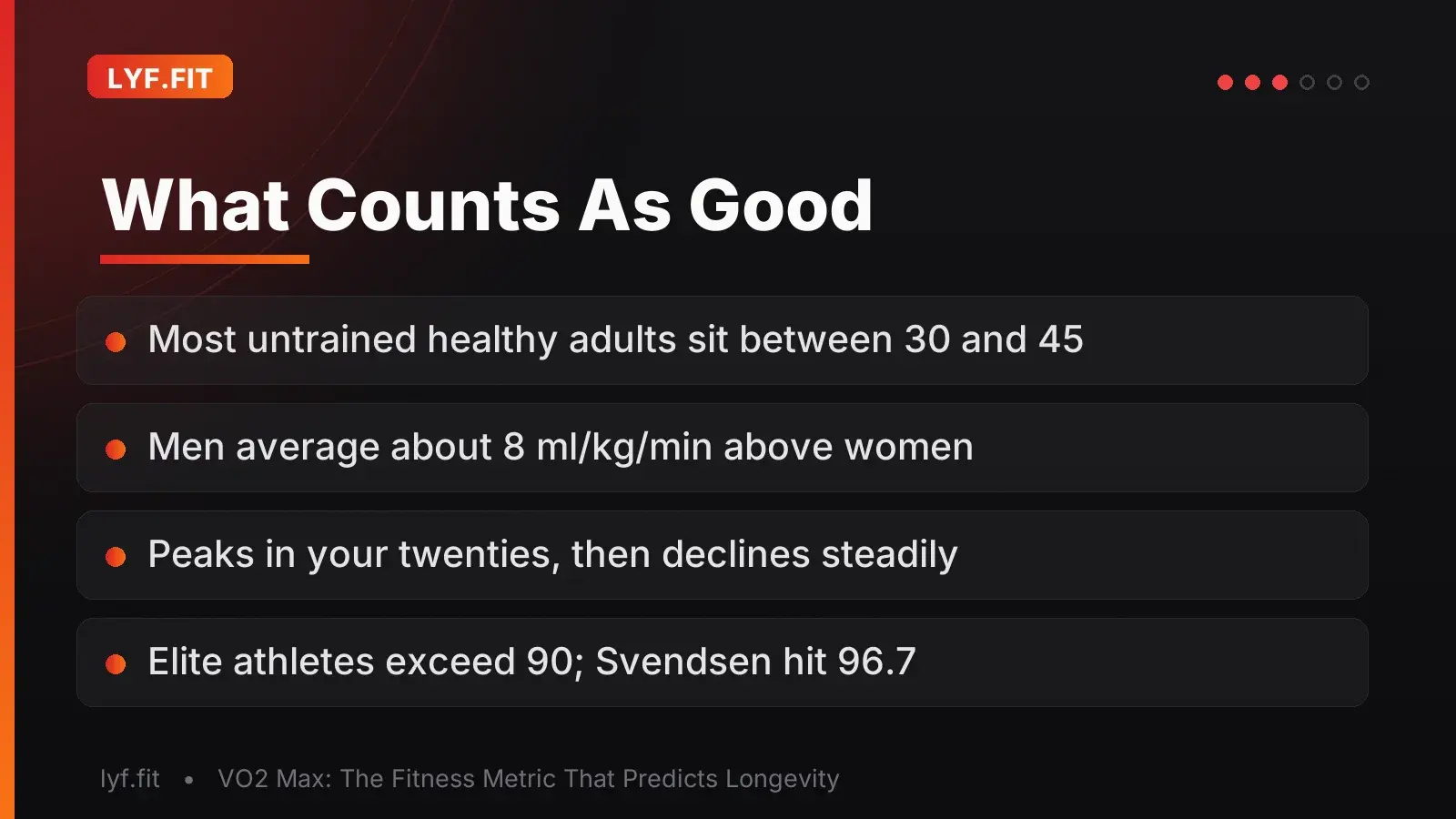
It depends heavily on age and sex. VO2 max peaks in your twenties and declines steadily afterward, and men average roughly 8 ml/kg/min higher than women, largely due to differences in body composition and blood.
| Age group | Men (approx. median) | Women (approx. median) |
|---|---|---|
| 20–29 | 48 | 38 |
| 30–39 | 43 | 33 |
| 40–49 | 39 | 30 |
| 50–59 | 35 | 26 |
| 60–69 | 30 | 22 |
| 70–79 | 24 | 18 |
These are approximate 50th-percentile values in ml/kg/min, in line with large reference datasets such as the Cooper Institute's. Most untrained but healthy adults land somewhere between 30 and 45.
How is VO2 max measured?
The gold standard is a laboratory test. You wear a mask that captures every breath while you run or cycle at steadily rising intensity until exhaustion, and the equipment measures the oxygen you actually consume.
Field tests offer cheaper estimates. The Cooper 12-minute run, a timed 1.5-mile run, and the Rockport walk test all predict VO2 max from how far or fast you can go. Modern wearables — including the Apple Watch and Garmin devices — estimate it continuously by comparing your heart rate against your pace or power. These estimates are useful for tracking trends over time, but they are less accurate than a true lab test.
How high can VO2 max go?
Far higher than most people realise. Elite endurance athletes record extraordinary numbers because their sports reward oxygen delivery above almost everything else.
Cyclist Oskar Svendsen was tested at 96.7 ml/kg/min in 2012 at age 18 — long cited as among the highest reliably measured values. Cross-country skiing legend Bjørn Dæhlie recorded about 96, and triathlete Kristian Blummenfelt has reported a figure above 101, though that result drew scientific skepticism. For comparison, a sedentary adult may sit near 30. Genetics set a personal ceiling, and people respond to training at different rates — but everyone can move meaningfully toward their own ceiling.
Does VO2 max decline with age?
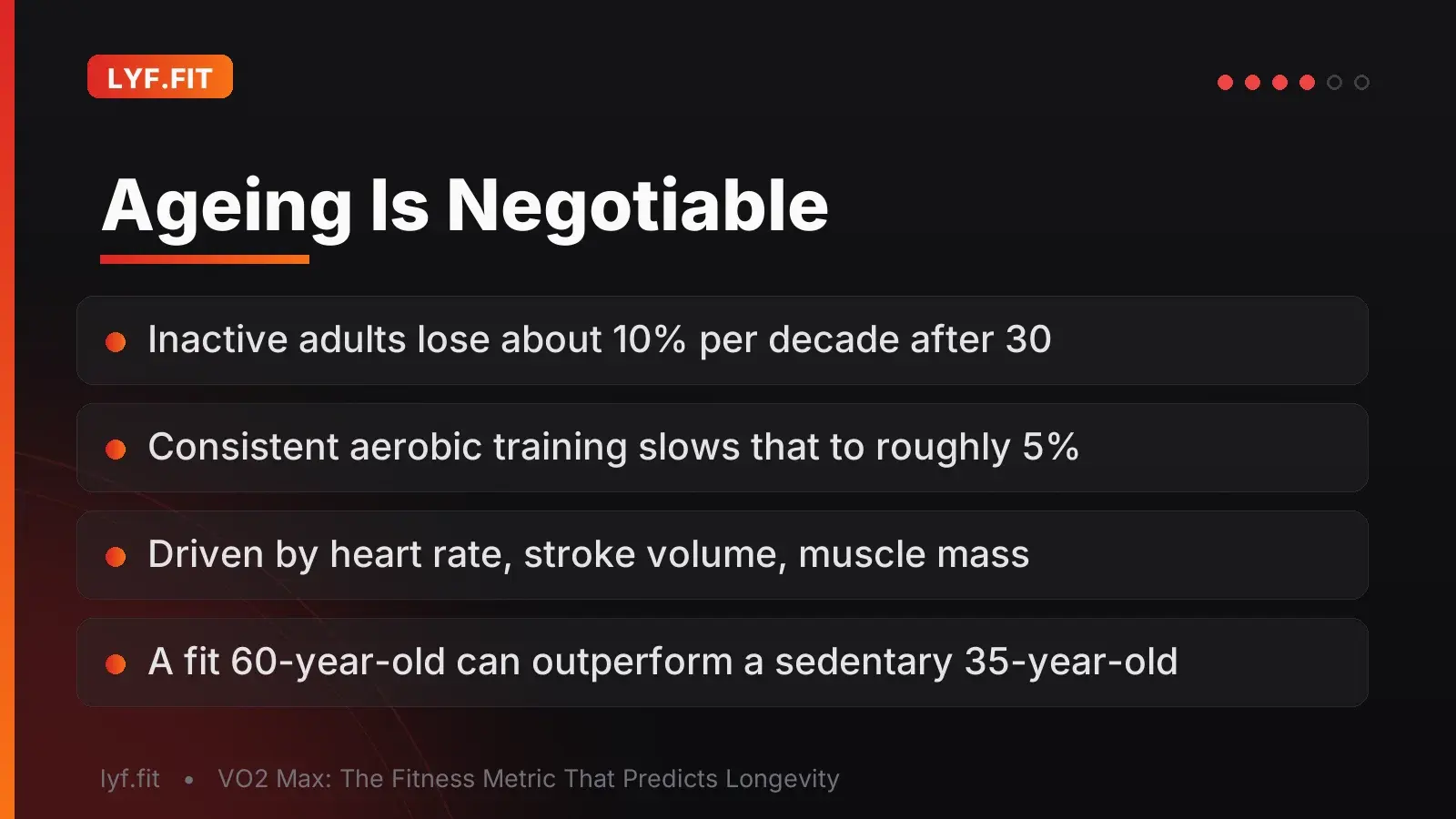
Yes, but the rate is partly in your control. After age 30, VO2 max falls by roughly 10% per decade in inactive people. That decline is driven by drops in maximum heart rate, stroke volume, and lean muscle mass.
Regular aerobic training changes the slope. Active adults who keep training consistently lose closer to 5% per decade — effectively giving them the aerobic capacity of someone years or even decades younger. This is why a fit 60-year-old can out-perform a sedentary 35-year-old on a treadmill test. The decline is normal; its steepness is not fixed.
How can you improve your VO2 max?
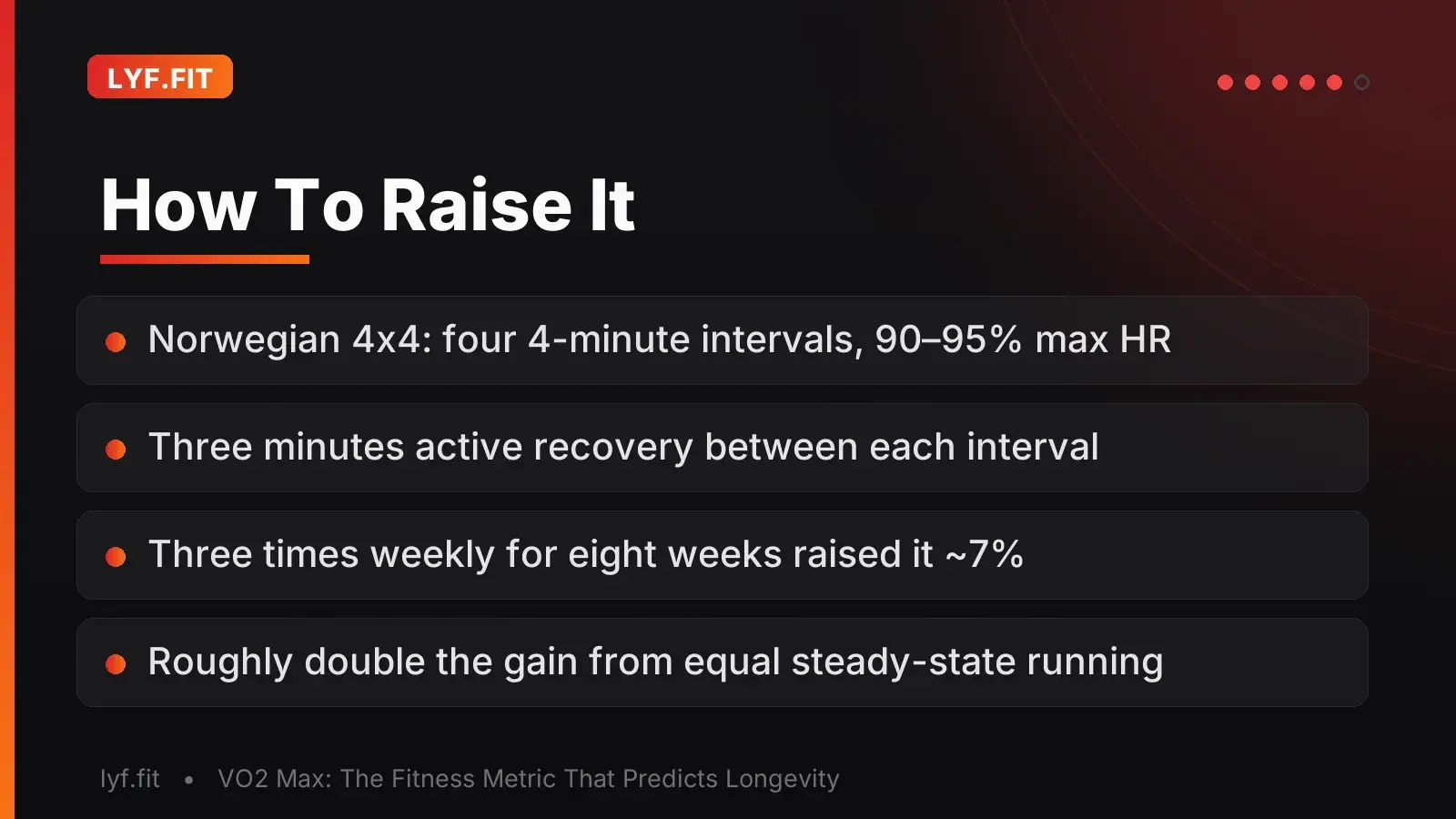
Intensity is the key driver. The most-studied method is the Norwegian 4x4 protocol, tested by Helgerud and colleagues in a 2007 study in Medicine & Science in Sports & Exercise.
The protocol uses four 4-minute intervals at 90–95% of maximum heart rate, each followed by 3 minutes of active recovery. Done three times a week for eight weeks, it raised VO2 max by about 7% — roughly double the gain from steady-state running covering the same total distance. A practical plan pairs one or two interval sessions with easier aerobic "base" work. Use our Interval Timer to run the 4x4 structure, and the Pace Calculator to set the right effort. Beginners should build a base first before adding hard intervals.
Can everyone improve their VO2 max?
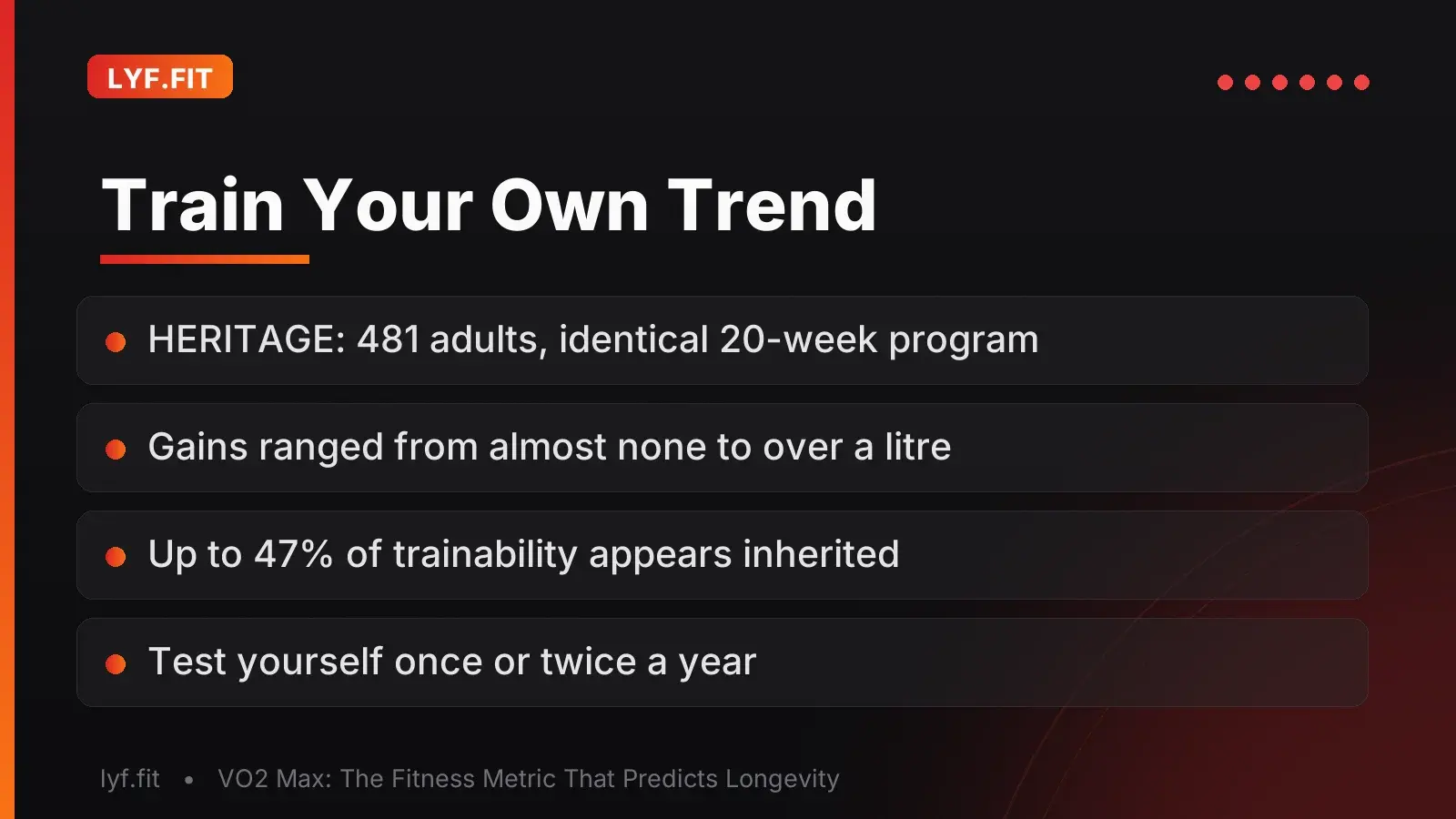
Most people can, but not equally. The HERITAGE Family Study, led by Claude Bouchard, put 481 previously sedentary adults through an identical 20-week endurance program and measured the results.
The average gain in VO2 max was about 400 ml of oxygen per minute — yet the range was striking. Some participants, the so-called non-responders, improved barely at all, while high responders gained more than a litre per minute from the very same training. The researchers estimated that up to 47% of this difference in trainability was inherited. The message is not discouraging: nearly everyone improves with consistent training, but your rate of progress is partly written into your genes, so measure yourself against your own past results, not against someone else.
The bottom line
VO2 max is best understood as a trainable vital sign. It reflects how well your heart, lungs, and muscles work together, and it consistently predicts long-term health. You do not need an athlete's score: the largest survival gains come from moving out of the lowest fitness category, not from chasing elite numbers. Train intensity a little, stay consistent, and check with a doctor before starting hard intervals if you have a heart condition. Test yourself once or twice a year — by lab assessment, a field test, or a wearable — so you can watch the trend, because progress on your own chart matters far more than any population percentile.
Interactive Tools
Save these contextual tools to your profile for quick access.
Core Concepts
1 / 6Test Your Knowledge
1 / 4What does VO2 max measure?
Stop completely guessing.
Use our interactive PWA tools to calculate your exact macros, 1RM, and running pace offline.