

Disclaimer: Some of the links on this page are affiliate links. As an Amazon Associate and affiliate for other networks, we may earn a commission from qualifying purchases at no additional cost to you.
Rucking — walking with a weighted pack — is one of the most time-efficient training tools most people have never tried. In a single easy, conversational-pace session it delivers a zone-2 aerobic stimulus and loads your skeleton hard enough to signal new bone formation, all while producing a fraction of the joint impact of running. For older adults, desk workers, and anyone rebuilding a base, it may be the highest-return hour in the training week.
Why does adding weight to a walk change the stimulus so much?
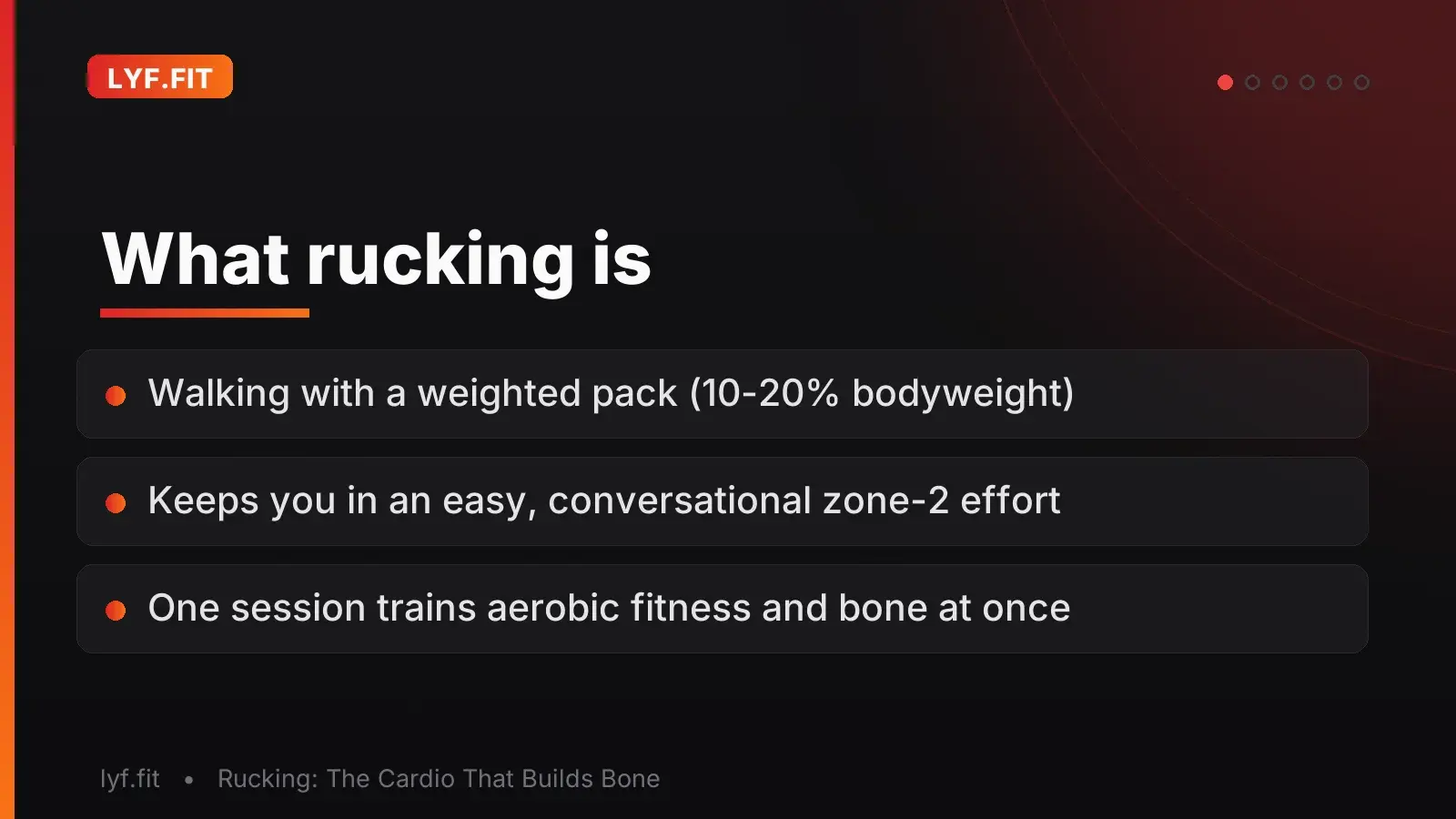
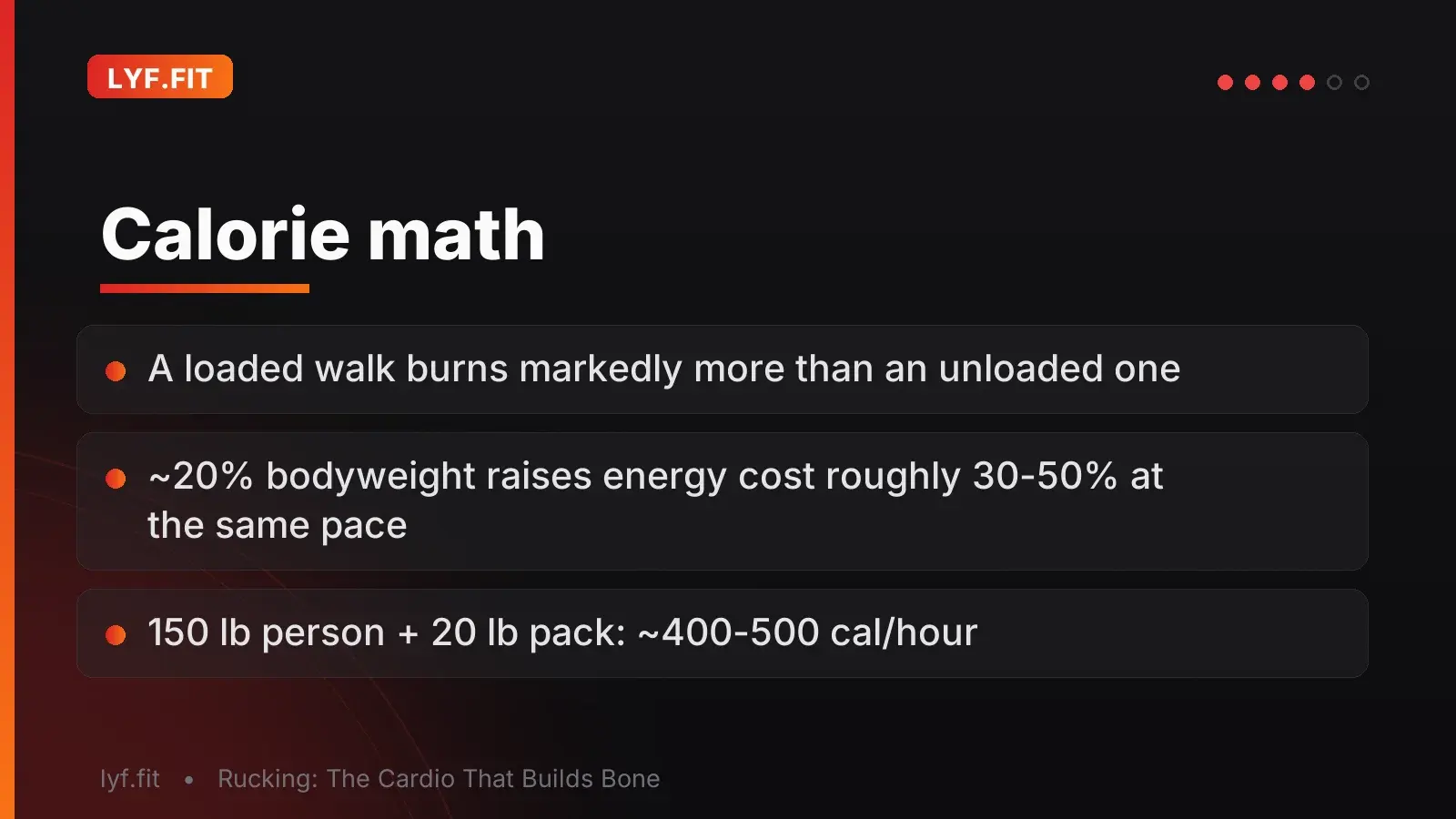
A walk is low-intensity by design. Add 15 to 30 pounds to your back and the same route suddenly demands far more from your aerobic engine — without asking you to move faster. Load-carriage research suggests that carrying roughly 20% of your bodyweight raises the energy cost of walking by about 30 to 50 percent at the same pace, and heavier loads push the metabolic cost considerably higher still. A 150-pound person carrying a 20-pound pack burns in the neighborhood of 400 to 500 calories per hour. Crucially, the effort stays in the "still able to talk" zone-2 range that builds mitochondrial density and aerobic base. You get a heavier training dose without the pounding of speed.
How does rucking actually build bone?
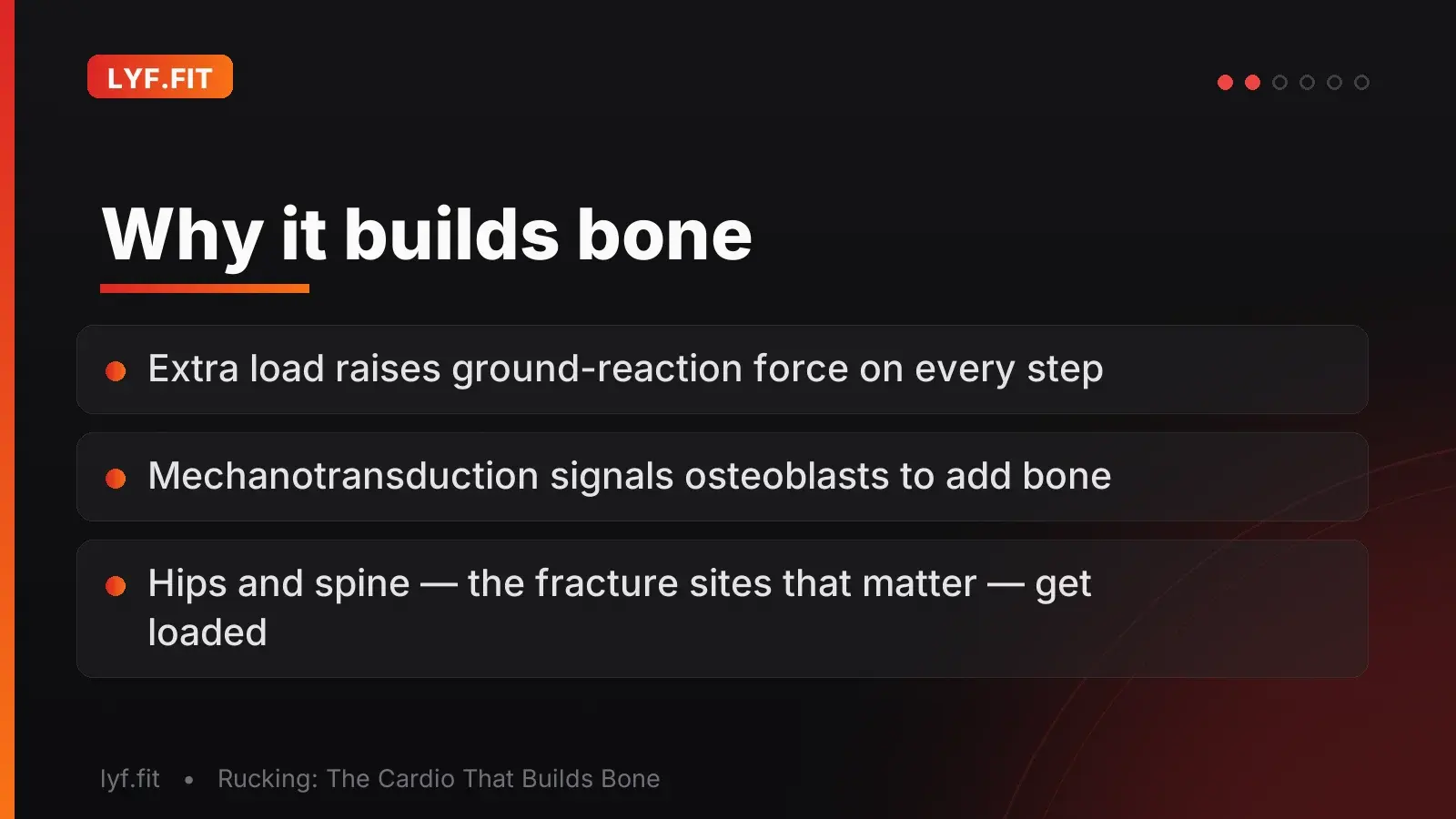
Bone is living, adaptive tissue. It remodels in response to the mechanical forces placed on it — a principle formalized as Wolff's Law and driven by a cellular process called mechanotransduction: strain on the skeleton is sensed by osteocytes, which signal bone-building osteoblasts to lay down new tissue. Rucking raises the ground-reaction force on every one of your thousands of daily steps, and it does so at the hip and spine — precisely the sites where fracture risk matters most with age. Ordinary walking rarely exceeds the strain your skeleton already sees, so it offers little osteogenic signal. Adding external load pushes the stimulus above that habitual threshold, where adaptation begins.
The longitudinal evidence for weighted loading is genuinely encouraging. In a five-year Oregon State University trial, postmenopausal women who trained in weighted vests plus jumping three times weekly maintained hip bone mineral density — in some women the femoral neck actually rose modestly — while a comparison group that did not do the loaded exercise lost bone at the hip. That study used a vest plus jumping rather than rucking specifically, but the loading principle is identical: sustained, above-habitual skeletal load helps preserve the bone that unloaded aging steadily erodes. Because bone responds to the peaks of loading rather than sheer duration, even short, consistent loaded sessions carry a signal.
How much weight should you start with, and how fast should you add more?
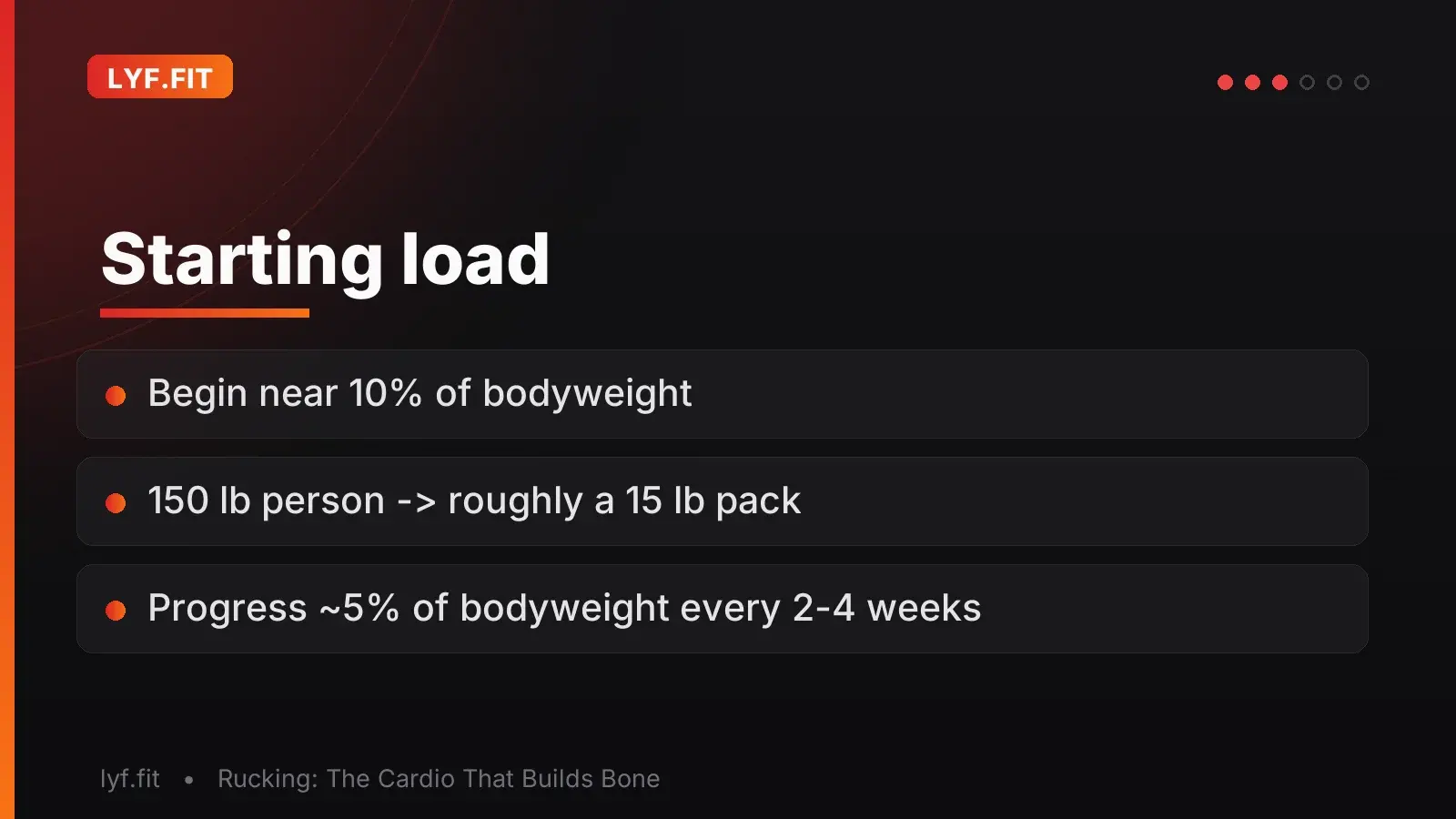
Start conservatively. A widely used entry point is about 10% of bodyweight — roughly a 15-pound pack for a 150-pound person — carried on easy 20-to-40-minute walks. The limiting tissue early on is rarely your heart or lungs; it is your shoulders, upper back, and feet adapting to the load. From there, progress slowly: adding no more than about 5% of bodyweight every two to four weeks lets connective tissue keep pace. Most recreational ruckers settle in a productive 10-to-20% bodyweight band, reserving heavier loads (25%+) for those with a real training history. There is no prize for rushing the ramp, and the extra calorie cost of load rises faster than the load itself — going from a 20-pound to a 40-pound pack roughly doubles the calories burned above baseline walking.
| Metric | Walking | Rucking | Running |
|---|---|---|---|
| Calories per hour (150 lb) | ~200–300 | ~400–500 | ~600–800 |
| Bone-loading stimulus | Low | Moderate–high | High |
| Joint impact | Very low | Low–moderate | High |
| Skill / technique required | Minimal | Minimal | Moderate |
| Injury risk for beginners | Very low | Low | Moderate–high |
Is rucking really easier on your joints than running?
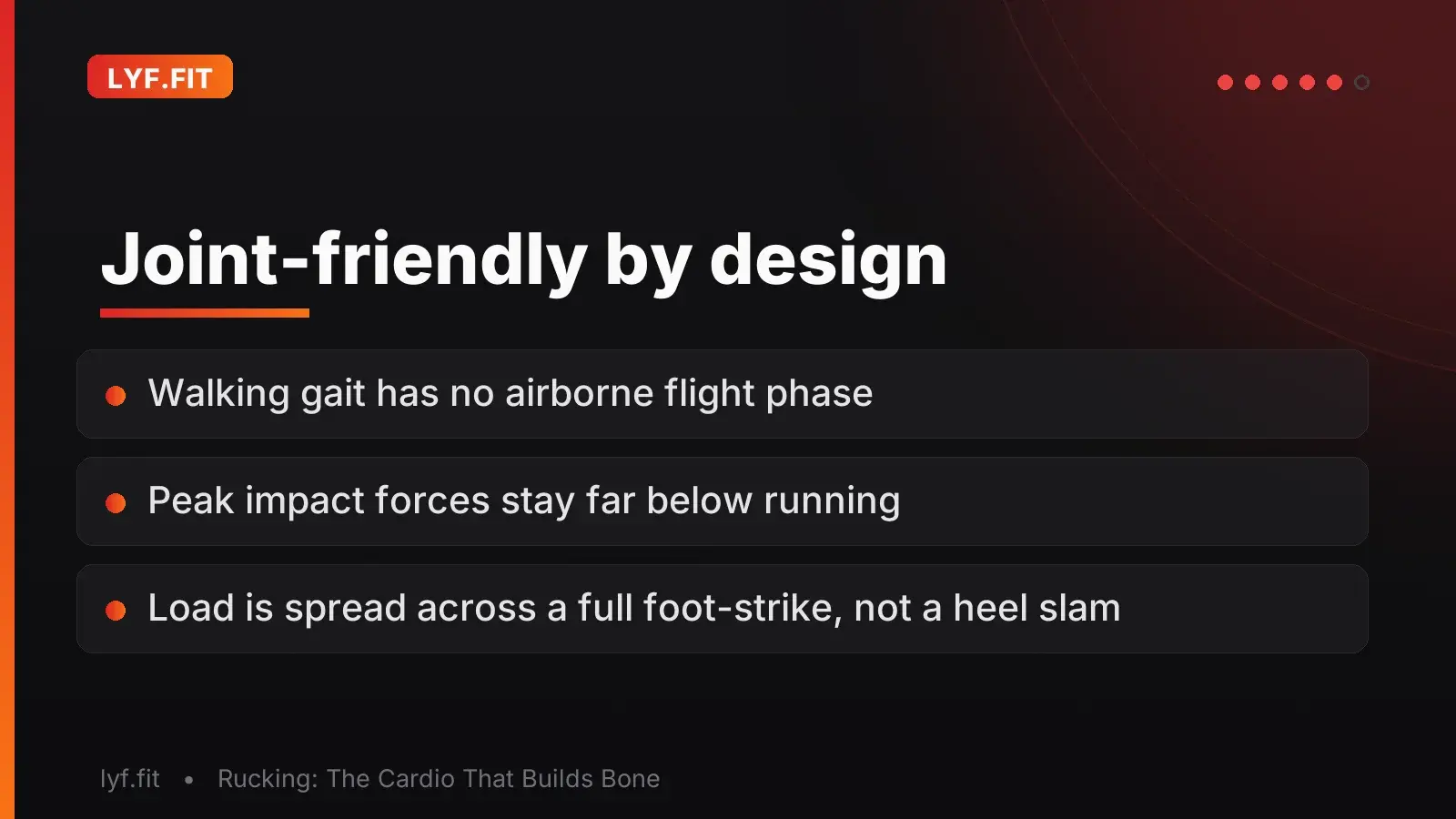
Yes, in a mechanically important way. Running has a flight phase — a moment when both feet leave the ground — so each landing absorbs a peak force commonly cited at two to three times bodyweight, delivered through a brief heel strike. Walking, loaded or not, keeps one foot on the ground at all times; there is no airborne drop to arrest. The added pack raises the force your skeleton absorbs, which is exactly the point for bone, but it spreads that force across a full rolling foot-strike rather than concentrating it in a repeated impact. The result is a higher sustained load with a lower peak impact — a favorable trade for knees, hips, and anyone easing back from a layoff.
How long before rucking pays off?
The two adaptations arrive on different clocks. Aerobic fitness responds quickly: within four to six weeks of two or three sessions a week, most people notice their zone-2 pace feels easier and their resting heart rate drifts down as mitochondrial density climbs. Bone works on a far slower timeline. Remodeling cycles run roughly three to four months from the first strain signal to measurable mineral deposition, and meaningful changes in bone density show up over many months to years, not weeks — which is exactly why the durable evidence comes from multi-year trials. The practical takeaway is patience: the cardio payoff keeps you motivated while the skeletal payoff accrues quietly in the background. Consistency across seasons matters more than any single heavy carry.
Who gets the most out of rucking?
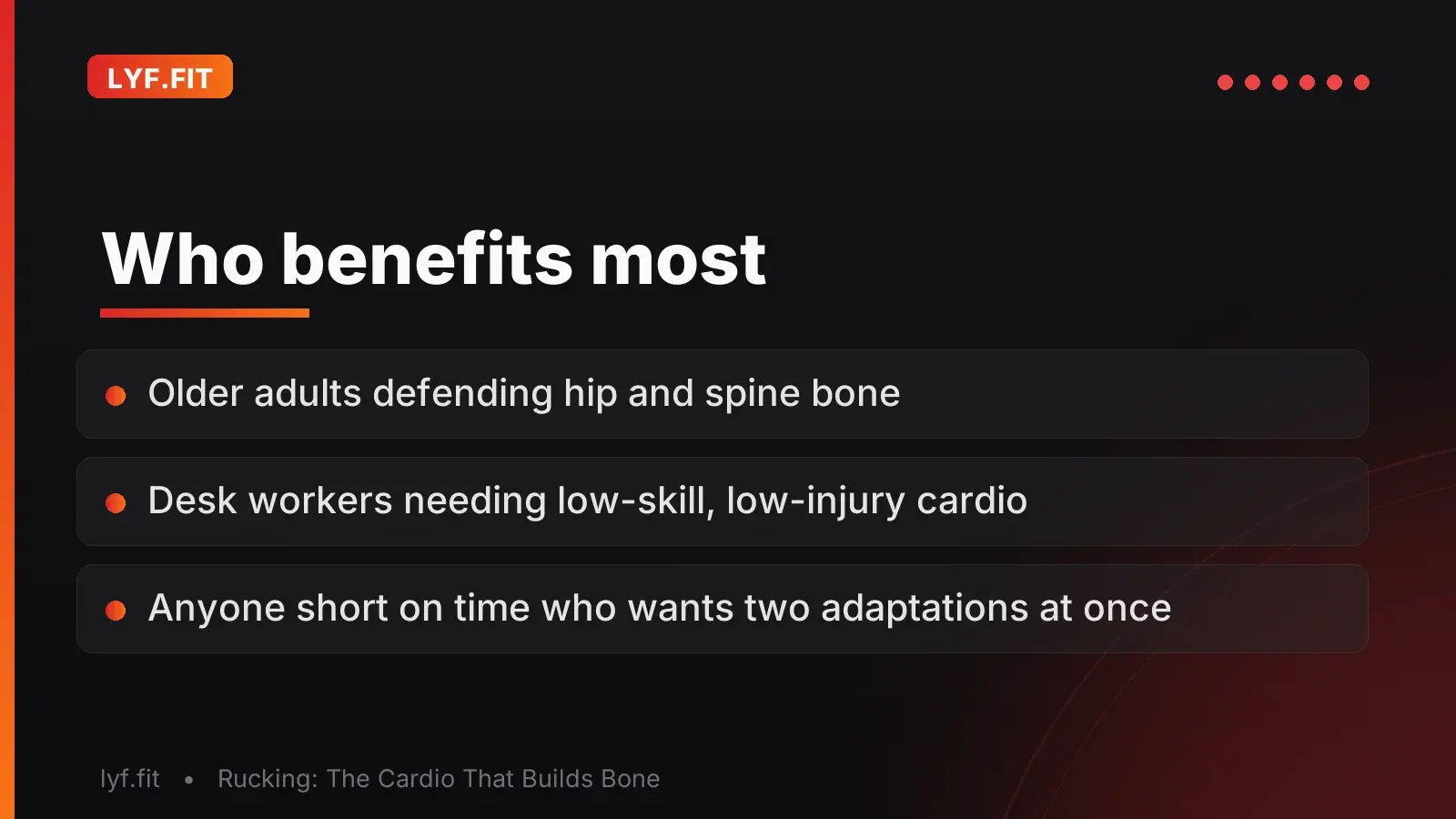
Three groups stand out. Older adults face steady, silent bone loss and often can't tolerate running; rucking loads the skeleton without pounding it. Desk workers need cardio that is low-skill, low-injury, and easy to slot into a lunch break or commute — no technique to learn, no gym required. And time-crunched people get two adaptations in one session: aerobic base and skeletal loading, rather than choosing between a cardio day and a lifting day. Postural and grip demands ride along for free, since the pack quietly recruits your upper back and trunk to stay tall under load. It is not a strength substitute — heavy resistance training remains the gold standard for muscle and maximal bone loading — but as a supplement or an on-ramp, few tools are as forgiving.
Test Your Knowledge
1 / 3What is a sensible starting load for a beginner rucker?
How should you fit the pack and structure your week?
Fit matters more than brand. The load should ride high and tight against your upper back, not sag toward your waist; a snug sternum strap and a hip belt keep the weight from swinging and pulling on your shoulders. Use a plate or sandbag secured so it can't shift mid-walk. For volume, two to four sessions a week of 30 to 60 minutes is a durable starting template — enough to accumulate meaningful loaded time without overloading recovery. Keep most rucks at an easy, nose-breathing effort; save any faster or hillier work for one session once the base is solid. Track pace so you can hold that zone-2 window, and check the energy cost as your load climbs.
Interactive Tools
Save these contextual tools to your profile for quick access.
Frequently asked questions
Done sensibly, it is gentler than running. The risks come from starting too heavy or with a poorly fitted pack. Begin near 10% of bodyweight, keep the load high and snug against your upper back, and progress slowly. If you have an existing spine or joint condition, clear it with a physician first — this is education, not medical advice.
Both add skeletal load; a vest distributes weight around the torso while a ruck pack concentrates it high on the back. The bone-loading principle is the same, and multi-year weighted-vest research points to the durability of the approach. A pack tends to be more comfortable for longer walks and easier to load progressively.
Enough to push skeletal strain above what your daily walking already provides — for most people, a pack in the 10-to-20% bodyweight range once conditioned. Bone adapts over months and years, not weeks, so consistency matters more than any single heavy session. Pair rucking with adequate protein, calcium, and vitamin D, which supply the raw materials your body may use to support bone.
Yes — they are among the best-suited groups. The low skill demand and low peak impact make it accessible when running is not. Start light and short, progress gradually, and let comfort under the pack guide how fast you add load.
Rucking earns its place in a longevity program precisely because it does two jobs at once: it builds the aerobic base that protects your heart and it loads the skeleton that helps defend against fractures — without the joint cost of running. Start light, fit the pack well, and let the miles accumulate. Dial in your effort and load with our pace calculator and calorie converter before your next walk.
Stop completely guessing.
Use our interactive PWA tools to calculate your exact macros, 1RM, and running pace offline.