


Disclaimer: Some of the links on this page are affiliate links. As an Amazon Associate and affiliate for other networks, we may earn a commission from qualifying purchases at no additional cost to you.
Lactate threshold is the intensity above which lactate floods into your blood faster than your body can clear it, and training there raises the ceiling on every endurance effort below it. Most plans obsess over easy Zone 2 and all-out sprints while ignoring this middle ground entirely. That gap is a mistake: threshold work is where a large share of real-world race pace lives, and it responds quickly to focused training.
If you already log easy aerobic miles, lactate threshold is the next lever to pull. It sits one floor above the Zone 2 base you've been building, and it answers a question Zone 2 never does: how fast can you go before the wheels come off?
What is the lactate threshold, exactly?
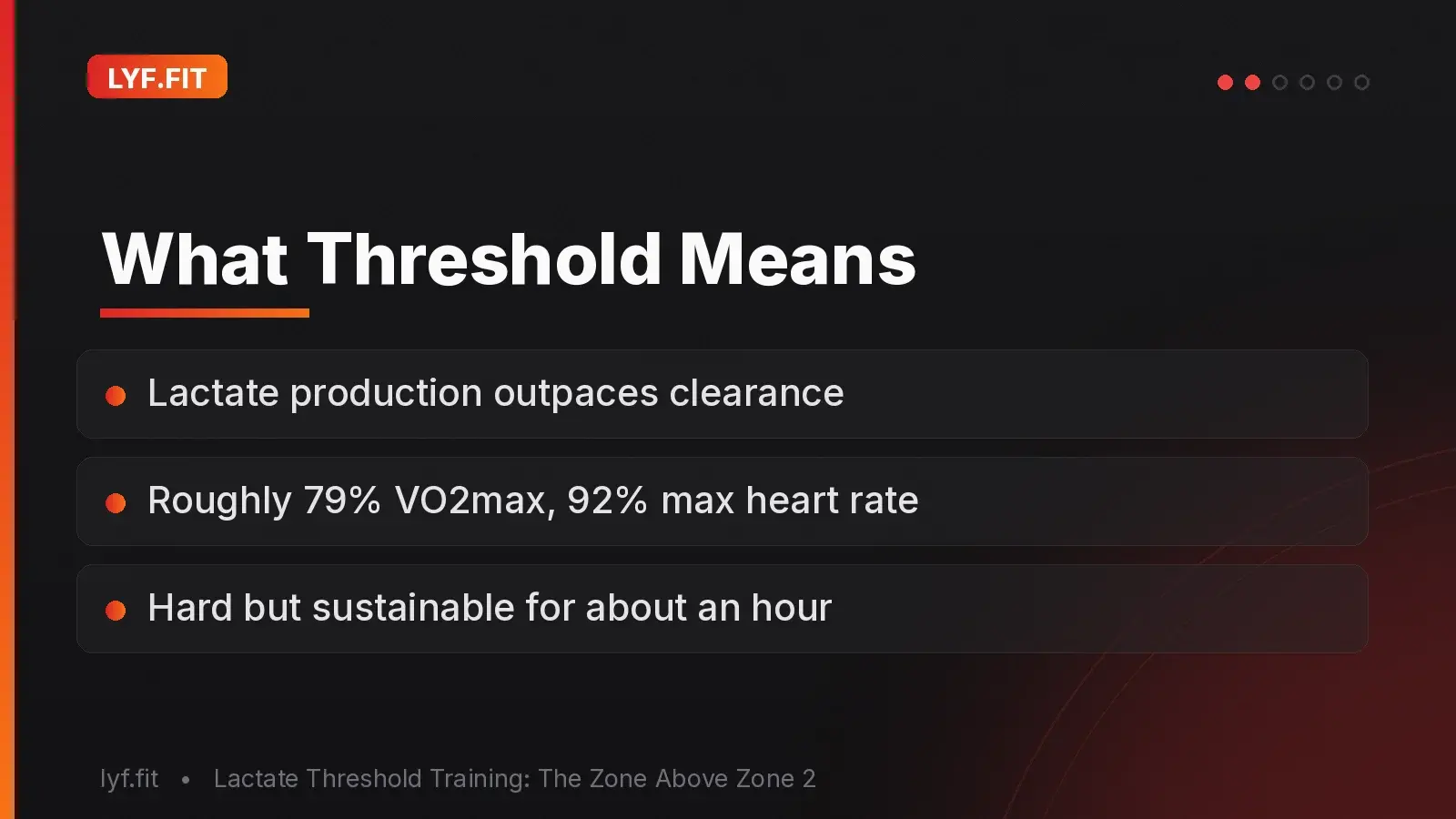
Your muscles always produce lactate, even at rest. At low intensities, your body clears it as fast as it appears, so blood lactate stays flat. As you speed up, production eventually outpaces clearance and lactate starts to accumulate. The intensity right before that runaway point is your lactate threshold.
Researchers often anchor it near a blood lactate concentration of about 2 mmol/L for the aerobic threshold and around 4 mmol/L for the higher anaerobic threshold. In a study of runners holding a fixed 2 mmol/L threshold pace, athletes ran at roughly 79% of VO2max and about 92% of maximum heart rate. The practical takeaway: threshold is genuinely hard, but sustainable, work, not a sprint.
How is threshold different from Zone 2?
Zone 2 and threshold train different machinery, and you need both. Zone 2 builds your aerobic engine, mitochondrial density, and fat-burning capacity at a conversational pace you could hold for hours. Threshold trains your ability to clear and tolerate lactate at a pace you can hold for roughly an hour, not all day.
Think of Zone 2 as widening the base of the pyramid and threshold as raising the point near the top. A bigger base lets the threshold climb higher; a higher threshold lets you cruise faster while still feeling "comfortably hard." Skipping threshold leaves a fast, durable gear untrained, which is exactly the gear that decides most 5K-to-half-marathon results.
Slide 1 of 6
Why does almost nobody program it?
Threshold falls into a no-man's-land that's easy to avoid. It's harder than the easy days most people enjoy, but less flashy than the brutal VO2max intervals that dominate social media. The popular "polarized" model, which prescribes mostly easy plus a little very hard, gets misread as "never train the middle," and threshold gets cut.
There's also a comfort problem. Threshold pace feels uncomfortable enough that beginners avoid it and experienced athletes often drift either too easy or too hard, missing the narrow productive window. The fix is structure: defined intervals at a known intensity, rather than vague "tempo" runs that creep into the wrong zone.
How do you find your threshold without a lab?
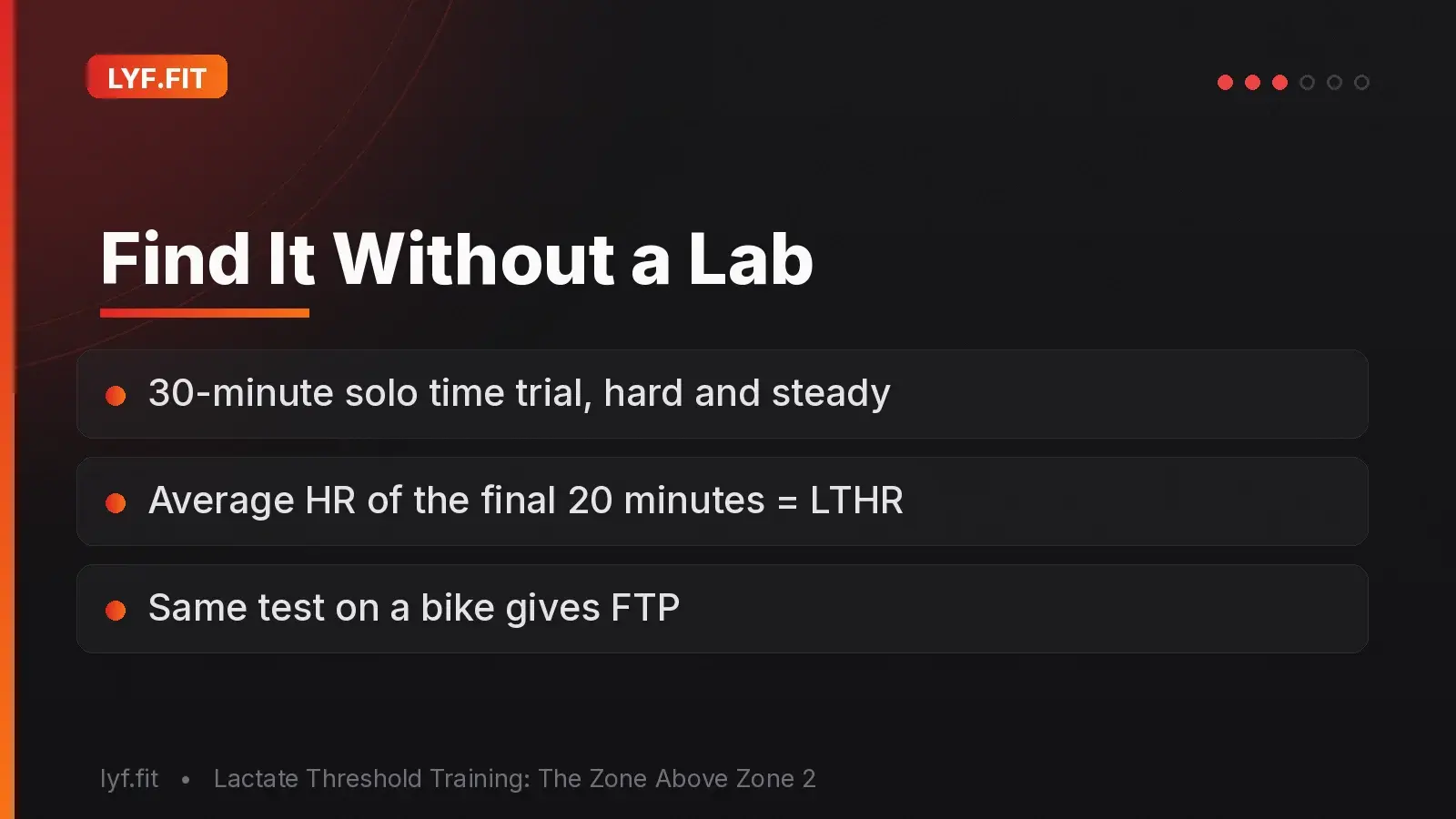
You don't need a blood lactate analyzer. The most popular field test is a 30-minute solo time trial at a hard, steady effort. Per coach Joe Friel's widely used protocol, you take your average heart rate over the final 20 minutes as your estimated lactate threshold heart rate (LTHR). The first 10 minutes are dropped because heart rate lags behind effort early on.
For most runners, threshold heart rate lands between about 85% and 92% of maximum, sitting at the bottom of the classic Zone 4. You can run the same test on a bike to find functional threshold power (FTP), which is the cycling world's name for the same concept. Once you have an LTHR or threshold pace, build your sessions around it. A running pace calculator turns a recent race result into target paces you can pin your threshold work to.
No time to run the full protocol? A recent all-out race is a decent shortcut. For many runners, threshold pace sits close to current 10K race pace — a touch faster than that for slower runners, and closer to 15K or half-marathon pace for very fit ones — roughly the effort you could hold for about an hour. On the bike, a shorter 20-minute all-out test is common: estimate FTP as about 95% of your average power for those 20 minutes, since you can hold slightly more for 20 minutes than for a full hour.
The two workouts that move the needle
Two session types cover most of the benefit, and they hit threshold from opposite directions.
Sweet-spot / tempo sessions sit just below threshold, around 88–92% of LTHR, held continuously or in long blocks. Think 2 × 15 minutes or a steady 25–30 minute tempo. These build the most threshold-specific endurance per unit of fatigue, which is why time-crunched athletes love them.
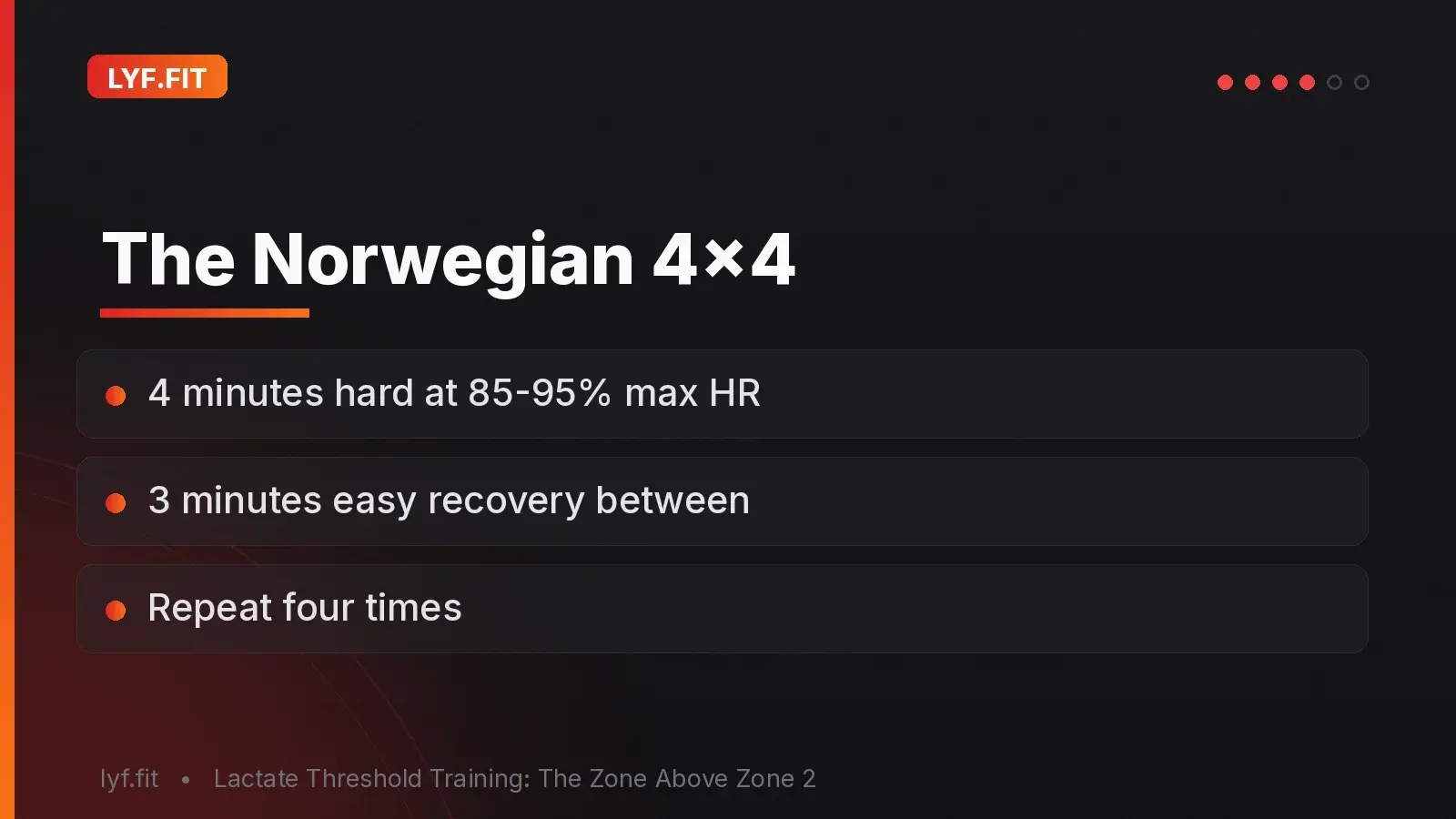
Norwegian 4×4 intervals push at or just above threshold to pull VO2max up, which in turn lifts the threshold underneath it. The protocol is four 4-minute efforts at roughly 85–95% of max heart rate, each followed by 3 minutes of easy recovery at about 65–70% of max. It's hard enough to develop VO2max optimally without blowing up on the first rep. An interval timer makes the work-rest cycling automatic so you can focus on effort.
| Session | Intensity | Structure | Trains | Best for |
|---|---|---|---|---|
| Sweet-spot tempo | ~88–92% LTHR | 2 × 15 min or 25–30 min steady | Threshold endurance | Time-crunched base building |
| Threshold intervals | ~95–100% LTHR | 4–6 × 5 min, 1 min easy | Lactate clearance | Sharpening race pace |
| Norwegian 4×4 | 85–95% HRmax | 4 × 4 min, 3 min easy | VO2max (raises ceiling) | Lifting the whole curve |
How often should you train threshold?
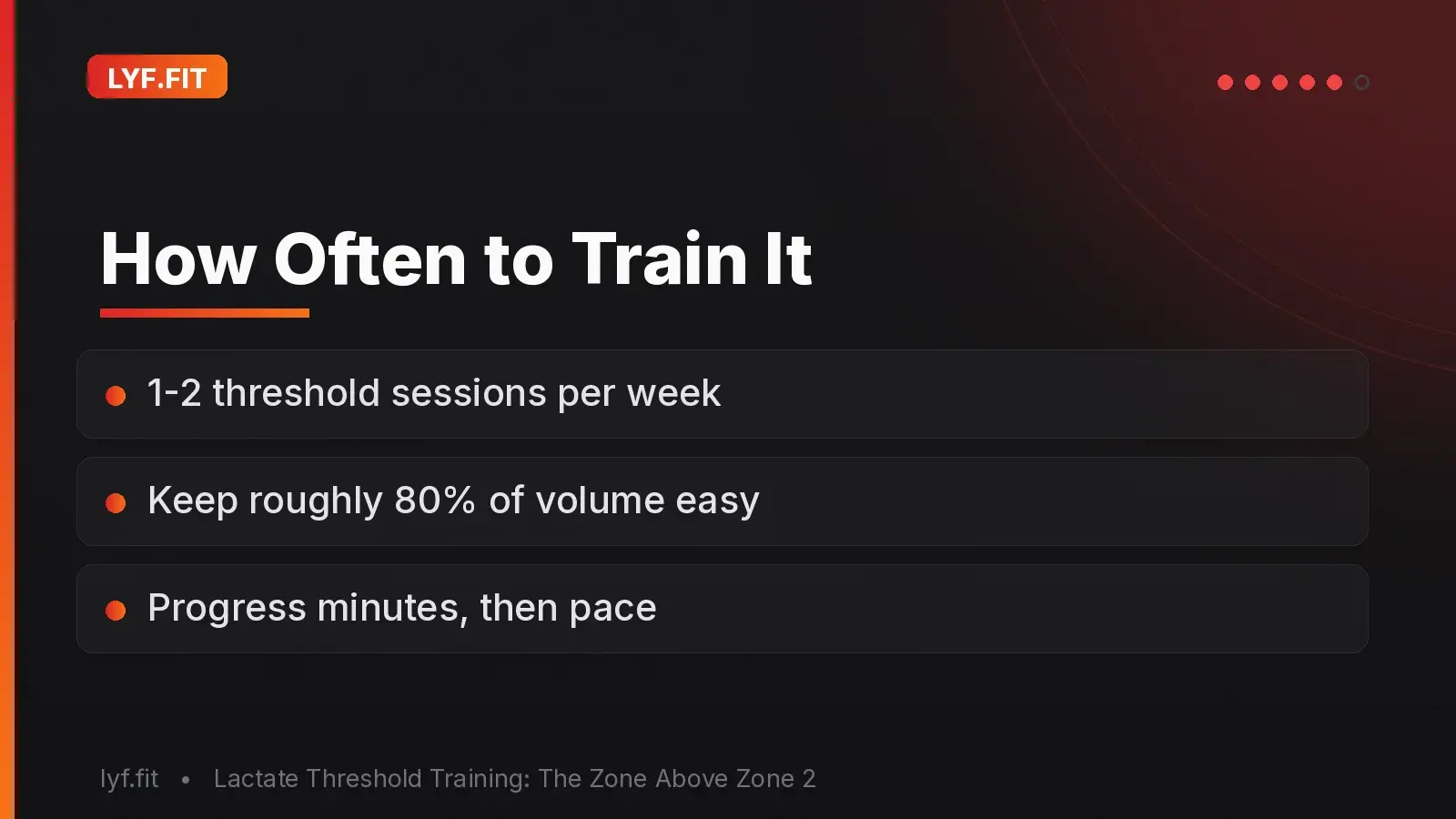
For most recreational athletes, one to two threshold sessions per week is plenty, layered on top of a foundation of easy aerobic volume. A common split is roughly 80% easy work and 20% moderate-to-hard, with threshold occupying a meaningful slice of that hard 20%. Going harder more often doesn't raise threshold faster; it just digs a fatigue hole.
Treat threshold like strength training: progressive but patient. Add a few minutes of total time-at-threshold per week, or nudge the pace down slightly as the same effort gets easier. Recovery between hard sessions matters as much as the sessions themselves, so keep easy days truly easy. If you want the longevity case for all this aerobic work, the VO2max longevity data is worth a read, and if you're weighing interval styles, our breakdown of HIIT versus steady cardio adds useful context.
Test Your Knowledge
1 / 4What defines the lactate threshold?
Interactive Tools
Save these contextual tools to your profile for quick access.
Workout Rest Timer
A customizable countdown timer designed specifically for your rest periods between lifting sets.
Running Pace Calculator
Calculate pace and splits, compare distances, and export a practical race-day pace card.
Interval Timer
A programmable HIIT and Tabata timer that automatically loops between work and rest phases.
Frequently asked questions
No. VO2max is the size of your aerobic engine, the maximum oxygen you can use. Lactate threshold is the percentage of that engine you can sustain for a long effort. Two athletes with identical VO2max can have very different thresholds, and threshold often improves faster with training than VO2max does.
Yes. Threshold corresponds to a "comfortably hard" effort you could hold for about an hour, where talking is reduced to short phrases. Rating of perceived exertion (a 7–8 out of 10) and pace from a recent race both work as guides, though a monitor makes pacing more precise.
Threshold responds relatively quickly. Many athletes notice a measurable shift in pace or power at the same heart rate within four to six weeks of consistent, structured threshold work, assuming adequate easy volume and recovery around it.
No, that's an old myth. Lactate is actually a fuel your body recycles, and it clears within hours of exercise. Delayed soreness comes from mechanical muscle damage, not lingering lactate.
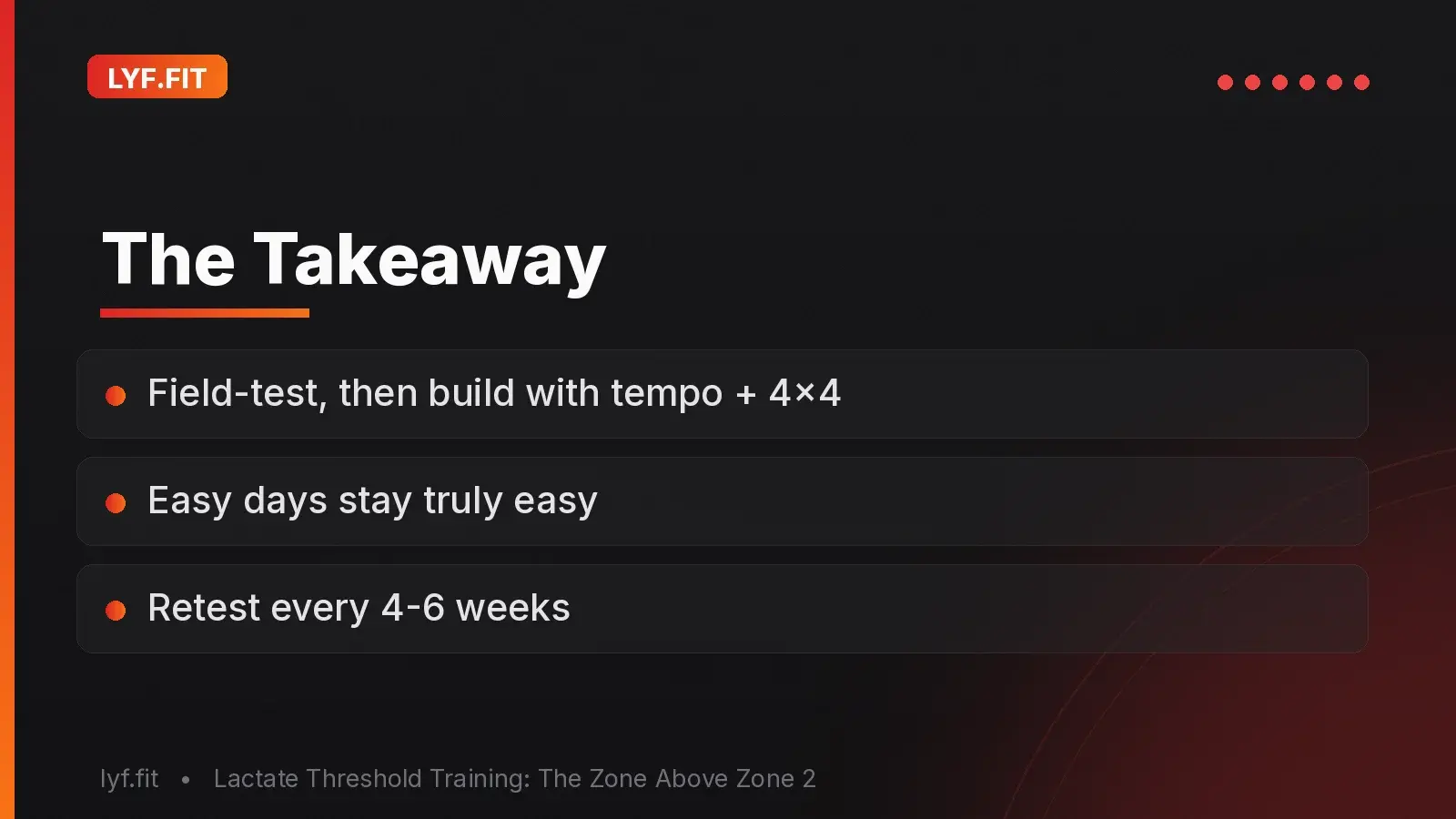
The zone above Zone 2 is where a lot of fitness hides in plain sight. Find your threshold with a simple field test, build it with sweet-spot tempos and Norwegian 4×4 intervals, and protect it with easy days that stay easy. Plug a recent race time into the pace calculator to set your targets, then let the work compound.
This article is educational and not medical advice. Consult a physician before starting a new high-intensity training program, especially if you have a cardiovascular condition.
Stop completely guessing.
Use our interactive PWA tools to calculate your exact macros, 1RM, and running pace offline.