

Disclaimer: Some of the links on this page are affiliate links. As an Amazon Associate and affiliate for other networks, we may earn a commission from qualifying purchases at no additional cost to you.
Body fat is not one uniform tissue. It comes in two main forms: subcutaneous fat, the pinchable layer just under your skin, and visceral fat, the deeper fat packed around the organs in your abdomen. Subcutaneous fat is mostly a normal energy reserve and insulator; visceral fat is more metabolically active and, in higher amounts, is associated with greater cardiometabolic risk. The practical upside is that visceral fat also tends to respond well to the same fundamentals — an energy deficit, more protein and fiber, resistance training, cardio, and better sleep.
Understanding the difference between the two changes not just how you view your physique but how you approach metabolic health and longevity.
What is Subcutaneous Fat?
Subcutaneous fat is the fat stored directly underneath your skin. This is the fat you can physically pinch. It covers your abdominal muscles, sits on your thighs, and makes up the "jiggle" on the back of your arms.
While this is the fat most people want to lose for aesthetic reasons, it is the less concerning of the two. In moderate amounts, subcutaneous fat is a completely normal energy reserve, a source of hormones, and an insulator. For most people it makes up the large majority of total body fat.
What is Visceral Fat?
Visceral fat is different. It is stored deep within your abdominal cavity, wrapped around vital organs such as the liver, stomach, and intestines. You cannot pinch it. A person can have a relatively flat stomach yet still carry a high amount of visceral fat — a pattern sometimes called "TOFI" (Thin Outside, Fat Inside).
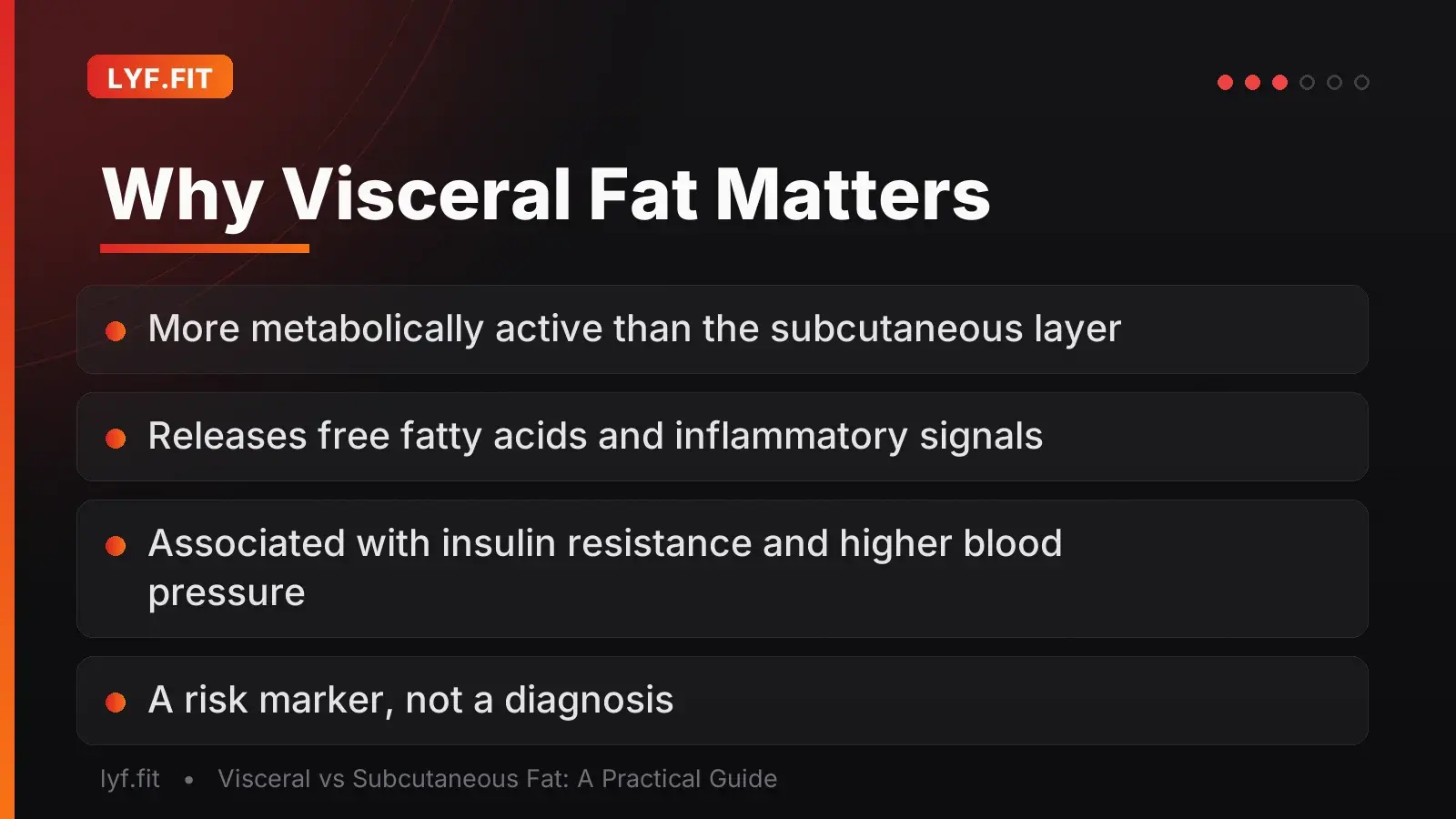
Visceral fat is also more biologically active than the subcutaneous layer. It releases free fatty acids and signaling molecules — including inflammatory cytokines — into circulation at higher rates, which is why it behaves so differently from the fat you can see and pinch.
Visceral vs subcutaneous fat at a glance
The two tissues sit in different places, do different jobs, and carry very different levels of concern. Here is how they compare:
| Feature | Subcutaneous fat | Visceral fat |
|---|---|---|
| Location | Just under the skin (belly, thighs, arms) | Deep in the abdomen, around the organs |
| Can you pinch it? | Yes | No |
| Rough share of body fat | The majority for most people | A smaller fraction, rising with age and inactivity |
| Metabolic activity | Lower | Higher — releases more free fatty acids and inflammatory signals |
| Main concern | Mostly aesthetic | A marker of cardiometabolic risk |
| How to gauge it | Skinfold calipers, visual | Waist metrics at home; DEXA/MRI in a clinic |
Why is visceral fat metabolically riskier?
Visceral fat drains partly into the portal vein, which feeds directly into the liver, and it is more metabolically active than subcutaneous fat. In research, higher visceral fat is associated with insulin resistance, higher blood pressure, less favorable cholesterol patterns, and elevated risk of type 2 diabetes and cardiovascular disease.
An important caveat: association is not the same as causation, and visceral fat is best understood as a risk marker, not a diagnosis. Plenty of factors — genetics, activity, diet, and sleep — shape both your visceral fat and your metabolic health. If you are worried about your numbers, that is a conversation for a physician, not a bathroom scale. Still, tracking central fat gives you a useful, actionable signal to work with.

How can you estimate visceral fat at home?
You do not need a lab to get a useful read. A few low-tech measurements track central fat reasonably well:
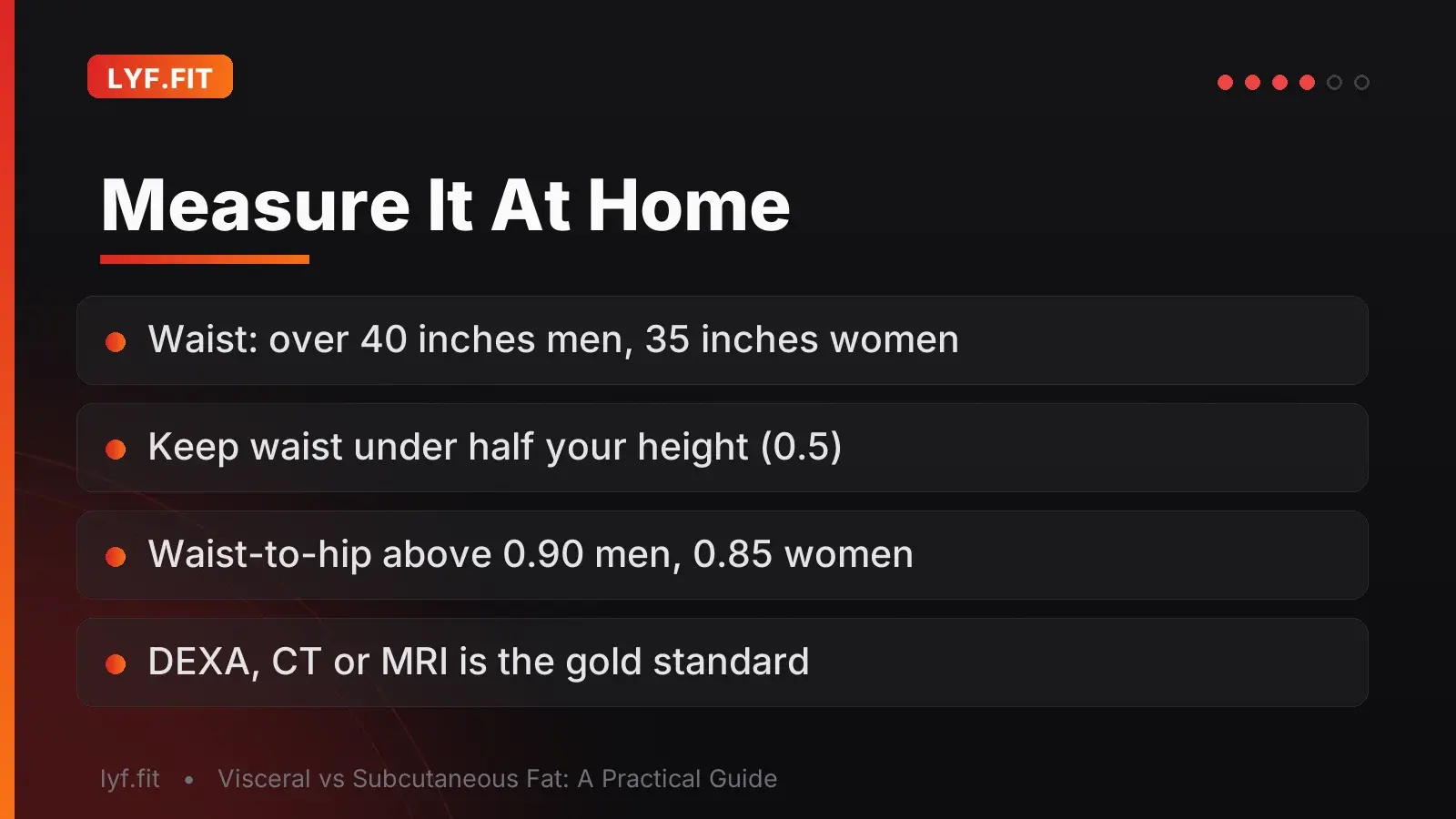
- Waist circumference. Measure around your bare midsection at the level of your navel, relaxed, without sucking in. Elevated risk is often flagged above roughly 40 inches (102 cm) for men and 35 inches (88 cm) for women.
- Waist-to-height ratio (WHtR). Divide your waist by your height in the same units. A simple public-health rule of thumb is to keep your waist under half your height — a ratio below about 0.5. Many researchers consider WHtR a better screen for central fat than BMI alone.
- Waist-to-hip ratio (WHR). Divide waist by hip circumference. The World Health Organization associates higher risk with ratios above about 0.90 in men and 0.85 in women.
- Smart bio-impedance scales. Many modern scales report a "visceral fat rating." Treat these as rough estimates that drift with hydration — watch the trend over weeks, not the exact number on any given morning.
The gold standard is imaging: a DEXA, CT, or MRI scan can directly quantify visceral adipose tissue, but those require a clinic and cost. For everyday tracking, a tape measure and your monthly waist-to-height ratio are more than enough.
RENPHO Smart Body Scale Sponsored
Track a visceral fat estimate and your weight trend on your smartphone via Bluetooth so you can watch the direction of travel over time.
What actually reduces visceral fat?
Create a modest energy deficit
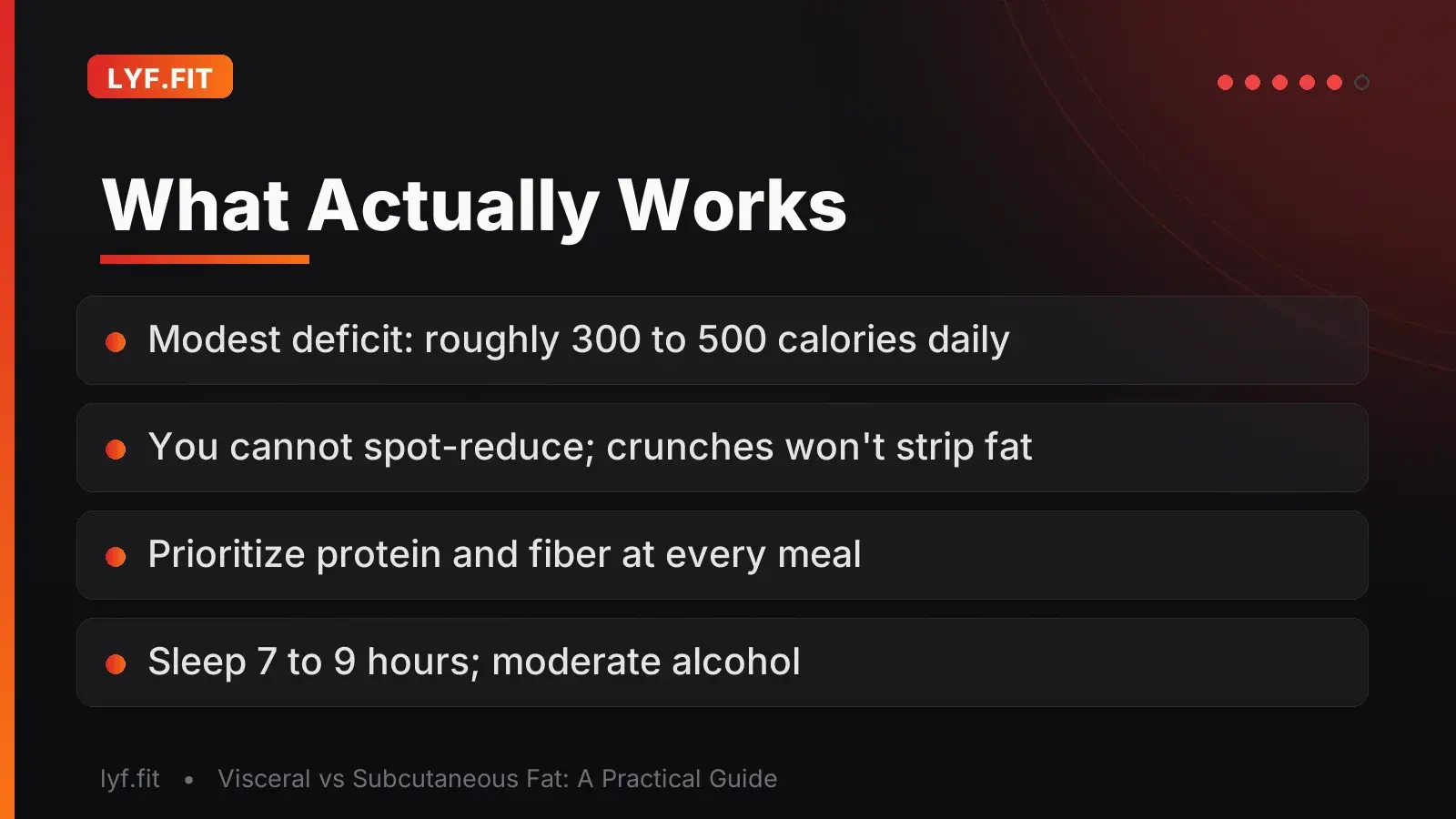
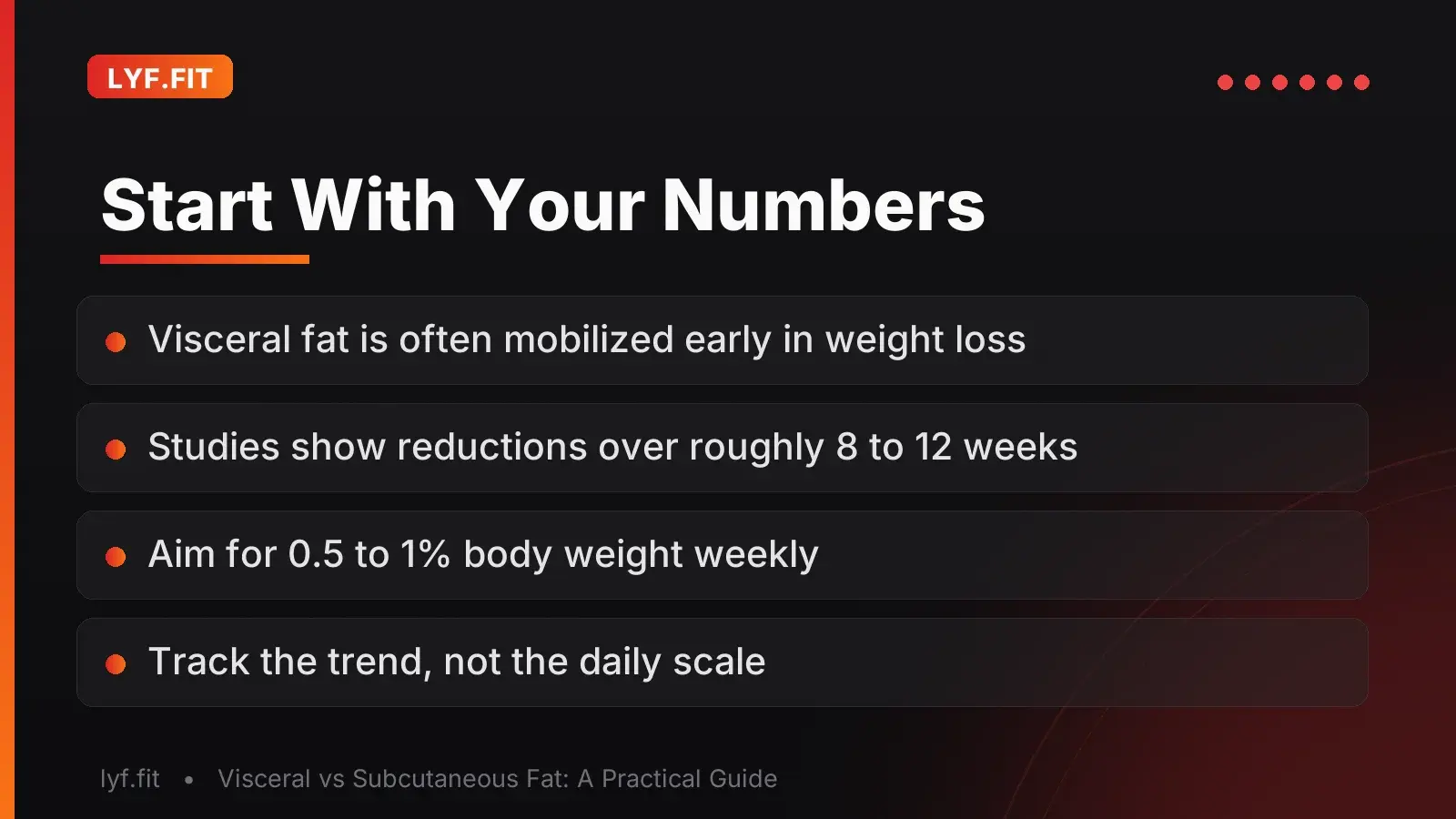
Visceral fat is still fat, so the master lever is a sustained energy deficit — expending more calories than you take in. Encouragingly, several studies suggest visceral fat is often mobilized early and preferentially during weight loss, so the deep fat frequently shrinks before the pinchable layer does. Find your maintenance calories with our TDEE calculator, subtract roughly 300 to 500 per day, and log intake in the macro diary. For the full framework, see our guide to TDEE and macros.
You cannot spot-reduce it
There is no exercise that selectively burns belly fat. Crunches build the abdominal muscles underneath the fat but do not strip the fat sitting on top of them. Fat loss happens systemically, driven by your overall deficit — not by the specific muscle you happen to be working. Endless ab circuits are a poor use of training time if visceral fat is the target.
Prioritize protein and fiber
Higher-protein diets help preserve lean mass in a deficit and carry a larger thermic effect, and research links higher protein intakes with better abdominal-fat outcomes during weight loss. Fiber matters too: observational research has linked each additional ~10 grams of soluble fiber per day with slower visceral fat accumulation over time. Practically, anchor each meal around a protein source plus plenty of vegetables, legumes, and whole grains.
Combine resistance training with cardio
The most effective programs pair both. Resistance training preserves and builds muscle, which supports your resting metabolic rate, while aerobic work adds energy expenditure and is consistently associated with visceral fat reduction. Zone 2 cardio — steady efforts where you can still hold a conversation — is a sustainable way to accumulate that volume without piling on fatigue.
Protect sleep, and moderate alcohol and stress
Short sleep and chronic psychological stress are both associated with greater visceral fat, plausibly through appetite and cortisol pathways. Most adults do best with 7 to 9 hours of sleep — our look at sleep and weight loss explains why. Heavy alcohol intake is also linked with central adiposity — the classic "beer belly" — so trimming it is often a quick, high-leverage win.
How long does it take to lose visceral fat?
There is no fixed timeline, but visceral fat is generally responsive. Because it is often mobilized early in weight loss, many people notice meaningful changes in waist circumference within the first several weeks of a consistent deficit and regular training. Studies of supervised diet-and-exercise programs have reported measurable visceral fat reductions over roughly 8 to 12 weeks.
Your results depend on your starting point, adherence, sleep, and genetics. Track the trend with a tape measure and a monthly waist-to-height ratio rather than the daily scale, which swings with water and food. A pace of about 0.5 to 1% of body weight per week protects muscle and is far easier to sustain than a crash approach.
Test Your Visceral Fat Knowledge
1 / 4Where is visceral fat primarily stored?
The bottom line
Stop fixating only on the fat you can pinch. Subcutaneous fat is mostly a cosmetic concern, while visceral fat is the better marker of metabolic risk — and the good news is that the same fundamentals address both. Dial in a modest energy deficit, eat enough protein and fiber, train with weights and cardio, sleep well, and moderate alcohol. Put numbers to your plan with our TDEE calculator and body fat estimator. This article is educational and not medical advice; if you have concerns about your metabolic health, talk with a physician.
Frequently asked questions
Yes. Some people carry a normal amount of subcutaneous fat and a flat-looking stomach while still holding excess visceral fat around their organs — a pattern nicknamed "TOFI," thin outside, fat inside. This is why body weight and appearance alone can be misleading, and why waist metrics add useful context beyond the scale.
A common guideline is to keep your waist circumference under half your height — a waist-to-height ratio below roughly 0.5. It is a screening rule of thumb, not a diagnosis, and it can vary by build and ancestry. Use it to track your own trend over time rather than as a hard pass-fail line.
Bio-impedance scales provide an estimate, not a precise measurement, and their readings shift with hydration, food, and time of day. They are most useful for spotting a trend across several weeks. For an exact figure you would need imaging such as a DEXA, CT, or MRI scan performed in a clinic.
Heavy alcohol intake is associated with greater central and visceral fat — the familiar "beer belly." Alcohol adds calories, can nudge appetite and food choices, and may influence how the body stores fat. Cutting back is often one of the simpler, higher-impact changes for reducing waist size.
Visceral fat is a signal, not a sentence — it responds to the same habits that improve overall health. Start by finding your numbers, then let consistency do the work.
Interactive Tools
Save these contextual tools to your profile for quick access.
Stop completely guessing.
Use our interactive PWA tools to calculate your exact macros, 1RM, and running pace offline.