

Disclaimer: Some of the links on this page are affiliate links. As an Amazon Associate and affiliate for other networks, we may earn a commission from qualifying purchases at no additional cost to you.
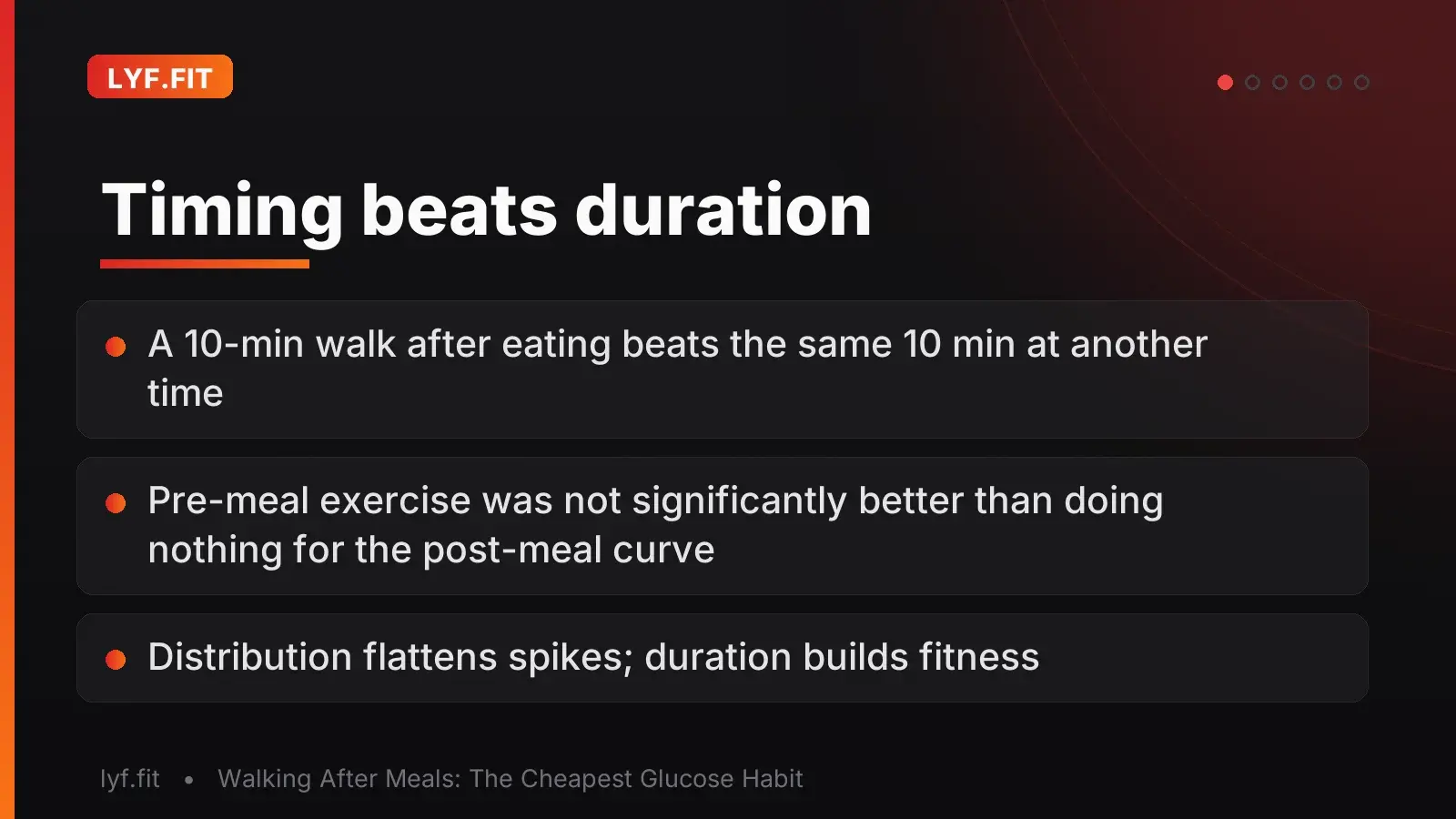
A 10-minute walk started right after you finish eating blunts the post-meal glucose rise more than the same 10 minutes walked at any other point in the day. The reason is mechanical rather than motivational: contracting skeletal muscle pulls glucose out of the bloodstream through a transport pathway that does not wait for insulin. Research suggests bouts as short as 2 to 5 minutes produce a measurable effect, which makes the post-meal walk one of the cheapest metabolic habits available — no equipment, no gym, no change of clothes.
Why does walking right after a meal work better than walking later?
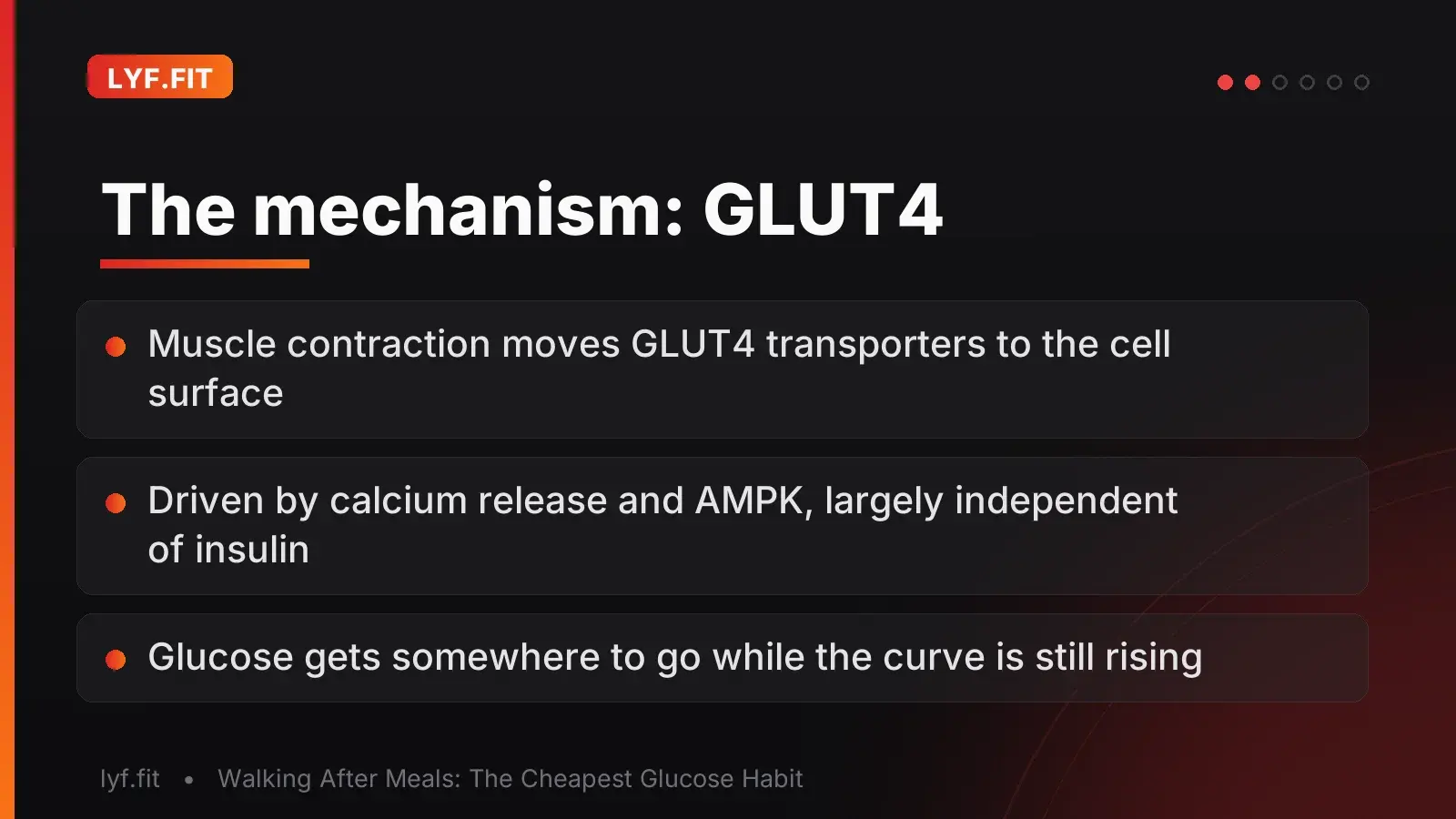
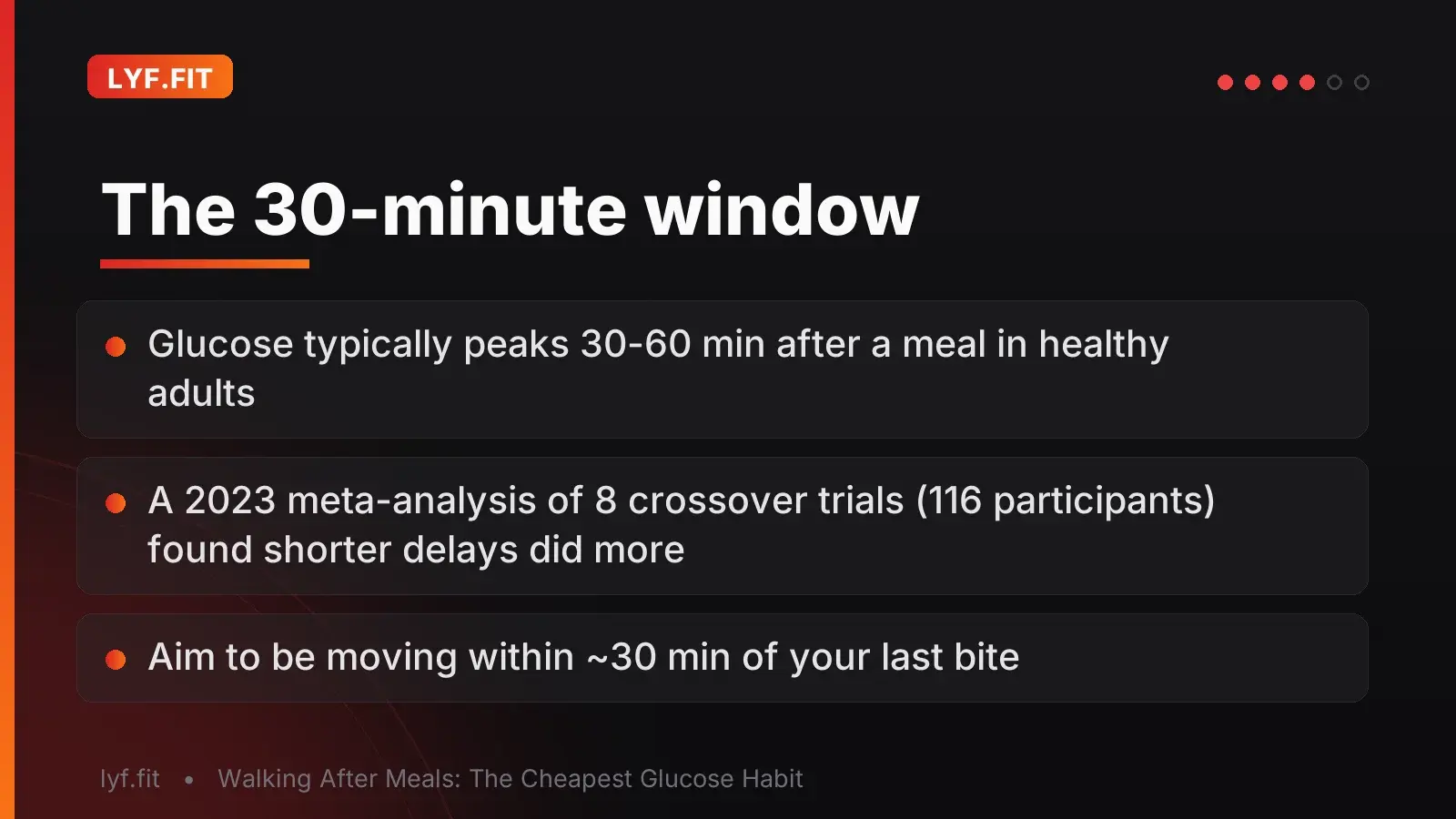
Skeletal muscle has two ways to open its doors to glucose. The familiar one is insulin-driven: insulin binds its receptor, a signaling cascade fires, and GLUT4 glucose transporters move to the cell surface. The second route runs on contraction itself. Calcium release and AMPK activation during muscle work push those same GLUT4 transporters to the membrane, and physiology reviews describe this contraction pathway as operating largely independent of insulin signaling. That independence is the whole point. A walk placed on top of a rising glucose curve gives circulating sugar somewhere to go precisely when there is the most of it to clear. In metabolically healthy adults, glucose typically peaks roughly 30 to 60 minutes after a meal and drifts back toward baseline within two to three hours. Walk four hours later and you are opening the doors to an empty hallway.
How short can the walk be and still count?
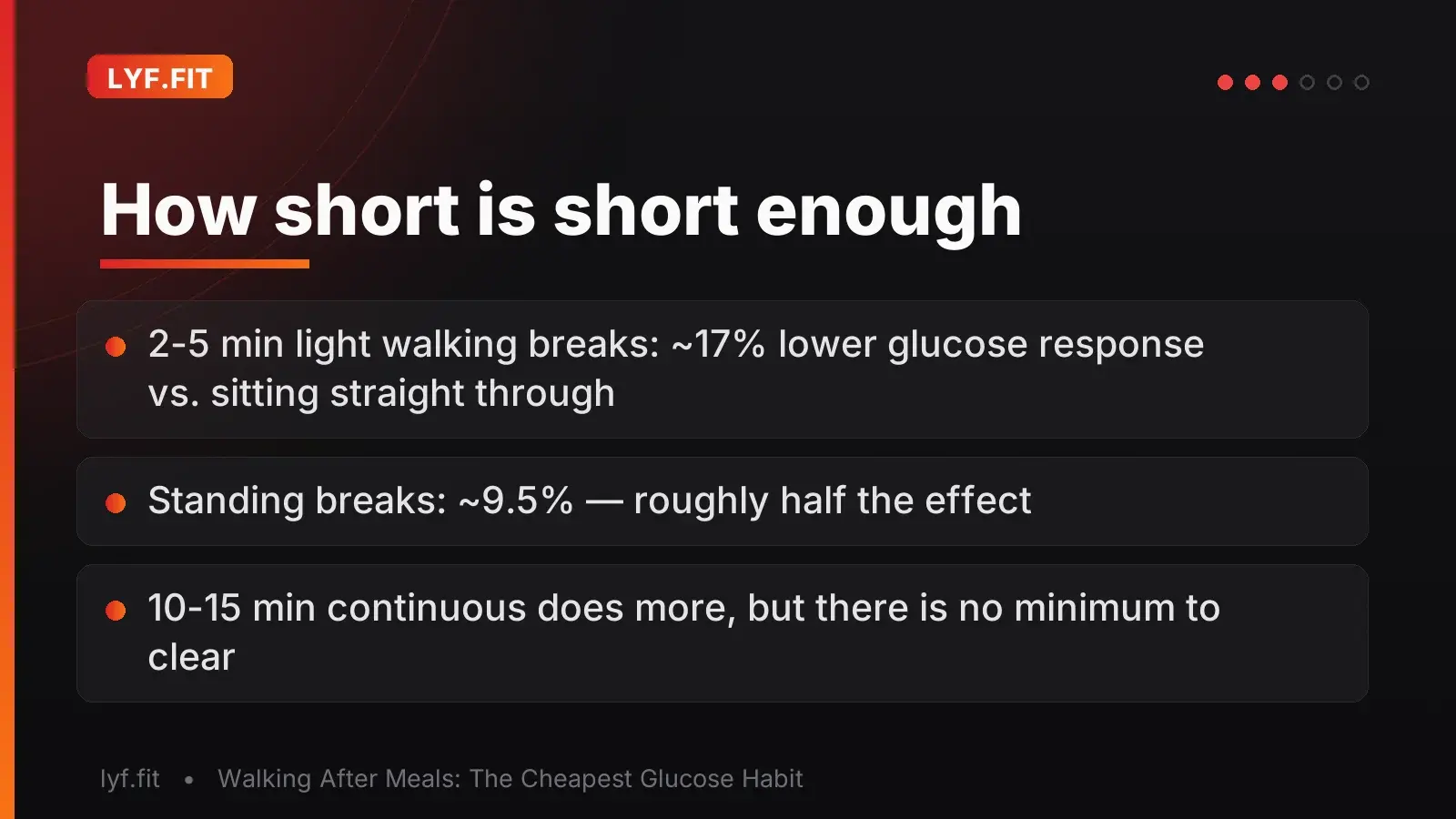
Shorter than most people assume. A 2022 systematic review and meta-analysis in Sports Medicine pooled trials that interrupted prolonged sitting with brief activity breaks — typically 2 to 5 minutes of light walking every 20 to 30 minutes — and reported roughly a 17% reduction in the glucose response compared with sitting straight through. Standing breaks helped as well, but by about 9.5%, close to half the walking effect. Larger doses still do more: trials using 10 to 15 minutes of continuous walking after a meal consistently show bigger reductions in the post-meal excursion than a two-minute shuffle. The practical read is that there is no minimum threshold you have to clear before the habit "counts." Two minutes to the mailbox and back is not a rounding error.
When exactly should the walk start?
Sooner is better, and "before the meal" does not substitute. A 2023 systematic review with meta-analysis pooled eight randomized crossover trials spanning 116 participants — 47 of them diagnosed with type 2 diabetes — and found that exercise performed after eating reduced post-meal glucose excursions compared with an inactive control condition, and also outperformed the same exercise performed before eating. Notably, pre-meal exercise was not significantly better than doing nothing at all for the post-meal curve. The authors reported that the interval between meal and movement moderated the size of the effect, with shorter delays producing the larger benefit. A sensible target is to be moving within about 30 minutes of your last bite. The dishes will still be there in 10 minutes.
Slide 1 of 6
Which meal matters most?
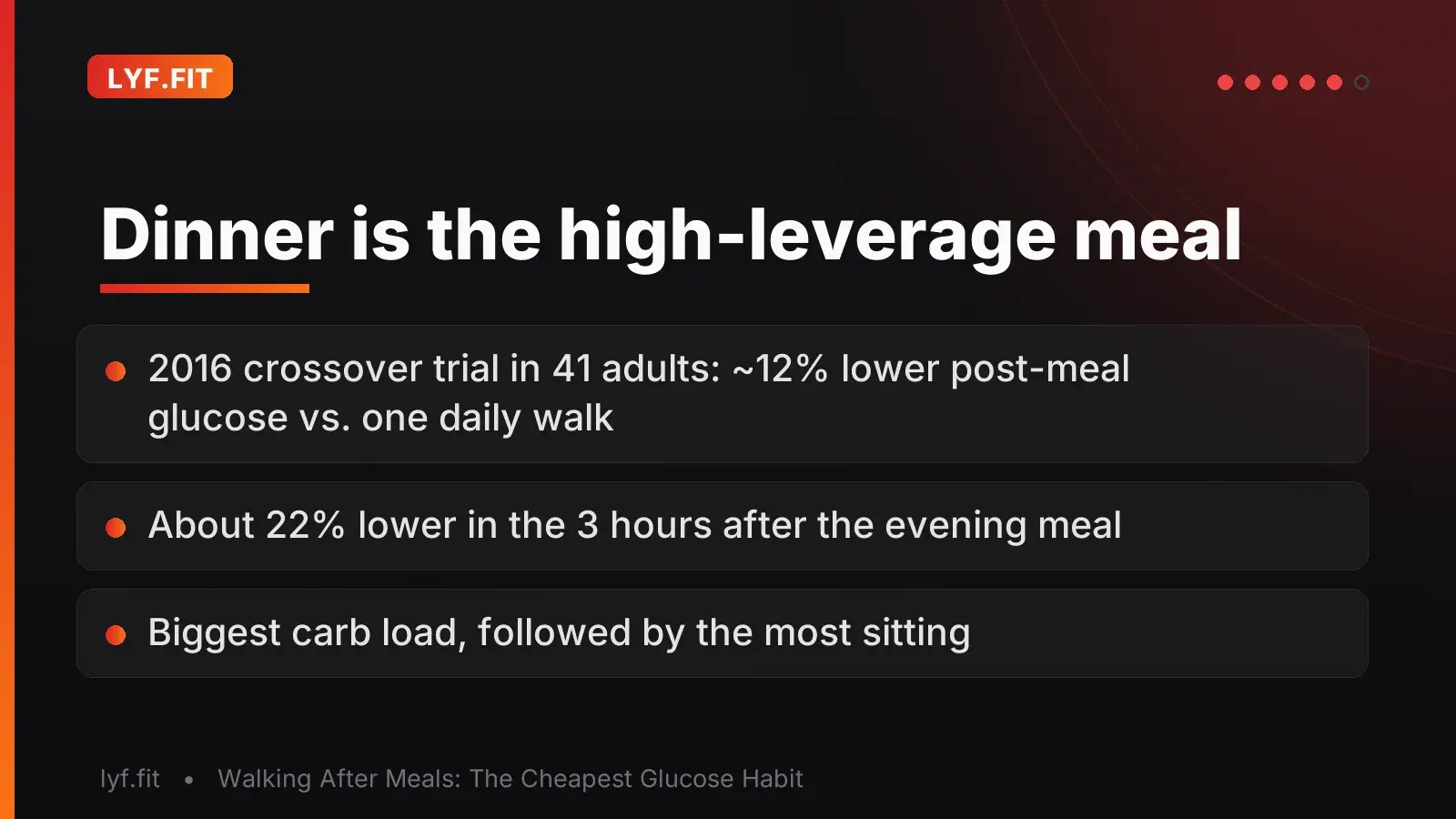
Dinner, for most people. In a 2016 randomized crossover study of 41 adults with type 2 diabetes, two weeks of walking 10 minutes after each of three daily meals was associated with post-meal glucose roughly 12% lower than two weeks of a single 30-minute walk taken at an unspecified time of day. Most of that advantage came from a reported 22% reduction in the three hours following the evening meal, and the gap was widest when that meal was carbohydrate-heavy. Two factors stack at dinner: it is often the day's largest carbohydrate load, and it is followed by the longest uninterrupted block of sitting. A 2013 Diabetes Care trial in 10 inactive adults aged 60 and older with fasting glucose between 105 and 125 mg/dL found the same post-dinner pattern.
Is one long daily walk just as good?
It depends what you are asking the walk to do. In that 2013 trial, both three 15-minute post-meal walks and a sustained 45-minute morning walk improved 24-hour glycemic control relative to a no-walk control day — but post-meal walking was significantly more effective than 45 minutes of sustained morning or afternoon walking at lowering glucose in the three hours after dinner. For total weekly activity volume, cardiorespiratory fitness, and calorie expenditure, a longer continuous walk is at least as valuable and probably better. For flattening the individual spikes, distribution beats duration. The two are not in competition; if you already walk 45 minutes in the morning, moving 10 of those minutes to after dinner costs nothing and may buy you a flatter evening curve.
| Intervention | What research suggests about post-meal glucose | Practicality |
|---|---|---|
| 2-5 min light walk, repeated through a sitting day | Roughly 17% lower glucose response vs. sitting straight through (2022 meta-analysis) | Easiest to insert; needs a repeating prompt or timer |
| 10-15 min walk after each main meal | ~12% lower overall and ~22% lower post-dinner vs. one daily walk in a 2016 crossover trial | Highest return; needs about 30 min/day total |
| Standing instead of sitting after eating | About 9.5% lower vs. prolonged sitting — roughly half the walking effect | Nearly frictionless; useful when walking is not an option |
| One 30-45 min walk at another time of day | Improves 24-hour control, but a smaller effect on the individual post-meal spike | Best for fitness and volume; easy to schedule once |
How fast do you actually have to walk?
Light to moderate is enough. The sitting-break trials used what researchers classify as light-intensity walking, and the 2013 post-meal trial used a moderate pace of about 3 METs — a conversational effort, generally in the 2 to 3 mph range, not a workout. That is a feature, not a limitation: the contraction-driven glucose uptake pathway responds to muscle working at all, and pushing into higher intensities adds cost, sweat, and a shower without a proportional payoff for this specific purpose. If you want to know where your usual stroll actually falls, the pace calculator will convert a known distance and time into minutes per mile. Otherwise, the honest heuristic is: walk like you are mildly late for something, not like you are being chased.
Does the walk do anything besides flatten glucose?
Probably, though the evidence quality varies by outcome. Light post-meal activity has been studied for its effect on gastric emptying and self-reported fullness, and short walks after eating are associated with modest improvements in post-meal triglyceride handling in some trials. Separately, daily step accumulation is one of the more consistent correlates of all-cause mortality in large observational cohorts — an association, not proof of causation, and one that appears to plateau rather than rising forever. None of this makes a post-meal walk a treatment for anything. It makes it a small, repeatable behavior with a plausible mechanism and unusually low downside, which is a rare combination in this field.
Test Your Knowledge
1 / 4In a 2022 systematic review, how did short light-intensity walking breaks compare with standing breaks for blunting post-meal glucose?
Who is likely to notice the most?
The people with the largest spikes have the most to flatten: older adults with elevated fasting glucose, anyone who sits in long uninterrupted blocks, and people eating a carbohydrate-dense evening meal. The 2013 trial deliberately recruited inactive adults aged 60 and up with fasting glucose in the 105 to 125 mg/dL range, and the 2016 trial studied adults with type 2 diabetes — populations chosen because their curves had the most room to move. If you take insulin or any glucose-lowering medication, are pregnant, or are managing a diagnosed metabolic condition, adding activity around meals can shift your numbers enough to matter; talk to your physician before restructuring your routine. This article is general wellness education, not medical advice, and a walk does not treat or prevent any disease.
How do you make the habit survive a normal Tuesday?
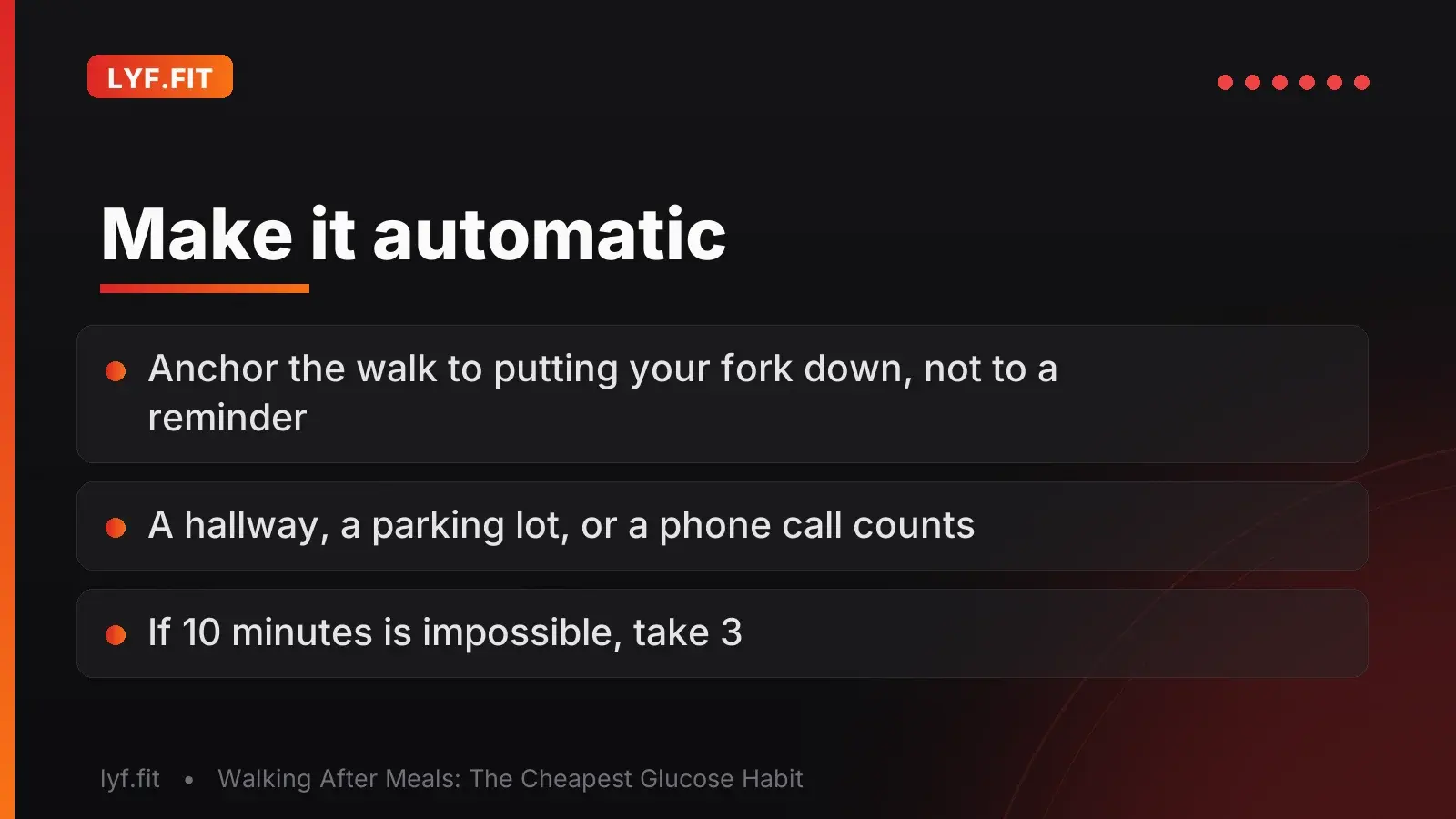
Anchor it to something that already happens rather than to willpower. The trigger is putting your fork down, not a calendar reminder. Ten minutes is short enough that a loop around the block, a lap of a parking lot, or pacing a hallway during a phone call all qualify — and if 10 is impossible, take 3. Pairing it with a glass of water helps, since the walk and the hydration cue reinforce each other; the water tracker is a low-friction way to log both. If you are also trying to understand the meal itself, the calorie converter translates label units, portion sizes, and kilojoules into numbers you can actually compare across foods.
Interactive Tools
Save these contextual tools to your profile for quick access.
Daily Water Tracker
A native utility to track your daily hydration goals effortlessly. Works offline; syncs to your account when you sign in.
Caloric Equivalent Converter
Select popular cheat meals and see exactly how much exercise time is required to burn them off.
Running Pace Calculator
Calculate pace and splits, compare distances, and export a practical race-day pace card.
Frequently asked questions
Walking is what most of the research used, but the mechanism is muscle contraction, not walking specifically. Trials have found similar directional effects from bodyweight squats, calf raises, and stair climbing performed in short bouts after eating. Walking wins on practicality and adherence: it requires no space, no equipment, and no recovery. If mobility is limited, seated calf raises or simply standing are reasonable substitutes — standing alone was associated with about a 9.5% reduction versus prolonged sitting.
Pick dinner. It is usually the largest carbohydrate load, and it is followed by the longest sedentary stretch of the day, which is why the post-dinner window produced the biggest share of the improvement in both the 2013 and 2016 trials. One consistent 10-minute post-dinner walk is almost certainly worth more than three walks you only do on good weeks.
At the intensities studied, this is rarely an issue — light walking is not running, and it does not divert blood flow away from digestion the way hard exercise can. Some people with reflux find that upright movement is more comfortable than reclining after a meal. If you feel unwell, slow down or shorten the bout; there is no requirement to hit a particular duration, and 3 easy minutes still engages the same pathway.
No. Post-meal walks target one narrow outcome — the shape of the glucose curve after eating — and they do it well. They do not build strength, they do a limited amount for cardiorespiratory fitness, and they are not a substitute for resistance training or longer aerobic sessions. Treat them as an addition that costs 10 minutes, not a replacement for anything you are already doing.
The case for walking after meals is unusually clean: a plausible, well-described mechanism, consistent short-term trial data, effectively zero cost, and no realistic downside for most healthy adults. Start with dinner, aim to be moving within 30 minutes of your last bite, and let the duration be whatever you will actually repeat. If you want to pair the habit with better visibility on what you are eating and drinking, start with the calorie converter and the water tracker.
Stop completely guessing.
Use our interactive PWA tools to calculate your exact macros, 1RM, and running pace offline.