


Disclaimer: Some of the links on this page are affiliate links. As an Amazon Associate and affiliate for other networks, we may earn a commission from qualifying purchases at no additional cost to you.
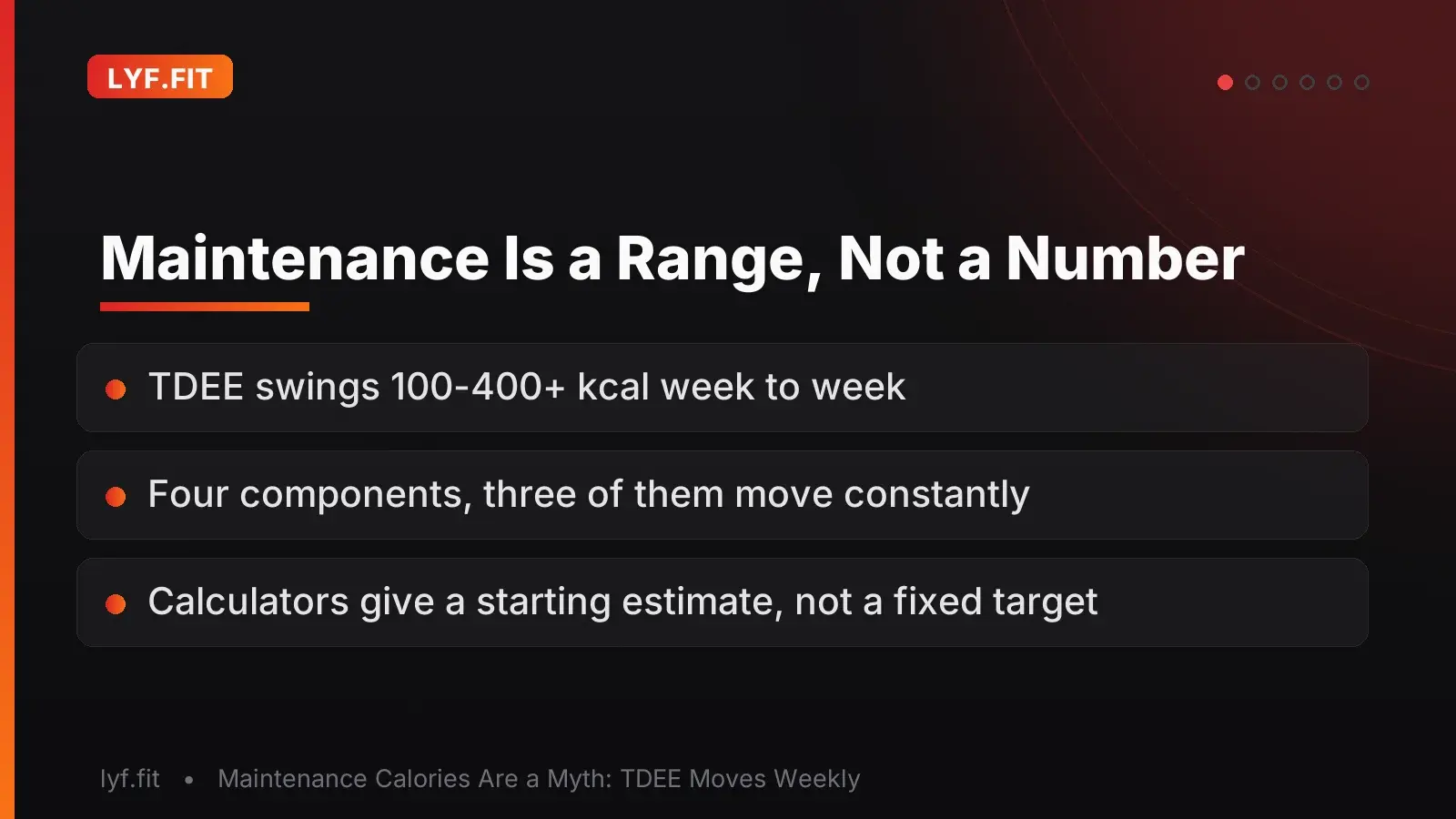
Your "maintenance calories" are not a single number — they are a moving range that shifts 100 to 400+ kcal from one week to the next. Total daily energy expenditure (TDEE) is the sum of four components, and the two largest sources of day-to-day variation, non-exercise activity and adaptive thermogenesis, respond constantly to how much you eat, move, and sleep. The number a calculator hands you is a population-average starting estimate, not a fixed target. The only reliable way to find your true maintenance is to track a 2-to-3-week trailing average of body weight against logged intake and adjust from the trend.
Why isn't TDEE a fixed number?
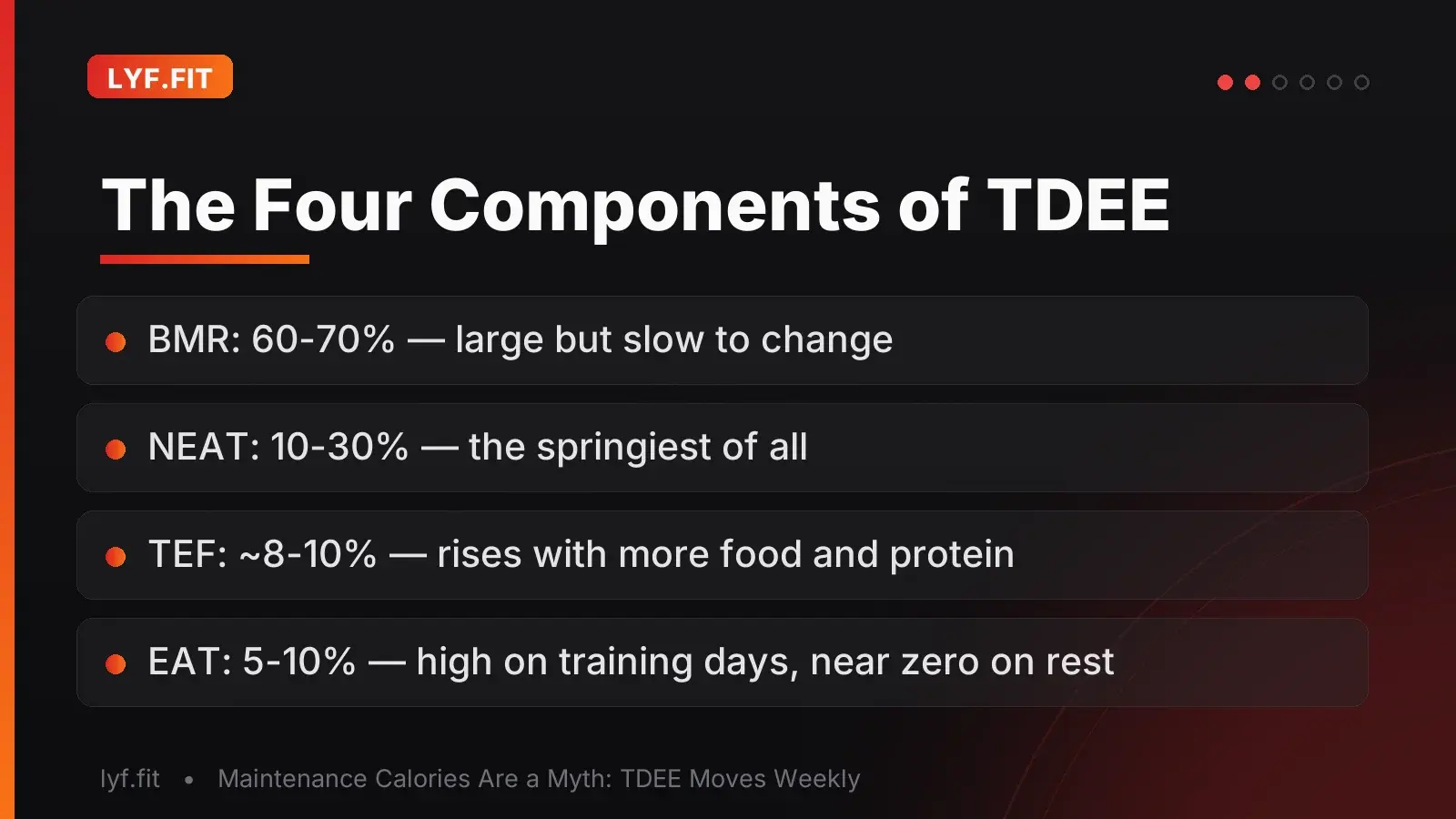
TDEE has four moving parts: basal metabolic rate (BMR), the thermic effect of food (TEF), exercise activity thermogenesis (EAT), and non-exercise activity thermogenesis (NEAT). BMR — the roughly 60-70% you burn keeping organs running — is the most stable, but it is not fixed either: it drifts with body mass, hormones, and dieting history. The other three respond to behavior in real time. Eat more protein and TEF rises; walk more meetings and NEAT climbs; sleep poorly and fidgeting drops. Because three of four components float, the sum floats too. Two people with identical BMRs can post maintenance figures 500 to 800 kcal apart, driven almost entirely by how much they move outside of formal workouts. Treating one calculator output as your permanent maintenance is like reading a single day's temperature as the climate.
What is NEAT and why does it swing so much?
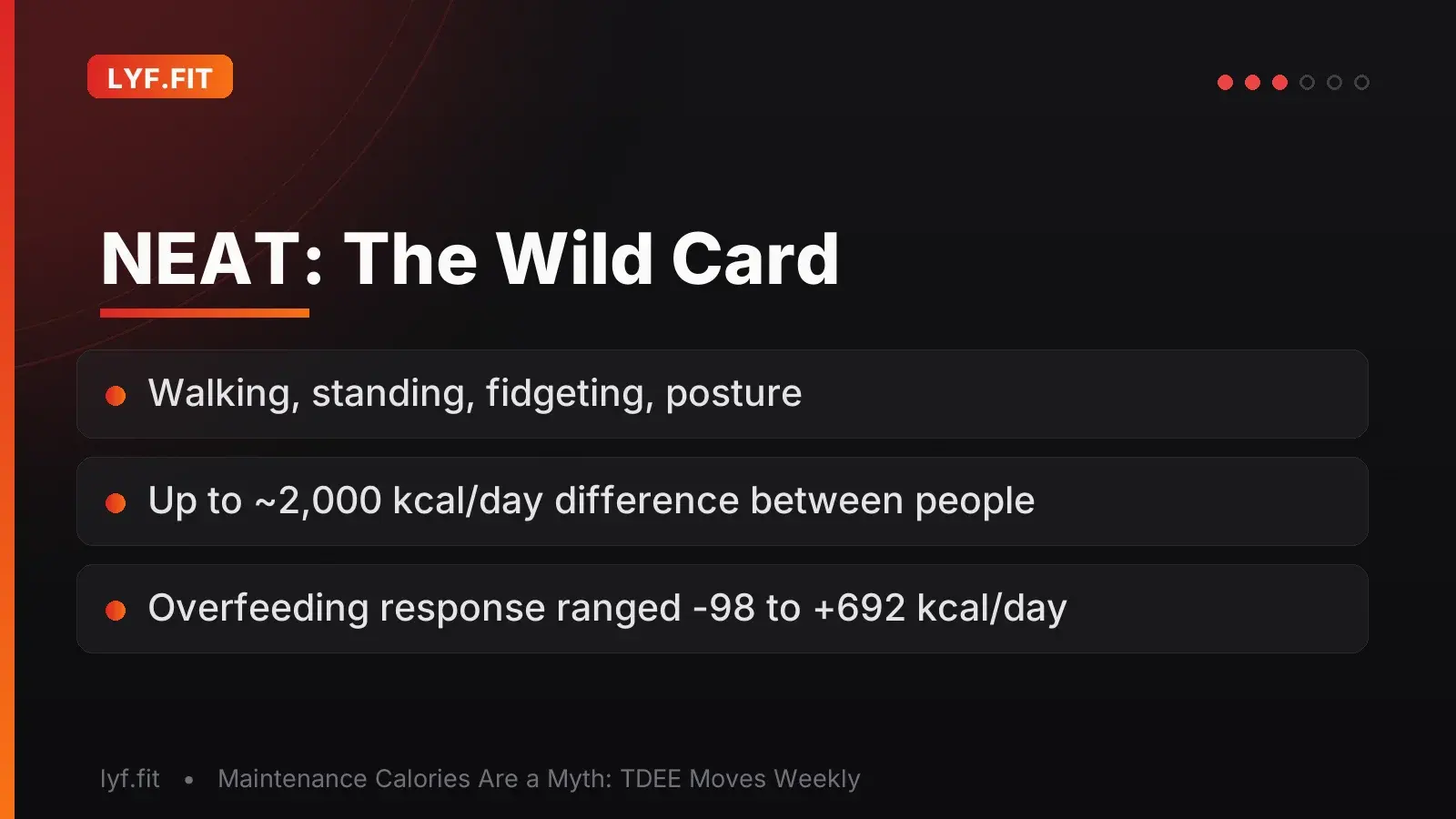
NEAT is everything you burn that isn't sleeping, digesting, or deliberate exercise: walking, standing, fidgeting, posture, gesturing. It is the single most variable component of human energy expenditure. Research from Mayo Clinic physiologist James Levine found NEAT can differ by up to 2,000 kcal per day between two similarly sized people, driven by occupation and lifestyle. It also swings within one person: in a 1999 overfeeding study, 16 adults ate 1,000 extra kcal daily for 8 weeks, and their NEAT response ranged from −98 to +692 kcal per day — an 8-fold spread that predicted who stayed lean. This is also why identical meal plans produce wildly different results across people: the food is controlled, but the involuntary movement burning it off is not. Your own NEAT can quietly rise or fall hundreds of calories week to week without any conscious change.

How much does adaptive thermogenesis lower your burn?
When you diet, your body defends itself by burning fewer calories than your new size predicts — a phenomenon called adaptive thermogenesis or metabolic adaptation. The most cited example: the "Biggest Loser" contestants dropped their resting energy expenditure roughly 500 kcal per day below what their post-diet body composition predicted, and a 2016 follow-up found the suppression persisted six years later, even after weight regain. Most everyday dieters see a smaller effect — typically tens to low-hundreds of kcal — but it is real and it compounds. This is why a deficit that worked in week 2 can stall by week 6: your maintenance floor has moved down toward your intake. Sleep loss and aggressive deficits appear to amplify the adaptation, while diet breaks and refeeds may blunt it. Adaptation is a moving target, not a one-time penalty.
What do the components of TDEE actually contribute?
Not every part of your burn moves equally. BMR is large but slow to change; NEAT is smaller but wildly elastic; TEF and EAT sit in the middle. Understanding which levers actually swing helps you stop obsessing over the stable parts and start managing the variable ones — you cannot consciously raise your BMR much, but you can absolutely walk an extra few thousand steps. The table below shows each component's rough share of TDEE and how much it realistically fluctuates day to day and week to week.
| TDEE component | Rough % of total | How much it varies |
|---|---|---|
| BMR (basal metabolic rate) | 60-70% | Low short-term; drifts with weight, hormones, dieting |
| NEAT (non-exercise activity) | 10-30% | Very high — hundreds of kcal/day, up to ~2,000 between people |
| TEF (thermic effect of food) | ~8-10% | Moderate — rises with more food and more protein |
| EAT (exercise activity) | 5-10% (20%+ in athletes) | High on training days, near zero on rest days |
Why does the scale lie week to week?
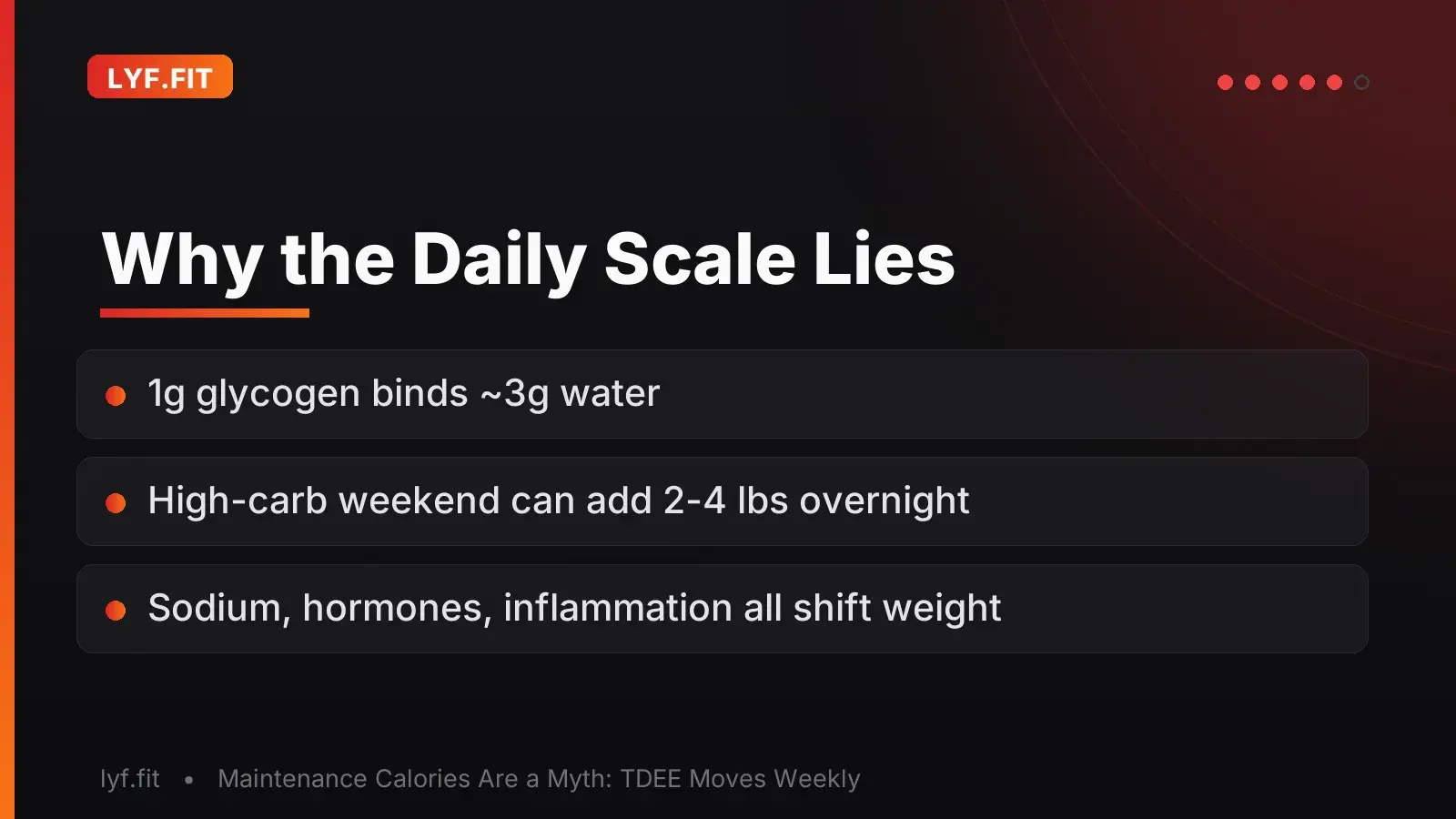
Even if your true energy balance were perfectly stable, the scale would still bounce, because most short-term weight change is water, not fat. Each gram of stored glycogen binds roughly 3 grams of water, so a high-carb weekend can add 2-4 lbs overnight with zero fat gain. Sodium, menstrual-cycle hormones, undigested food, and post-workout inflammation all shift scale weight by pounds within a day. Women often see the clearest example mid-cycle, when fluid retention can mask two full weeks of genuine fat loss. A single morning weigh-in tells you almost nothing about fat trajectory. This noise is exactly why a same-day comparison between the scale and yesterday's calories is meaningless — you need to average across the fluctuations before any signal appears.
How do you find your real maintenance range?
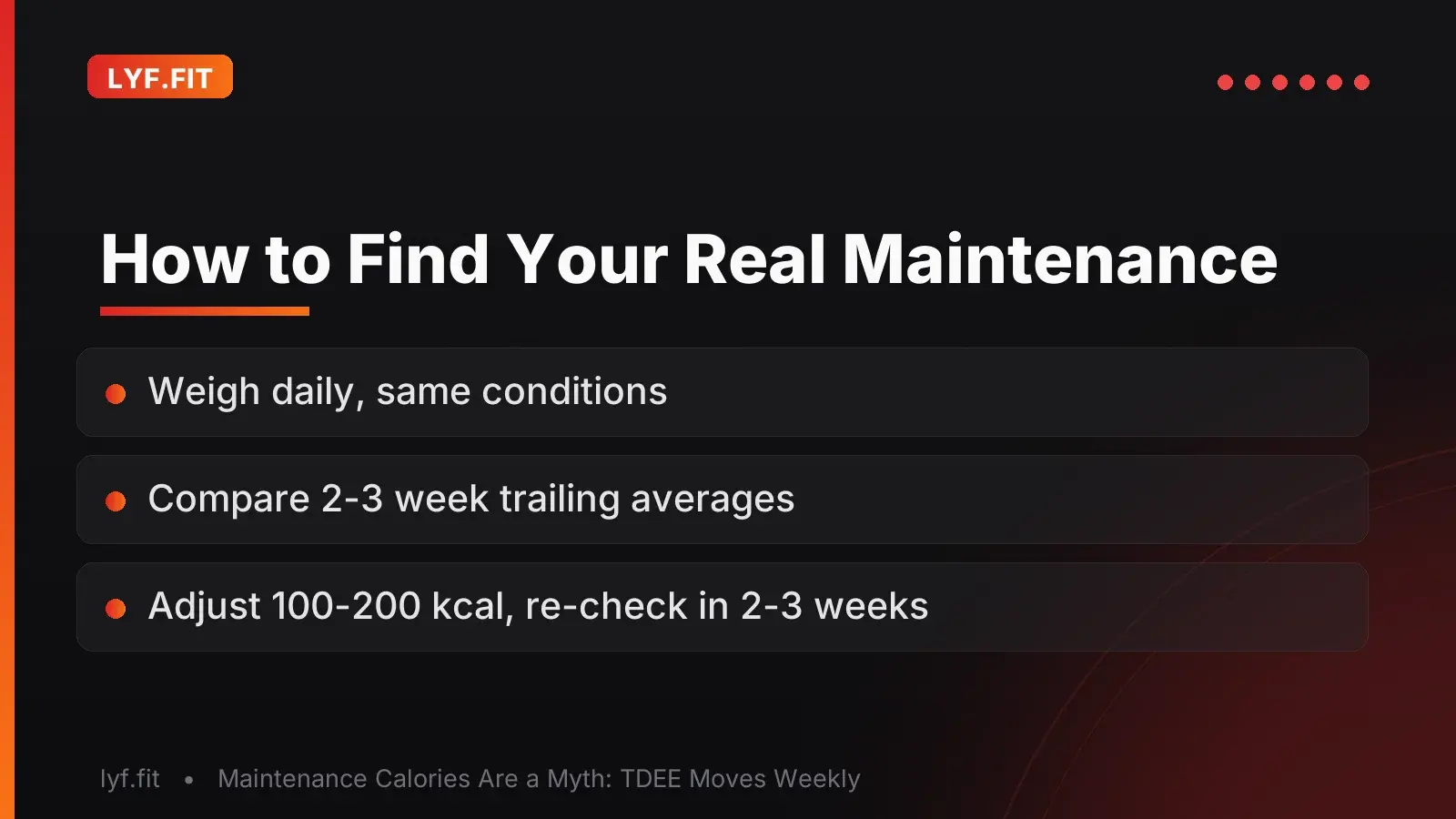
Stop chasing a number and start reading a trend. Weigh yourself daily under the same conditions — morning, post-bathroom, pre-food — and log intake honestly, then compare 2-to-3-week rolling averages, not single days. If your trailing-average weight is flat, that average intake is your current maintenance. If it drifts up or down, adjust intake by 100-200 kcal and re-check after another 2-3 weeks. One practical guardrail: never adjust on the strength of a single alarming or encouraging weigh-in — give any change a full 14-to-21-day window before judging it, because that is roughly how long water and glycogen shifts take to wash out of the average. Think of maintenance as a band 200-400 kcal wide, not a line. The trend is the truth; the daily number is noise you average out.
Test Your Knowledge
1 / 4Which TDEE component is the most variable day to day?
Interactive Tools
Save these contextual tools to your profile for quick access.
Frequently asked questions
No — it's a starting estimate, not a verdict. Population-based equations get most people within a few hundred calories, which is enough to begin. Use the TDEE calculator to set an initial intake, then let 2-3 weeks of real weight and food data correct it. The calculator gives you the launch point; the trailing average gives you the truth.
For most people, maintenance is a band roughly 200-400 kcal wide rather than a single number, because NEAT and adaptive thermogenesis shift week to week. On high-activity, high-food weeks your maintenance climbs; on sedentary, low-sleep weeks it drops. Aim to keep your trailing-average weight flat within that band rather than hitting an exact calorie figure.
Re-check every 2-3 weeks, and re-estimate more formally after any 5-10 lb change in body weight. As you lose fat, BMR falls and adaptive thermogenesis can lower the range further; as you gain, it rises. Logging intake in a tool like the macro diary alongside daily weigh-ins makes each re-check fast and objective.
Modestly, yes. Protein has the highest thermic effect of any macronutrient — roughly 20-30% of its calories are burned during digestion, versus 5-10% for carbs and 0-3% for fat. Shifting calories toward protein can nudge TEF upward by a meaningful amount over a day, which is one reason higher-protein diets tend to make fat loss feel easier.
Maintenance calories are best understood as a living range that your body renegotiates every week through NEAT, adaptation, and water shifts. Anchor to the 2-3 week trend, not the daily scale or a static calculator output. Set your starting point with the TDEE calculator, track intake honestly in the macro diary, and let the rolling average tell you where your real maintenance lives today. Consult a physician before making significant dietary changes.
Stop completely guessing.
Use our interactive PWA tools to calculate your exact macros, 1RM, and running pace offline.