

Disclaimer: Some of the links on this page are affiliate links. As an Amazon Associate and affiliate for other networks, we may earn a commission from qualifying purchases at no additional cost to you.
After 40, preserving muscle becomes increasingly important during weight loss. Calorie restriction can reduce lean tissue, while resistance training and adequate protein help limit that loss; research in older adults also shows a smaller muscle-protein-synthesis response to a given protein dose. The practical approach is a gradual cut — roughly 0.5-1 percent of body weight per week for resistance-trained adults — with enough protein and lifting as the anchor.
Why does the same deficit cost more muscle at 45 than 25?
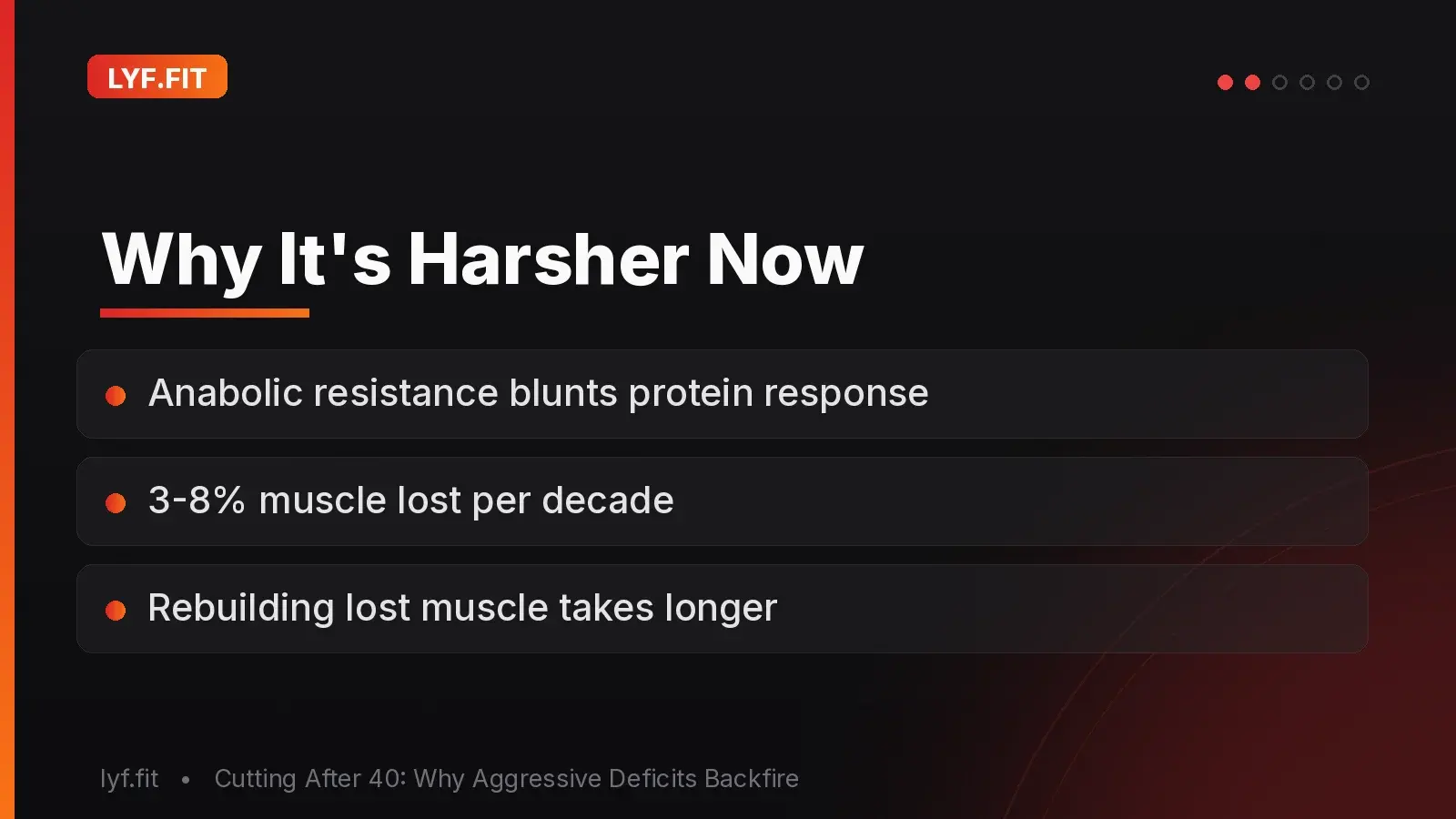
Three age-related shifts can stack against crash dieting. First, anabolic resistance: a pooled analysis in healthy older and younger men estimated that muscle protein synthesis plateaued after about 0.40 g/kg per meal in the older group versus 0.24 g/kg in the younger group. Those estimates are useful context, not a universal prescription, but they support taking protein intake seriously during a cut.
Second, recovery capacity varies more with training history, sleep, health, and life stress as people age. A large deficit layered onto frequent hard training can make it harder to maintain training quality. Third, regaining lost lean mass takes time, so protecting it during weight loss is generally more efficient than trying to rebuild it afterward.
What does an aggressive deficit actually do to body composition?
The composition of weight lost depends heavily on deficit size, protein intake, starting body composition, and training. In older adults with obesity, a systematic review found that resistance training substantially reduced calorie-restriction-related lean-mass loss while preserving fat loss. That does not guarantee zero muscle loss for every person, but it makes lifting one of the strongest available safeguards.
Losing lean tissue can reduce daily energy expenditure, on top of the adaptive changes that occur during weight loss. Appetite can also remain elevated after a substantial loss. In one study of 50 adults with overweight or obesity who completed a 10-week very-low-energy diet, several appetite-related hormones and subjective hunger remained altered at the 62-week follow-up. That specific population and intervention do not prove that every moderate cut produces the same response, but they are another reason to avoid treating faster loss as automatically better.
Slide 1 of 6

How fast should you cut after 40?
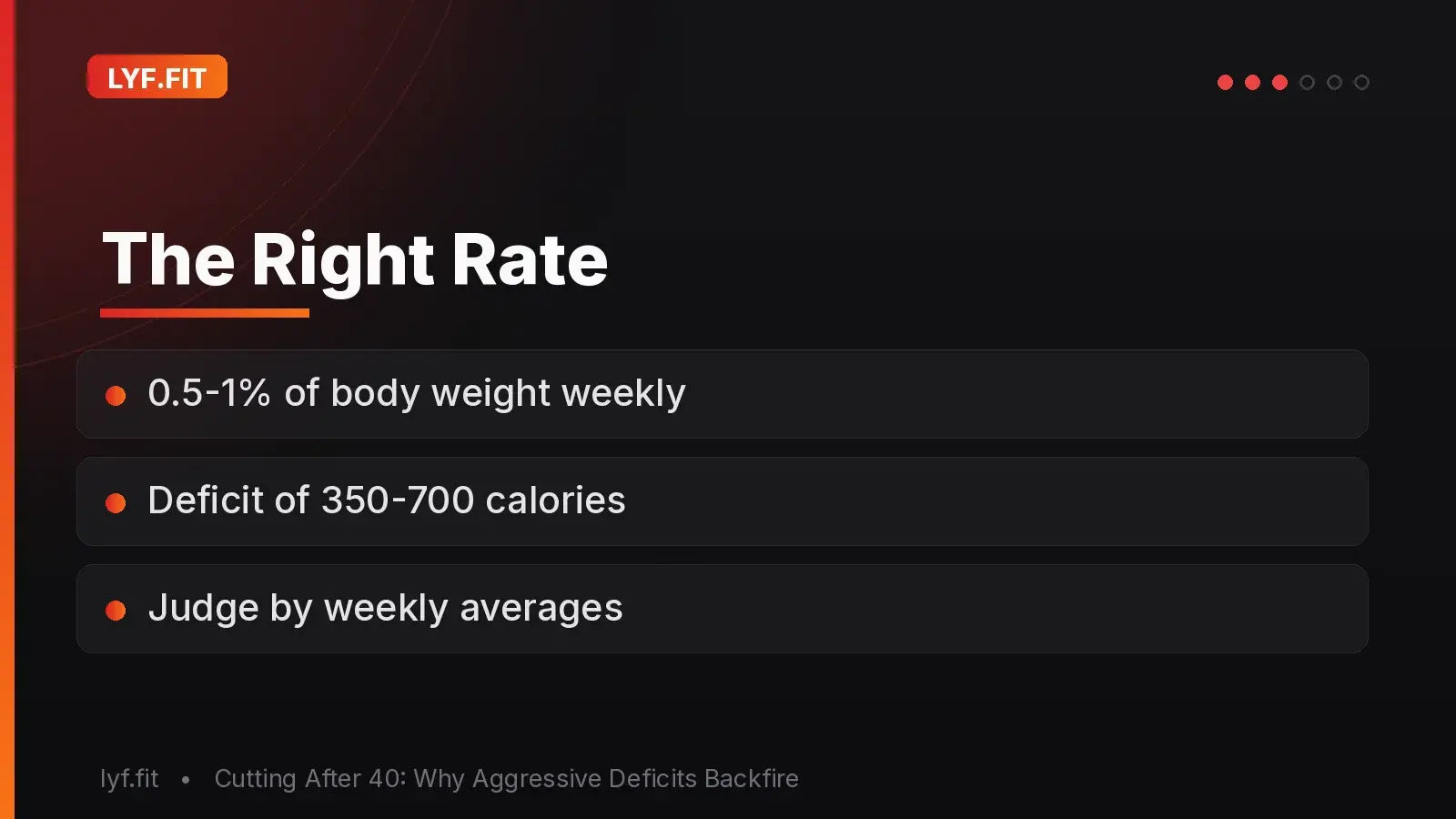
A narrative review focused on resistance-trained athletes recommends targeting 0.5-1 percent of body weight per week to help retain fat-free mass — for a 200 lb lifter, roughly 1-2 lbs. That is a starting range, not a guarantee; medical history, starting body composition, training, and adherence all change the outcome.
| Larger, faster deficit | More moderate deficit | |
|---|---|---|
| Scale trend | Usually faster, with more day-to-day variability | Usually slower and easier to evaluate over several weeks |
| Lean-mass risk | More concerning when protein or resistance training is inadequate | Generally easier to pair with muscle-retention habits |
| Training quality | More likely to be disrupted as recovery demand rises | More likely to remain workable, though individual responses vary |
| Metabolic adaptation | Still occurs and may be more pronounced with greater total loss | Still occurs; no approach eliminates adaptation |
| Adherence | Often harder because hunger and fatigue can rise | Often easier to sustain, but preference and context matter |
Start by estimating maintenance with the TDEE calculator, choose an intake aimed at the weekly range above, and judge the trend from weekly averages across multiple weeks rather than any single morning. Adjust gradually if the trend, training performance, or recovery says the initial estimate was wrong.
Where is the protein floor?
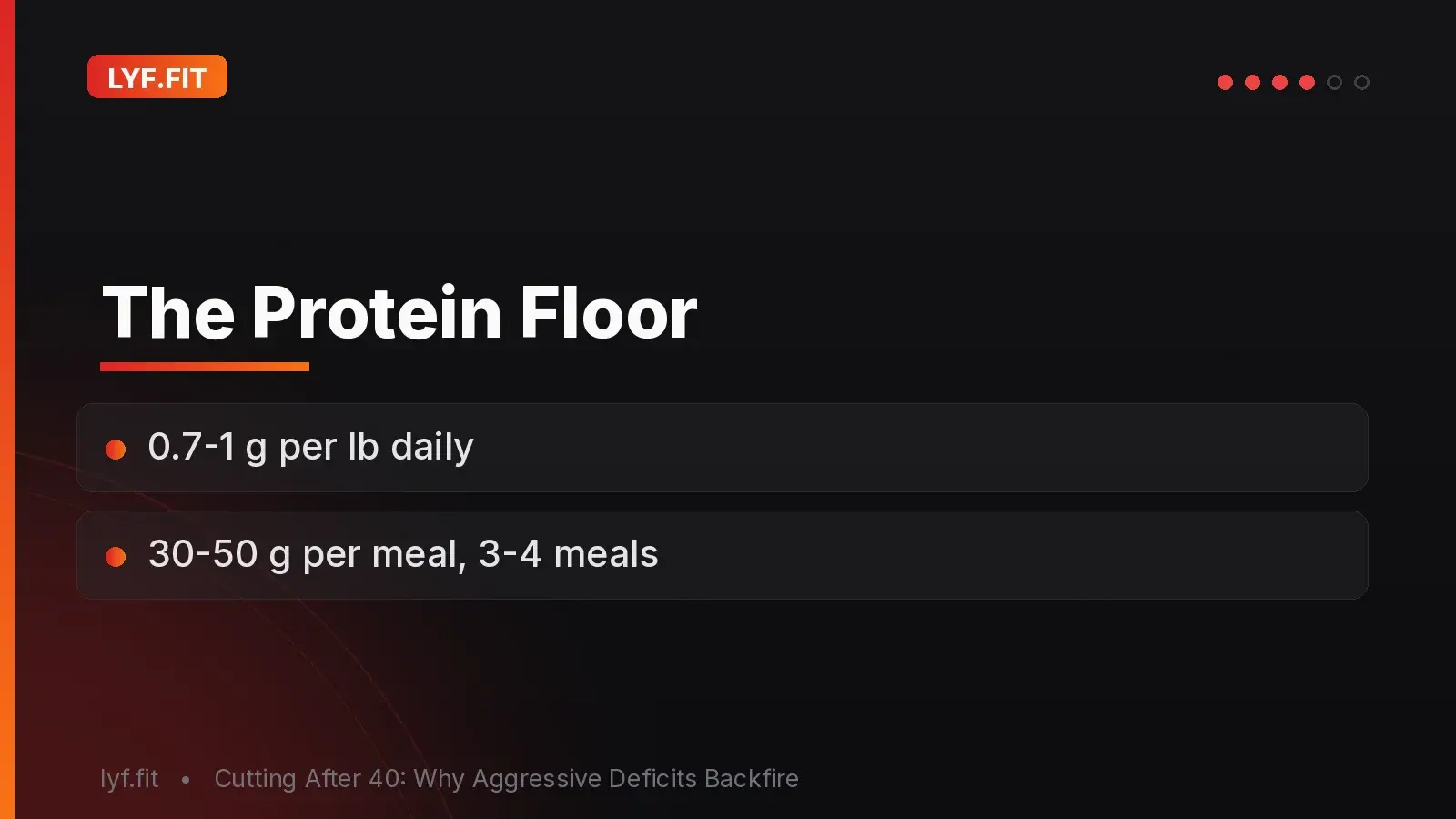
For healthy adults who lift, roughly 0.7 g per pound of body weight per day (about 1.6 g/kg) is a defensible baseline: a large meta-analysis found no additional resistance-training-related fat-free-mass gain beyond about 1.62 g/kg/day. A calorie deficit or individual diet may justify more, but more is not automatically better, and people with kidney disease or other relevant conditions should get individualized guidance.
Distribution matters more with age because of the per-meal anabolic threshold. Three to four meals of 30-50 g each clears the roughly 0.4 g/kg trigger better than a protein-light day rescued by a giant dinner — the same logic covered in our look at protein timing. Whole foods first; a whey shake is simply the cheapest way to make a 40 g meal happen on a workday.
Optimum Nutrition Gold Standard 100% Whey Sponsored
Hitting a 0.7-1 g/lb protein floor in a calorie deficit is the hard part of cutting after 40 — 24 g per ~120-calorie scoop makes the math workable.
Do diet breaks actually work?
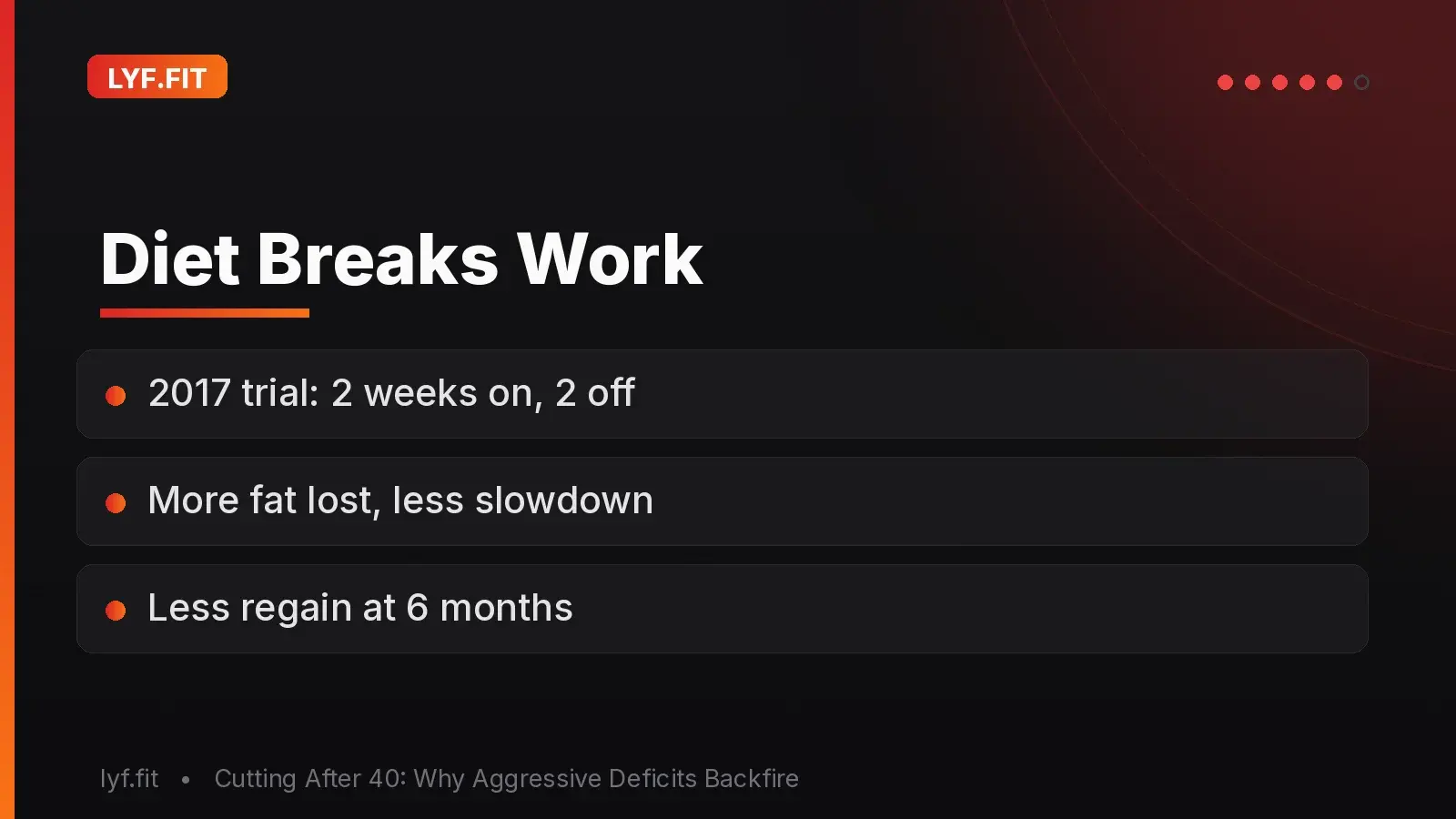
The best-known test is the 2017 Australian MATADOR trial, which compared 16 straight weeks of dieting against the same 16 weeks delivered in 2-week deficit blocks separated by 2-week maintenance periods. In the study's men with obesity, the intermittent group lost more weight and fat, showed less reduction in resting energy expenditure, and regained less weight at six-month follow-up.
The practical translation is more modest than "diet breaks always work": planned maintenance periods can make a long cut easier to sustain, but one trial in men with obesity does not establish an ideal schedule for everyone. If you use them, treat them as controlled maintenance rather than a cheat period, and recalculate your TDEE as body weight changes.
Test Your Knowledge
1 / 4What is 'anabolic resistance' in adults over 40?
What does the non-negotiable training look like?
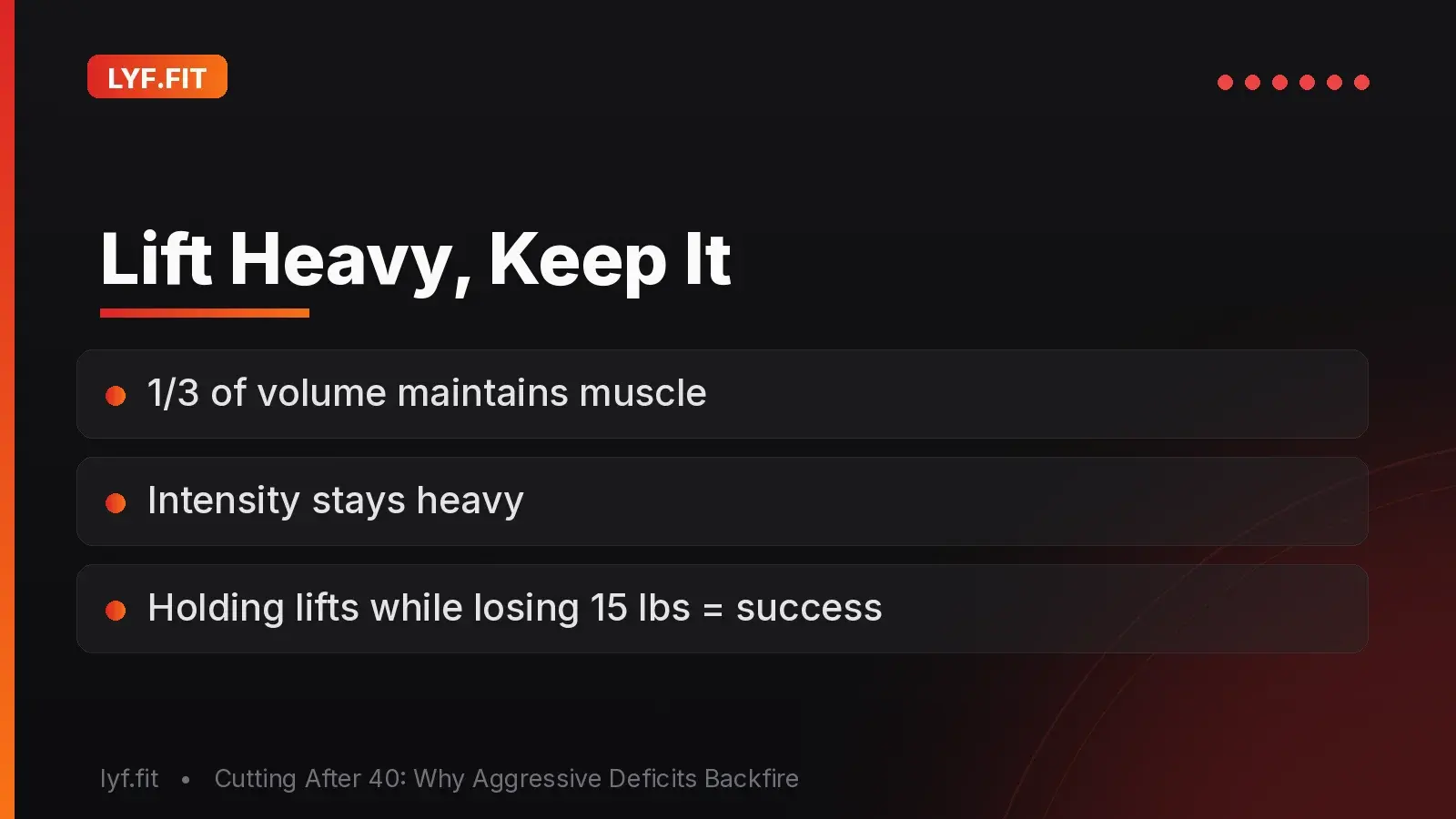
Resistance training provides a reason for the body to retain muscle during weight loss. Keep the work challenging enough to preserve strength and reduce volume only as recovery requires; there is no universal "one-third of normal volume" rule that fits every age or training history. Two or three well-designed full-body sessions can be a practical setup, but the right schedule is the one that preserves useful loading without outrunning recovery.
Resist the instinct to convert every lifting session into cardio as the deficit deepens. Easy aerobic work and daily movement can add expenditure while resistance training keeps its muscle-retention role. Expecting to maintain rather than constantly set personal records is reasonable during a cut, as our guide to training after 40 explains. If several lifts keep sliding, reassess sleep, food intake, exercise selection, and total training stress before blaming age.
Interactive Tools
Save these contextual tools to your profile for quick access.
Body Fat Estimator
Calculate your estimated body fat percentage using the accurate U.S. Navy Method formula.
TDEE & Macro Calculator
Calculate your Total Daily Energy Expenditure and get custom macronutrient targets for your goals.
Daily Macro Diary
A daily log to track your protein, carbs, and fats. Data stays on your device; syncs to your account when you sign in.
Frequently asked questions
Research on anabolic resistance points to roughly 0.4 g per kg of body weight per meal to maximize muscle protein synthesis in older adults — about 35-40 g for a 200 lb person, spread across 3-4 meals daily. Leucine-rich sources (meat, dairy, eggs, whey) clear the threshold most easily. Total daily intake still matters most; per-meal distribution is the refinement, not the foundation.
If you're new or returning to lifting, recomposition — eating near maintenance with high protein while training hard — often delivers visible change without a formal deficit, and our body recomposition guide covers the setup. Established lifters carrying genuinely excess fat do better with a deliberate moderate cut, because recomp slows dramatically as training age rises.
Age-related physiology can influence body composition and recovery, but a difficult cut does not by itself diagnose a hormone problem. Protein intake, training consistency, sleep, medications, health conditions, and deficit size can all matter. Anyone with persistent fatigue, libido changes, or unexplained body-composition changes should discuss them with a qualified clinician rather than self-diagnosing from a diet response.
The short, boring list: creatine monohydrate (3-5 g daily) has the strongest evidence for preserving strength and lean mass, whey or another protein powder helps you reach the protein floor cheaply, and vitamin D if you're deficient. Most "cutting" supplements are thermogenic stimulants with trivial effect sizes. Our rundown of supplements for fighting muscle loss during a cut grades the options.
A successful cut after 40 is defined by what you keep, not just what you lose. Set a moderate deficit from your real maintenance number with the TDEE calculator, enforce the protein floor with the macro diary, and track tape measurements in the body fat calculator so progress shows up even in weeks the scale sulks.
Stop completely guessing.
Use our interactive PWA tools to calculate your exact macros, 1RM, and running pace offline.
Sources
- Protein ingestion to stimulate myofibrillar protein synthesis requires greater relative protein intakes in healthy older versus younger men
- Achieving an Optimal Fat Loss Phase in Resistance-Trained Athletes: A Narrative Review
- A systematic review, meta-analysis and meta-regression of the effect of protein supplementation on resistance training-induced gains in muscle mass and strength in healthy adults
- Resistance Training Prevents Muscle Loss Induced by Caloric Restriction in Obese Elderly Individuals: A Systematic Review and Meta-Analysis
- Intermittent energy restriction improves weight loss efficiency in obese men: the MATADOR study
- Long-term persistence of hormonal adaptations to weight loss