

Disclaimer: Some of the links on this page are affiliate links. As an Amazon Associate and affiliate for other networks, we may earn a commission from qualifying purchases at no additional cost to you.
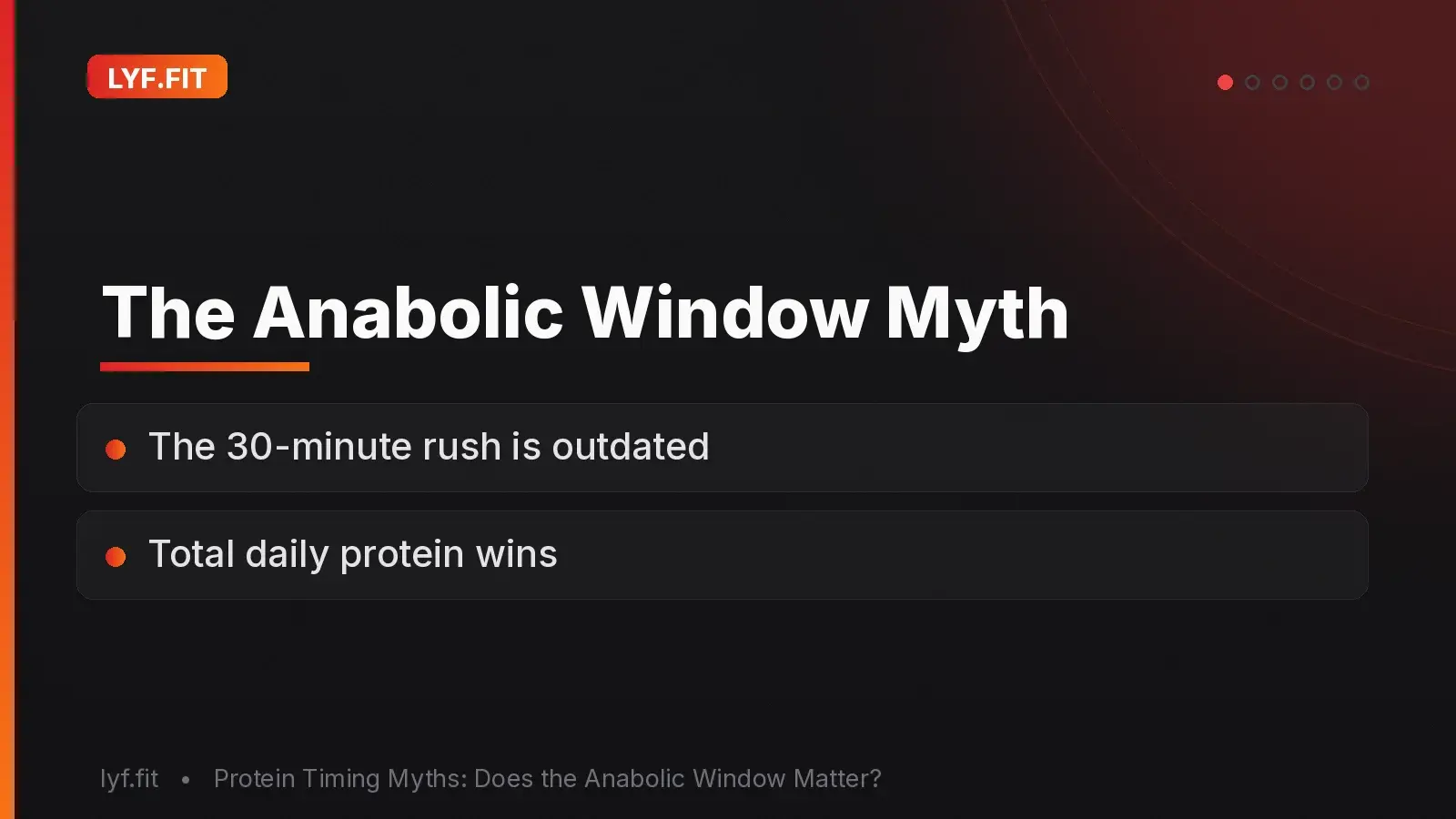
For most lifters, the post-workout "anabolic window" is far wider than the old 30-minute rule suggested. Research indicates that total daily protein intake is the strongest predictor of muscle growth, and the practical window for a post-workout meal stretches several hours, not minutes. Timing still matters at the margins, but it is the tiebreaker, not the main event.
Does the anabolic window actually matter?
The "anabolic window" is the idea that you must consume protein within roughly 30 to 60 minutes after training or forfeit your gains. The evidence does not support that urgency. A frequently cited 2013 meta-analysis found that once total daily protein was accounted for, the specific timing of intake around a workout had a limited independent effect on hypertrophy and strength. Total protein was the dominant variable.
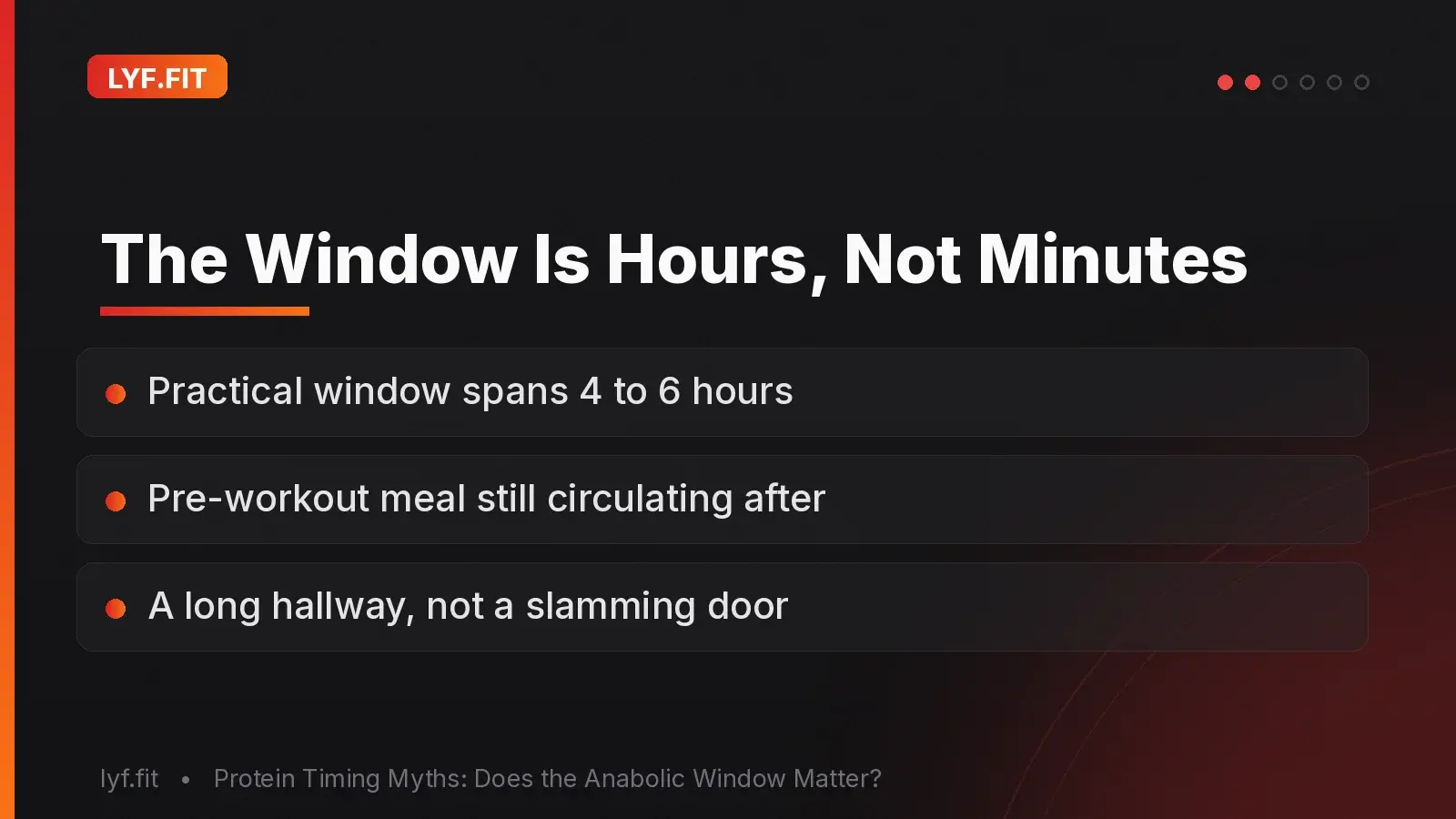
A companion review reframed the window as potentially 4 to 6 hours wide, depending on the size and composition of your last meal. If you ate a protein-containing meal a couple of hours before lifting, amino acids are still circulating during and after your session. The "window" is less a slamming door and more a long hallway.
What actually drives muscle growth?
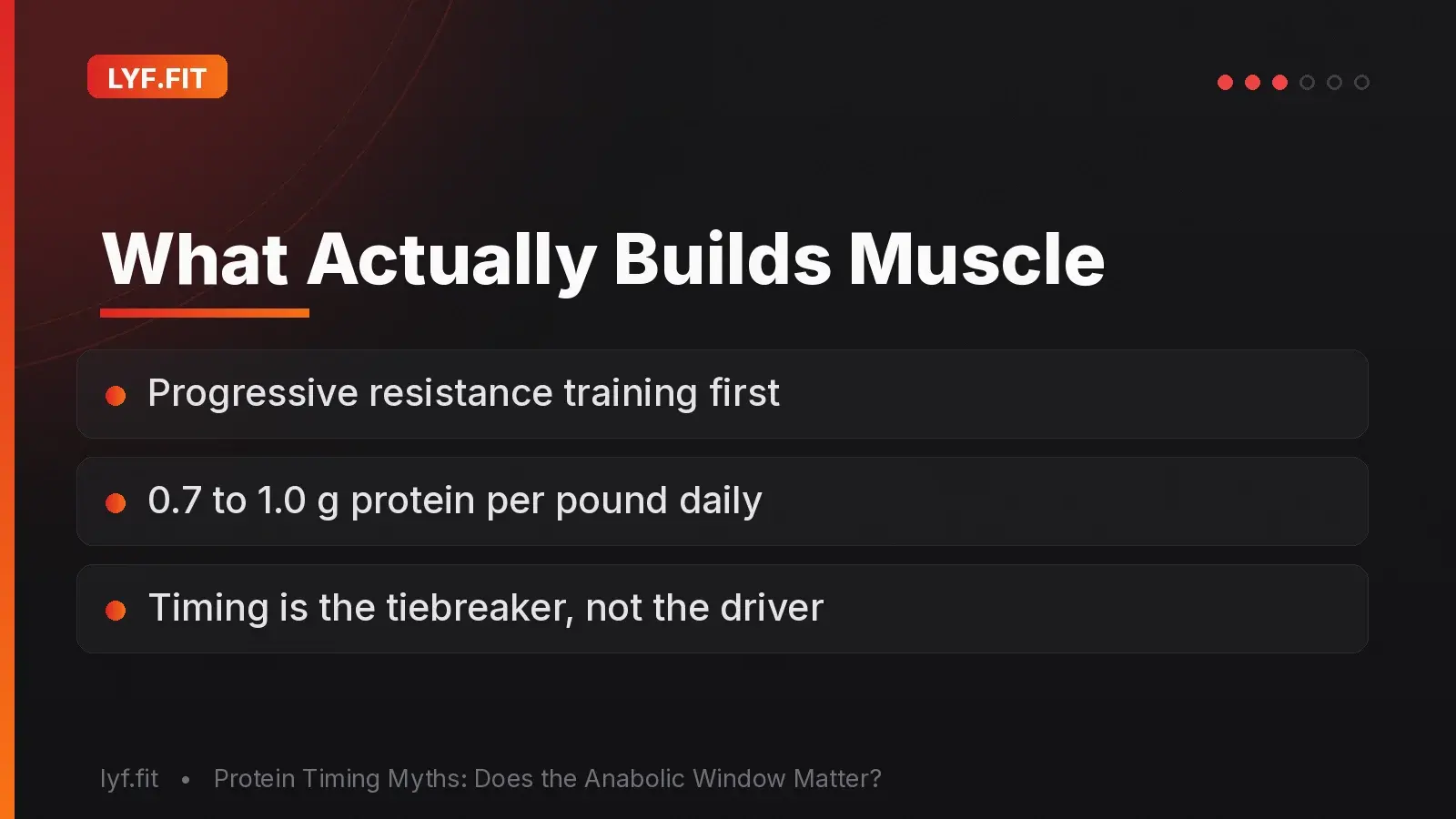
Muscle is built when daily muscle protein synthesis (MPS) outpaces breakdown over weeks and months. The biggest levers are progressive resistance training and hitting a daily protein target, generally 0.7 to 1.0 grams per pound of body weight (roughly 1.6 to 2.2 g/kg) for people training to build or retain muscle. A 175-lb lifter lands around 120 to 175 grams per day.
Timing operates a full tier below that. If your total intake and training are dialed in, shuffling when those grams arrive produces small effects. If your total is too low, no amount of clever timing rescues it. This is why total-intake tools like our TDEE calculator and a simple macro diary move the needle more than a stopwatch by the shaker bottle. For the mechanism behind why training is the primary trigger, see our breakdown of muscle hypertrophy.
Slide 1 of 6
How much protein can you use in one meal?
The old belief that the body "wastes" anything over 20 to 30 grams per meal is outdated. While per-meal MPS does appear to plateau, eating larger boluses still supports muscle through prolonged amino acid availability and reduced breakdown. The more useful concept is the leucine threshold: the amount of the amino acid leucine in a meal needed to maximally switch on MPS.
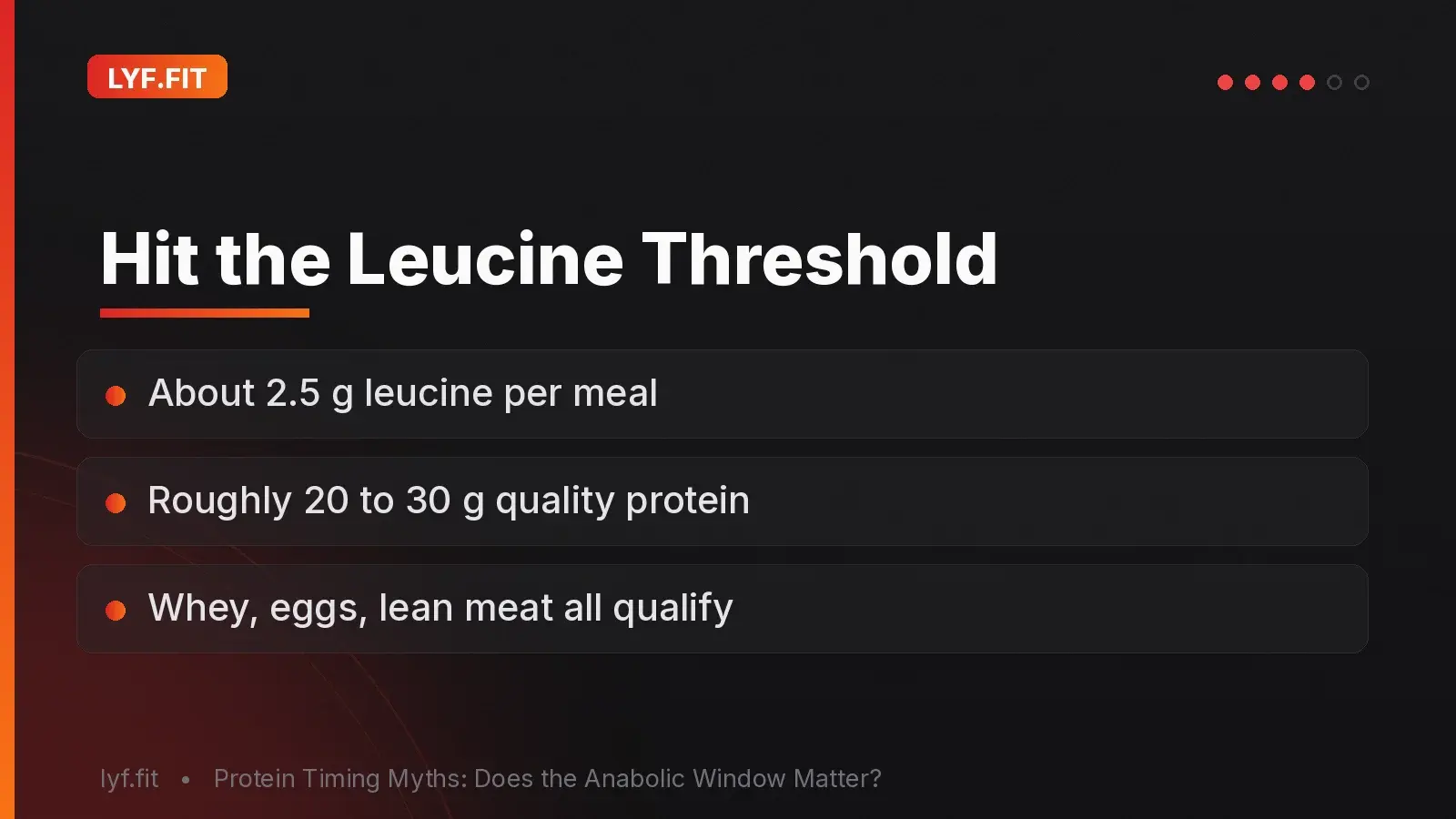
That threshold sits around 2.5 grams of leucine for younger adults, which maps to roughly 20 to 30 grams of a high-quality protein like whey, eggs, or lean meat. Hitting it at each meal is more productive than obsessing over a post-workout deadline.
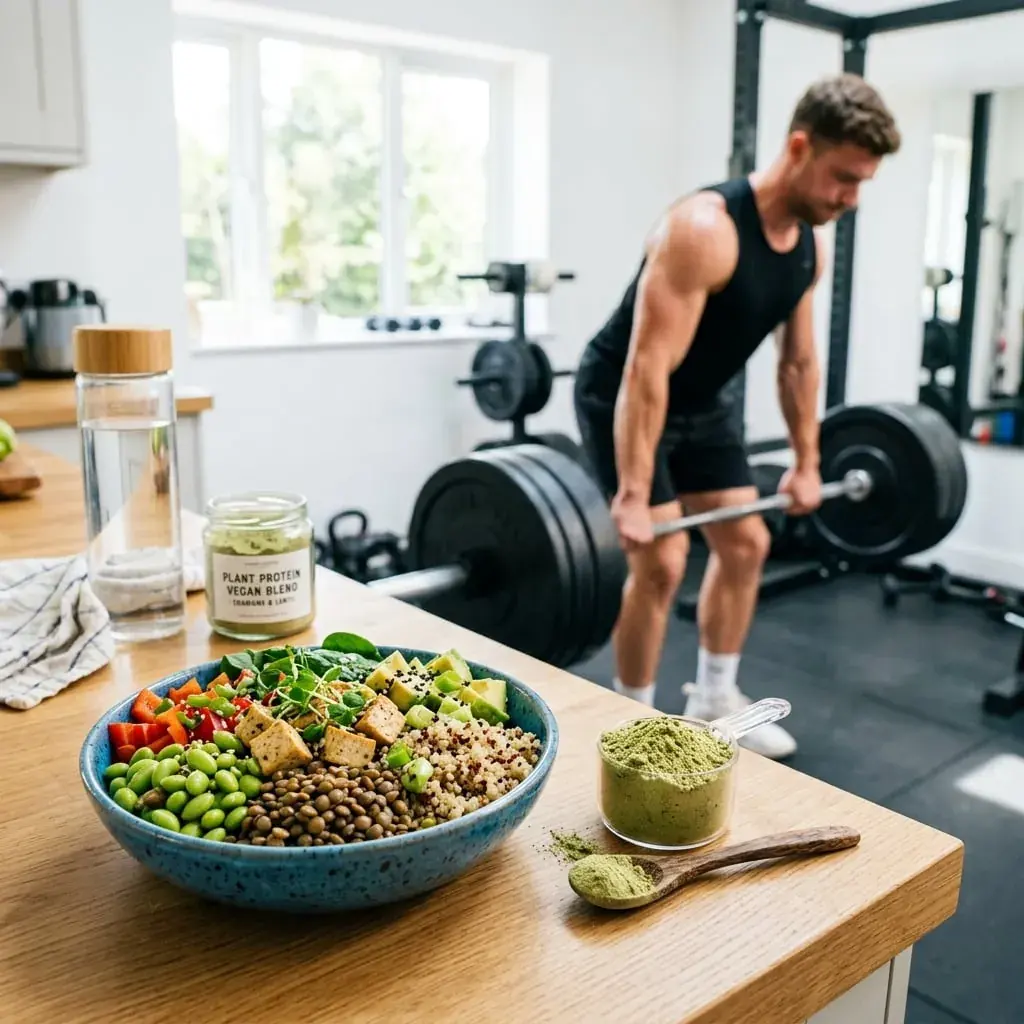
Protein quality matters here too. Animal proteins, whey, and soy carry a higher leucine fraction than most plant sources, so a plant-based eater may need a slightly larger portion to clear the same threshold. That is a solvable problem, not a barrier, and combining sources across a meal closes the gap. If you train fasted or eat lighter early in the day, the fix is rarely a faster post-workout shake; it is a more protein-forward breakfast and lunch so no single meal has to do all the work.
Why distribution beats a single mega-dose
Because each meal that crosses the leucine threshold triggers a fresh MPS spike, spreading protein across the day generally beats skewing it all into dinner. Consider 100 grams of protein eaten two ways:
| Pattern | Meals crossing leucine threshold | 24-hour MPS outcome |
|---|---|---|
| 15 g breakfast / 85 g dinner | One, maybe two | Lower net synthesis; much of the dinner bolus exceeds what one meal can use |
| 30 / 30 / 30 / 10 across the day | Three | Higher net synthesis; more frequent MPS spikes |
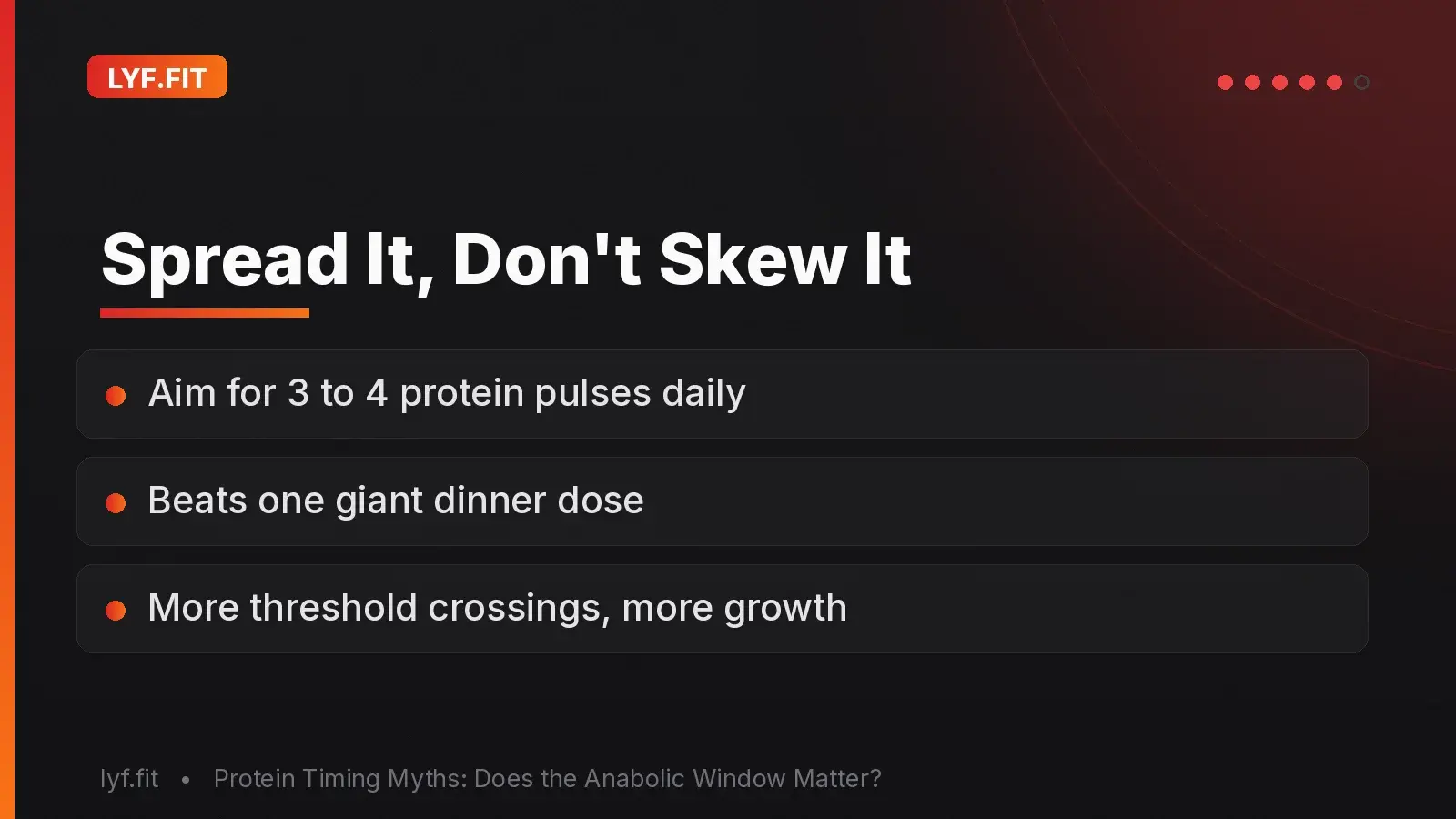
Research on protein distribution suggests 3 to 4 protein "pulses" of 0.25 to 0.4 g/kg each maintain a higher 24-hour anabolic state than one large dose. For most people, that is the single most actionable "timing" lesson, and it has nothing to do with the post-workout window.
To make it concrete, a 175-lb lifter aiming for roughly 150 grams a day might land on about 40 grams at breakfast, 40 at lunch, 40 at dinner, and a 30-gram snack or pre-bed serving. Each of those four meals clears the leucine threshold, nudging synthesis upward four separate times instead of once — the same daily total simply doing more work by being spread out.
Does timing change after 40?
This is where timing earns back some respect. Older muscle exhibits anabolic resistance, meaning it responds less efficiently to a given dose of protein. Studies suggest adults over 60 may need closer to 3 grams of leucine, around 30 to 40 grams of protein per meal, to fully stimulate MPS, roughly 25 to 40 percent more than younger adults need.
For trainees over 40, the takeaways are practical: prioritize hitting a higher per-meal protein floor, lean on leucine-rich complete proteins, and do not let breakfast be a token 10-gram afterthought. The distribution principle becomes more important, not less. Pairing each higher-protein meal with resistance training also helps, because exercise itself sensitizes aging muscle to the amino acids you feed it. Our guide to fitness over 40 covers how recovery and training adapt alongside nutrition.
Optimum Nutrition Gold Standard 100% Whey Sponsored
A fast-digesting whey delivers roughly 24 g protein and over 2.5 g leucine per scoop, an easy way to clear the threshold at any meal.
So when should you eat protein around training?
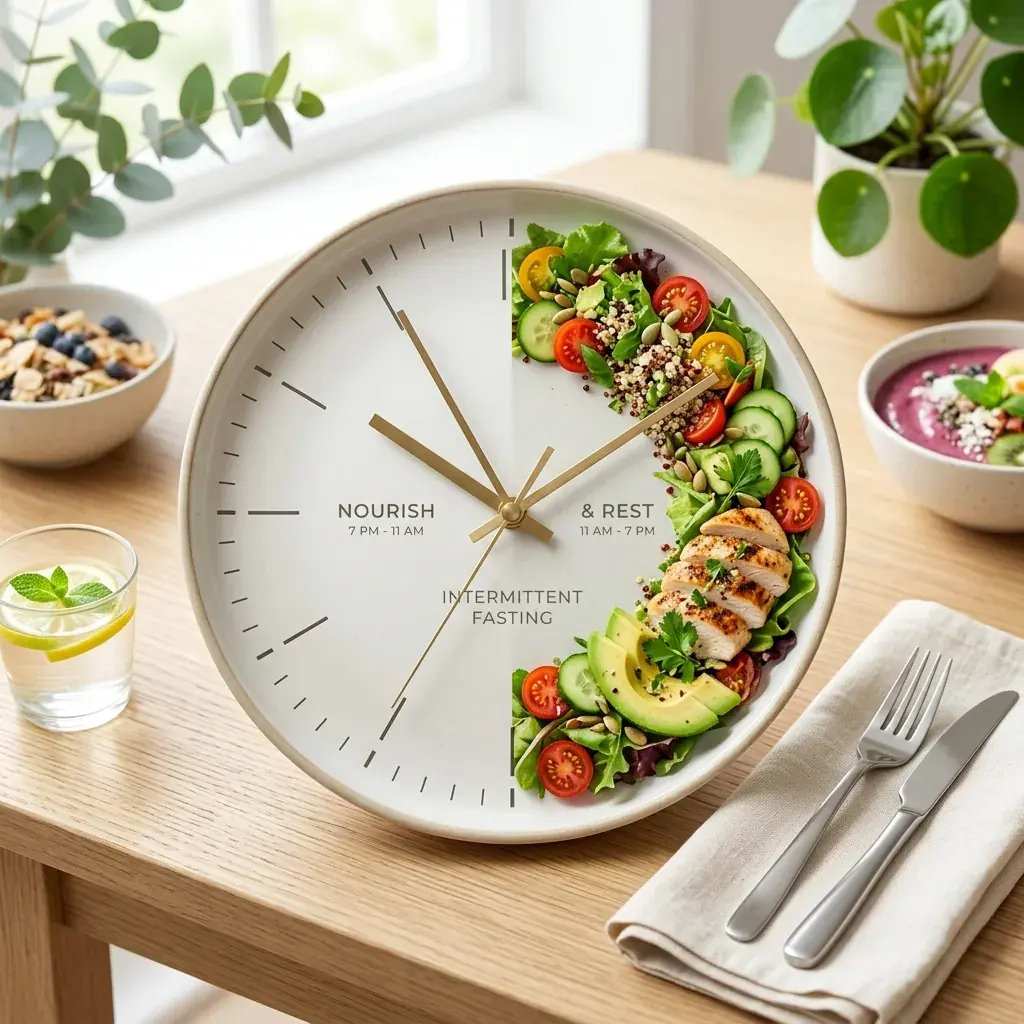
A sensible, evidence-aligned approach: eat a protein-containing meal within a few hours on either side of your workout, and do not train fully fasted for hours if muscle gain is the goal. If you lifted fasted in the morning, having protein reasonably soon afterward is reasonable, not because a window is closing, but because you are simply starting the day's intake. Beyond that, focus your energy on total daily grams and even distribution.
Test Your Protein Timing Knowledge
1 / 4What is the strongest predictor of muscle hypertrophy from the research?
The bottom line on protein timing
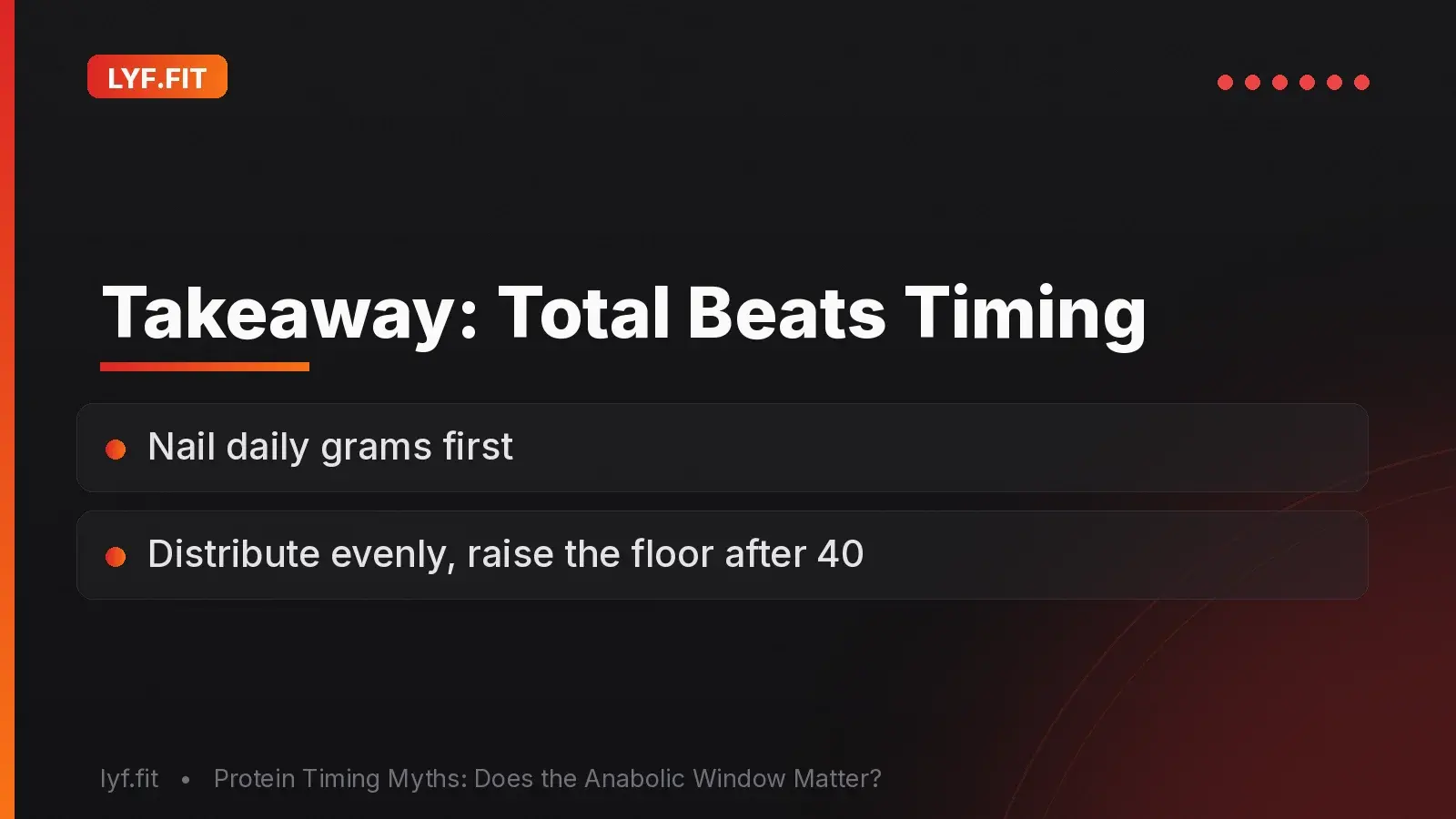
The anabolic window is real but generous. Nail your total daily protein first, distribute it across 3 to 4 meals that each clear the leucine threshold, and only then worry about training-adjacent timing. After 40, raise your per-meal floor. The clock is a footnote; the daily total is the headline.
Frequently asked questions
Not urgently. If you have eaten protein within a few hours of training, the practical window stays open for hours afterward. A post-workout shake is a convenient way to add to your daily total, but its timing is not magic. Prioritize hitting your overall daily protein goal first.
You absorb essentially all the protein you eat; the relevant idea is the leucine threshold for maximally stimulating muscle protein synthesis, around 2.5 grams of leucine, or 20 to 30 grams of quality protein, in younger adults. Larger meals still support muscle through prolonged amino acid availability, so a big dinner is not "wasted."
A pre-sleep protein feeding of 30 to 40 grams, especially slower-digesting sources like casein or dairy, can support overnight muscle protein synthesis and helps some people hit their daily total. It is a useful distribution tool rather than a mandatory ritual.
No. Branched-chain amino acids provide leucine but lack the full spectrum of amino acids needed to build muscle tissue, so complete protein sources outperform them. We cover this in detail in our BCAA guide.
Protein timing is a tiebreaker, not the main event. Lock in your daily target, spread it evenly, and let the obsession over the post-workout clock go. To put numbers to your own plan, set a target with our TDEE calculator and log your meals in the macro diary. This article is educational and not medical advice; consult a physician before major dietary changes.
Interactive Tools
Save these contextual tools to your profile for quick access.
TDEE & Macro Calculator
Calculate your Total Daily Energy Expenditure and get custom macronutrient targets for your goals.
Daily Macro Diary
A daily log to track your protein, carbs, and fats. Data stays on your device; syncs to your account when you sign in.
High-Protein Recipe Hub
A filtered database of healthy recipes specifically categorized by macros and active prep time.
Stop completely guessing.
Use our interactive PWA tools to calculate your exact macros, 1RM, and running pace offline.