


Disclaimer: Some of the links on this page are affiliate links. As an Amazon Associate and affiliate for other networks, we may earn a commission from qualifying purchases at no additional cost to you.
The magnesium form on the label changes how much you actually absorb and what the supplement is best suited for. Glycinate is the gentle, well-absorbed pick for sleep and calm; citrate doubles as an osmotic laxative for constipation; L-threonate is the form marketed for the brain; and cheap oxide is poorly absorbed and mostly useful as a laxative. All of them are just delivery vehicles for the same nutrient — elemental magnesium — and the adult RDA is 310–420 mg per day, a target most Americans miss.
Why does magnesium form matter at all?
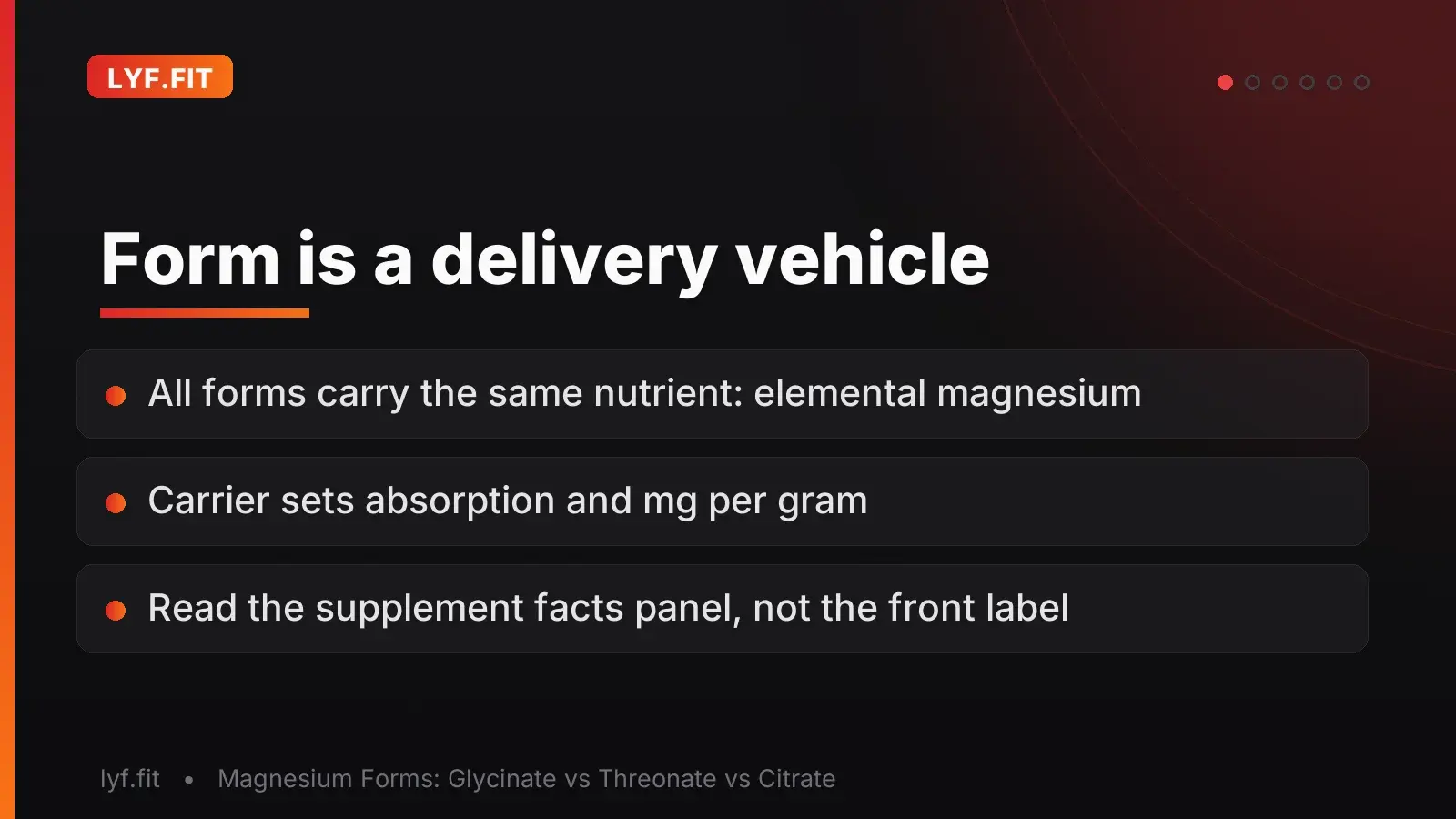
Every magnesium supplement pairs the mineral with a carrier molecule — an amino acid, an organic acid, or a simple oxide. That carrier determines two things: how much elemental magnesium you get per gram, and how readily your gut absorbs it. On a typical diet, roughly 30–40% of dietary magnesium is absorbed, but supplement forms diverge sharply. Magnesium oxide packs about 60% elemental magnesium by weight yet may absorb at only ~4%, while chelated forms like glycinate absorb far better despite carrying less mineral per pill. So the number that matters is not the compound weight on the front label — it's the elemental magnesium, usually listed in the supplement facts panel.
How common is falling short on magnesium?
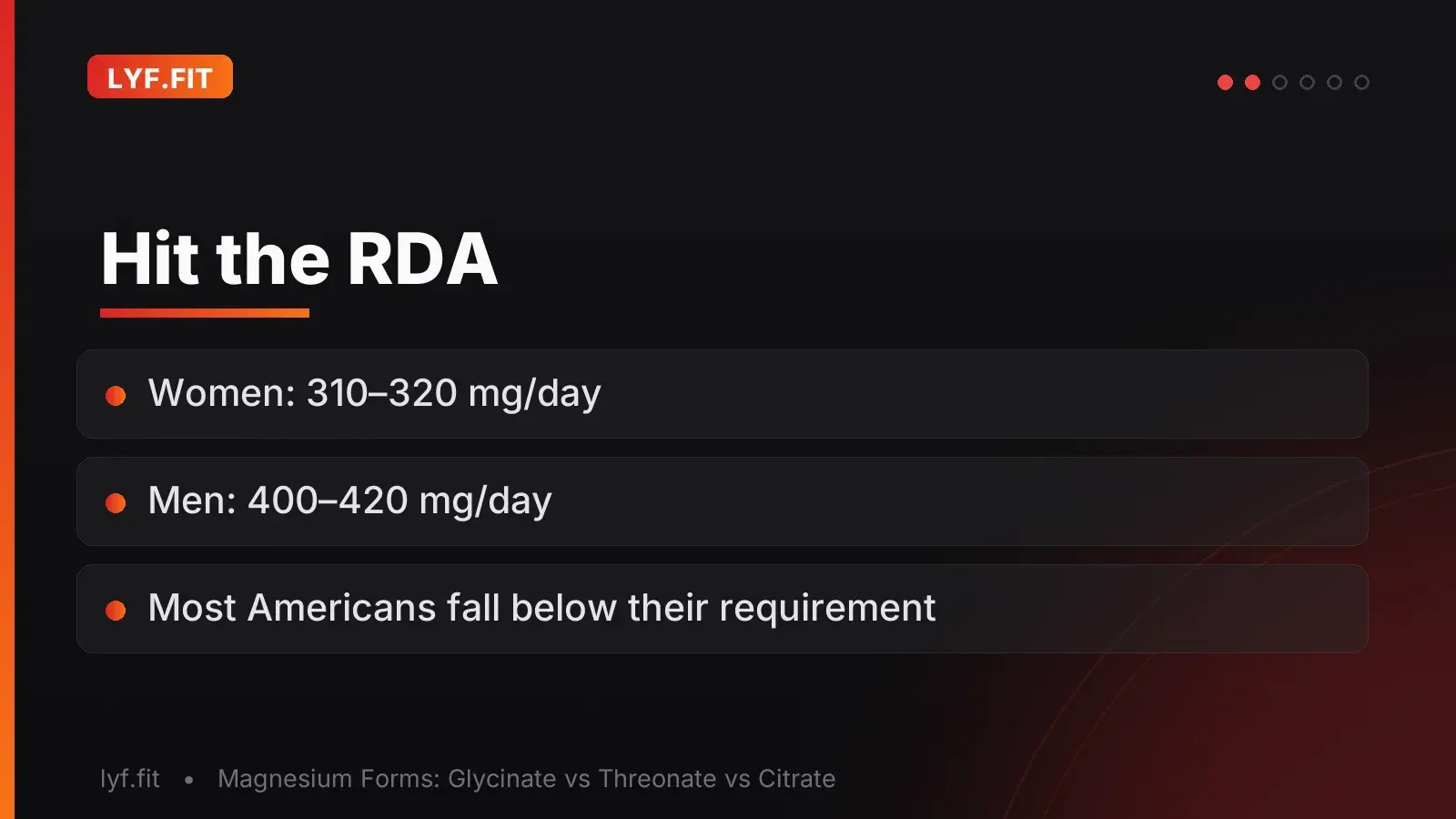
Magnesium sits inside more than 300 enzymatic reactions, from ATP energy production to nerve signaling and muscle relaxation. Despite that, NHANES survey data (2005–2006) found that a majority of Americans across age groups take in less magnesium from food than their Estimated Average Requirement, with older men and adolescent girls most likely to fall short. The RDA is 310–320 mg/day for adult women and 400–420 mg/day for adult men, rising to 350–360 mg during pregnancy. Diets heavy in refined grains and light on leafy greens, legumes, nuts, and seeds are the usual reason intake lags. Food should be the foundation; supplements fill a defensible gap, not replace the plate.
Which magnesium form is right for which goal?
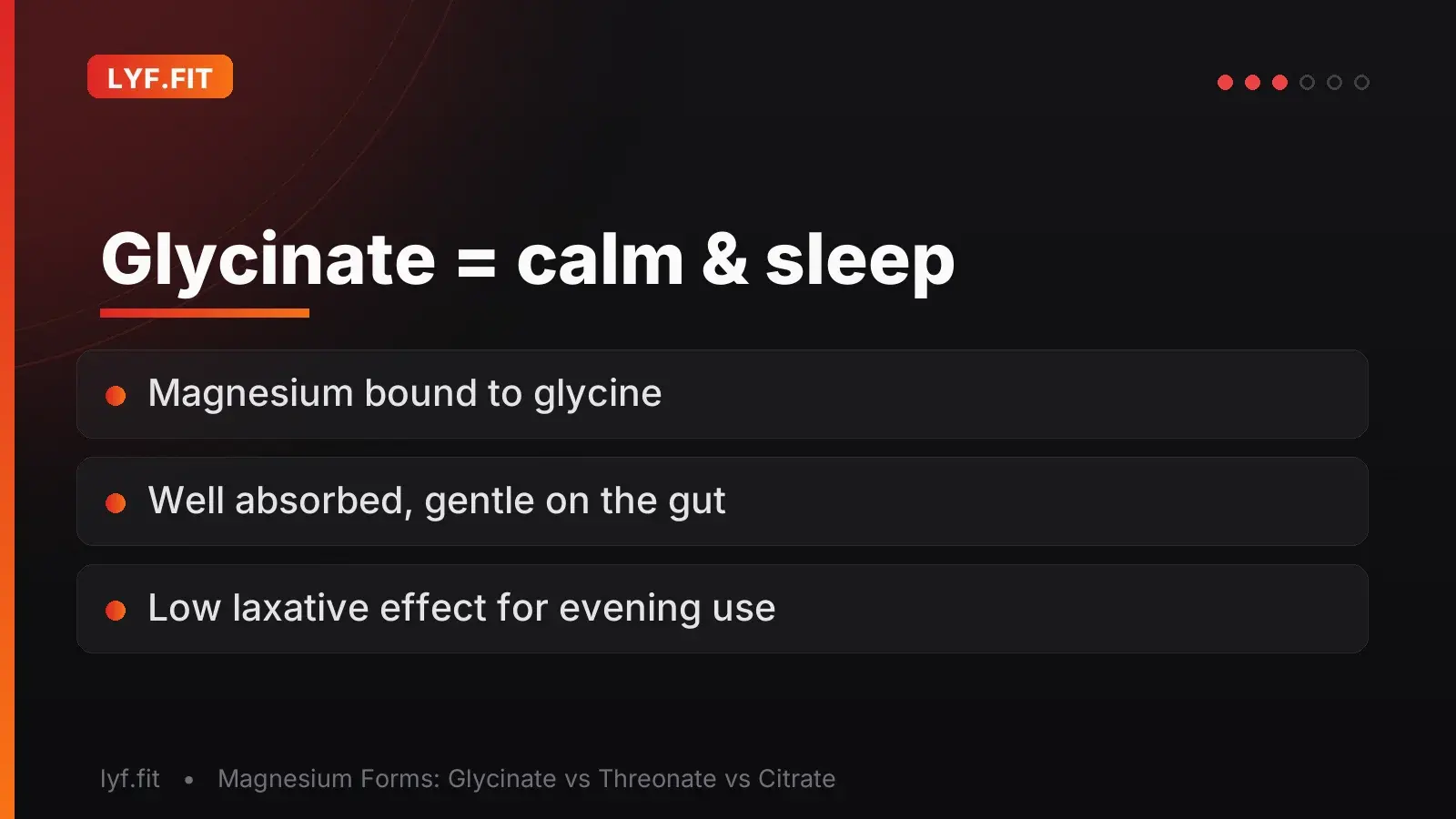
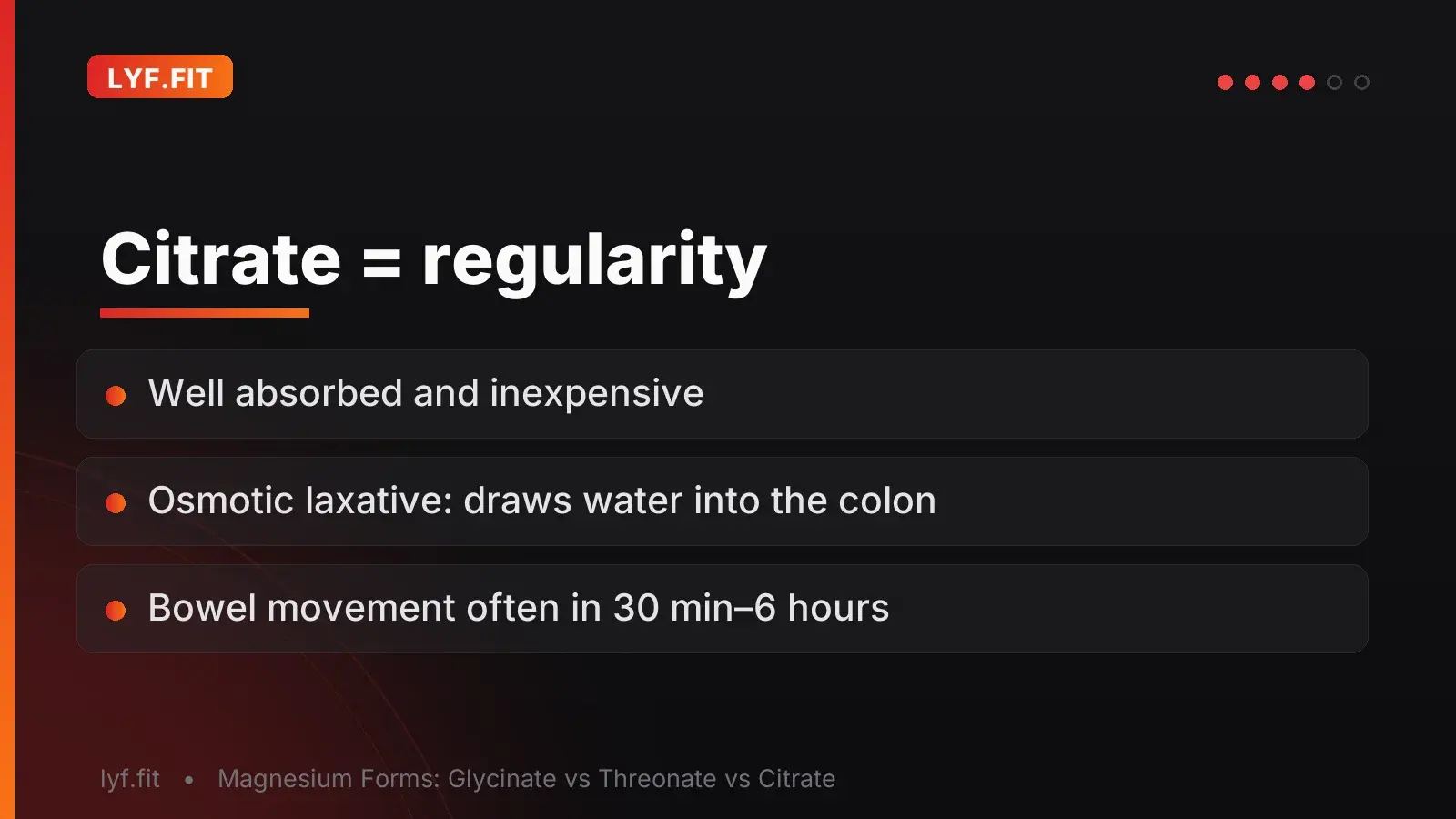
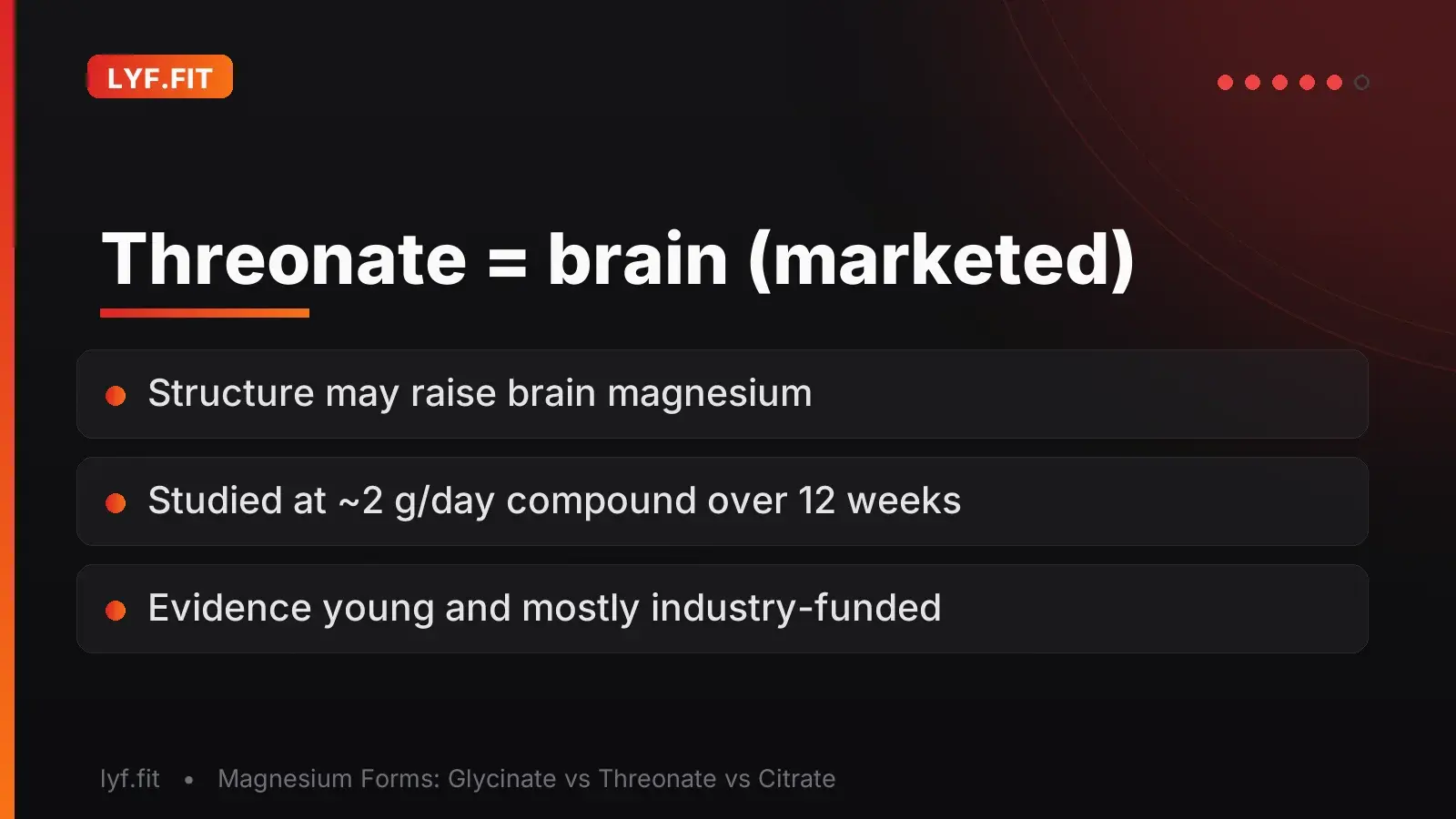
Match the form to the job. Glycinate (magnesium bound to the amino acid glycine) is well absorbed, easy on the stomach, and the common choice for evening use and relaxation. Citrate is well absorbed too but draws water into the colon, so it doubles as a gentle osmotic laxative — useful if constipation is the problem, less ideal if it isn't. L-threonate is the form studied for cognitive endpoints because its structure appears to raise brain magnesium more effectively. Malate is sometimes chosen for daytime energy support, and taurate pairs magnesium with the amino acid taurine. Oxide is the cheapest and least absorbed.
How do the major magnesium forms compare?
The table below summarizes absorption, best use, and the key caveat for each common form. Elemental-magnesium percentages are approximate and vary by manufacturer, so always confirm the supplement facts panel rather than the compound weight. Be skeptical of front-label claims that headline a large milligram number: a 500 mg or 1,000 mg figure usually refers to the whole compound, and the usable mineral inside it can be a small fraction of that. Absorption studies also vary in method and are often small, so treat the percentages as directional rankings, not precise guarantees. When two products list a similar elemental dose, the deciding factors become gut tolerance, price per serving, and whether you want a secondary effect like regularity.
| Form | Absorption | Best use case | Note |
|---|---|---|---|
| Glycinate | High, gentle on gut | Sleep, calm, general repletion | Chelated; low laxative effect |
| Citrate | Good | Constipation + repletion | Osmotic laxative at higher doses |
| L-threonate | Good; brain-targeted | Cognitive support (marketed) | Studied at ~2 g/day compound |
| Malate | Good | Daytime energy support | Limited head-to-head data |
| Taurate | Good | Cardiovascular/calm (marketed) | Sparse human trials |
| Oxide | Low (~4%) | Occasional laxative | Cheap; poor for repletion |
What does the research say about threonate for the brain?
Magnesium L-threonate (branded Magtein) is the form with the most brain-specific marketing, and it has some human data behind it. Trials have typically used about 1,500–2,000 mg of the compound per day — which delivers only roughly 140–145 mg of elemental magnesium — over 12 weeks. A randomized, placebo-controlled study in older adults with mild cognitive complaints reported improvements on cognitive testing versus placebo, and manufacturer-linked trials in healthy adults have shown memory-score gains. The evidence base is still young, mostly industry-funded, and not a treatment for any diagnosed condition. Threonate is a reasonable experiment for cognitive support, but glycinate covers general repletion at a fraction of the cost.
How much elemental magnesium should you actually take?
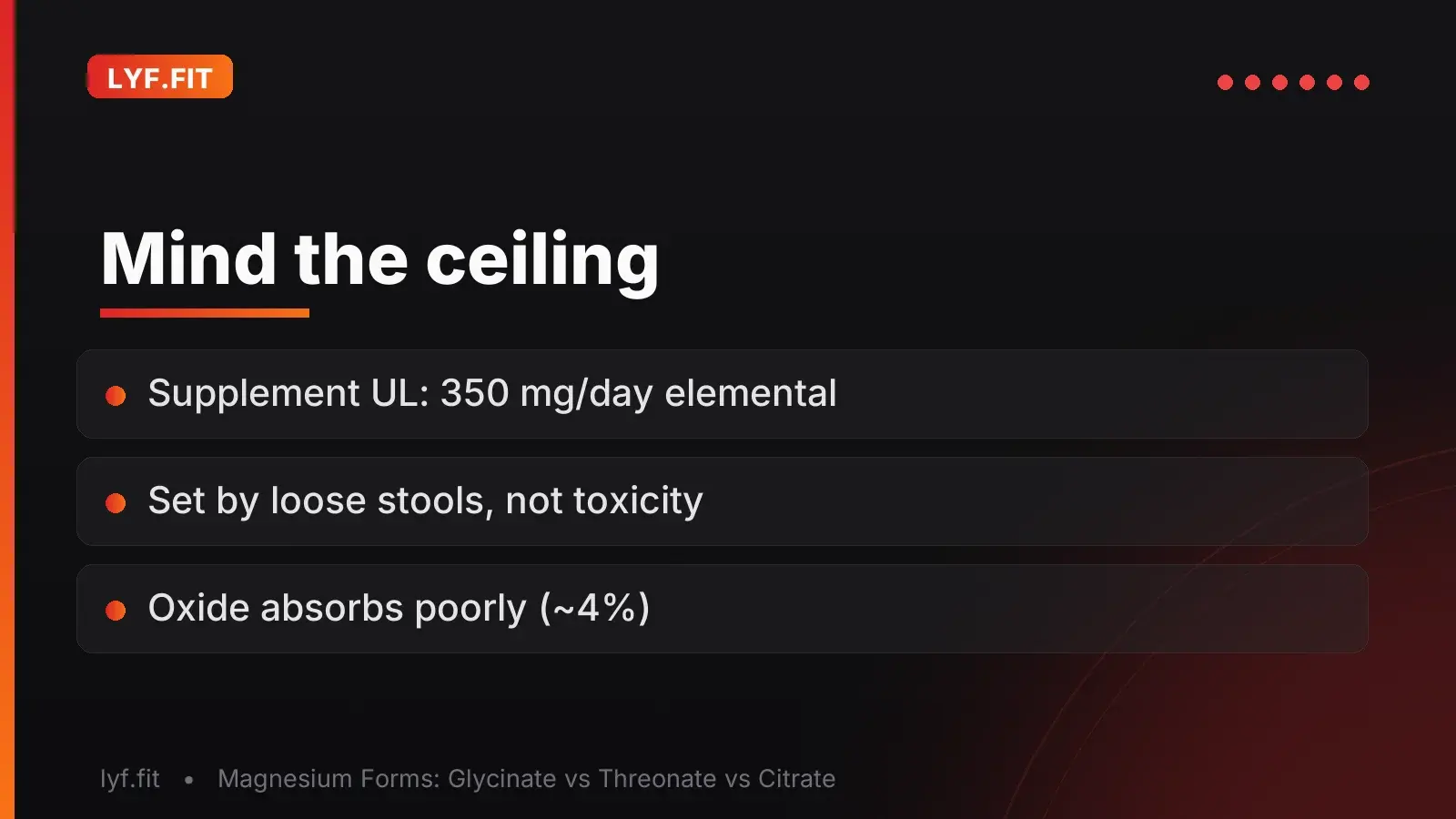
Anchor on elemental magnesium, not compound weight. The Tolerable Upper Intake Level for magnesium from supplements is 350 mg/day for adults — a limit set by the onset of loose stools, not by systemic toxicity, and it does not apply to magnesium from food. A common, conservative supplemental dose is 100–200 mg of elemental magnesium in the evening, adjusted to what your gut tolerates. Splitting a larger dose across two smaller servings can improve comfort and fractional absorption, since the gut takes up a higher percentage of small doses than large ones. Because citrate and oxide pull water into the bowel, they hit that laxative threshold sooner than glycinate does. If you take medications or have reduced kidney function, clear supplementation with your physician first, since impaired kidneys can let magnesium accumulate.
Test Your Knowledge
1 / 3Which number actually tells you how much magnesium you're getting?
What about oxide, malate, and taurate?
Oxide is high in elemental magnesium by weight but poorly absorbed — around 4% in some studies — so it's a budget laxative more than a repletion tool. Malate (magnesium plus malic acid, a compound in the energy cycle) is often marketed for daytime use and muscle comfort, though rigorous human comparisons are thin. Taurate pairs magnesium with taurine and is promoted for cardiovascular and calming effects, but human trials are sparse; the rationale is largely mechanistic. None of these treats a disease, and choosing among them is often a matter of marketing preference rather than proven superiority. For most people whose goal is simply to close a dietary gap without gut upset, glycinate remains the sensible default, with citrate as the pick when regularity is also a concern.
Interactive Tools
Save these contextual tools to your profile for quick access.
Frequently asked questions
For most healthy adults, a modest daily supplemental dose — commonly 100–200 mg of elemental magnesium — is well within the 350 mg/day upper limit for supplements. Food-source magnesium doesn't count toward that ceiling, so a magnesium-rich dinner on top of a capsule won't push you over. If you have kidney disease or take prescription medications, confirm with your physician first, because impaired kidneys clear magnesium less efficiently.
Glycinate is the usual evening choice because it's well absorbed and gentle, so it's less likely to send you to the bathroom overnight. Citrate can work too, but its osmotic laxative effect makes it better suited when constipation is also a goal. Neither is a sleeping pill — think general support for relaxation, not a sedative — and habits like a consistent bedtime and less late-night screen light do more for sleep than any capsule.
Preclinical and early human data suggest L-threonate raises brain magnesium more effectively than other forms, and 12-week trials at roughly 2 g/day of the compound have reported cognitive-test improvements. The research is still limited and often industry-funded, so treat threonate as a promising but unproven option — not a substitute for medical care for memory concerns.
Because each form carries a different amount of usable mineral per gram. A 500 mg citrate capsule might deliver only about 55–80 mg of elemental magnesium, while oxide of the same weight lists more but absorbs poorly. Reading the elemental figure in the supplement facts panel is the only way to compare products fairly and hit your RDA.
Choosing a magnesium supplement comes down to matching the form to your goal and counting elemental milligrams, not compound weight. Glycinate is the low-drama default for repletion and sleep, citrate helps when regularity is also an issue, and threonate is the experimental brain pick. Compare specific products and elemental doses in our supplements tool, and check any unfamiliar term against the glossary.
Stop completely guessing.
Use our interactive PWA tools to calculate your exact macros, 1RM, and running pace offline.