

Disclaimer: Some of the links on this page are affiliate links. As an Amazon Associate and affiliate for other networks, we may earn a commission from qualifying purchases at no additional cost to you.
Creatine's most underrated benefits show up not in the weight room but in how you age. The same molecule that fuels a heavy set helps older adults hold onto muscle and, when paired with lifting, may slow bone-density loss—and it does this on a simple 3–5 grams a day. This guide is the practical, healthy-aging companion to our brain deep dive: what creatine does for aging muscle and bone, how to dose it, and who won't respond.
Creatine monohydrate is among the most-studied supplements in sports science, with hundreds of trials and a strong safety record at 3–5 grams per day. It also recycles energy in the brain—we covered that cognitive evidence in depth in our breakdown of creatine and the brain—but the freshest, most decision-useful material for most readers is on aging and dosing, so that is where this piece lives.
Creatine Core Concepts
1 / 4Does creatine do anything for the brain?
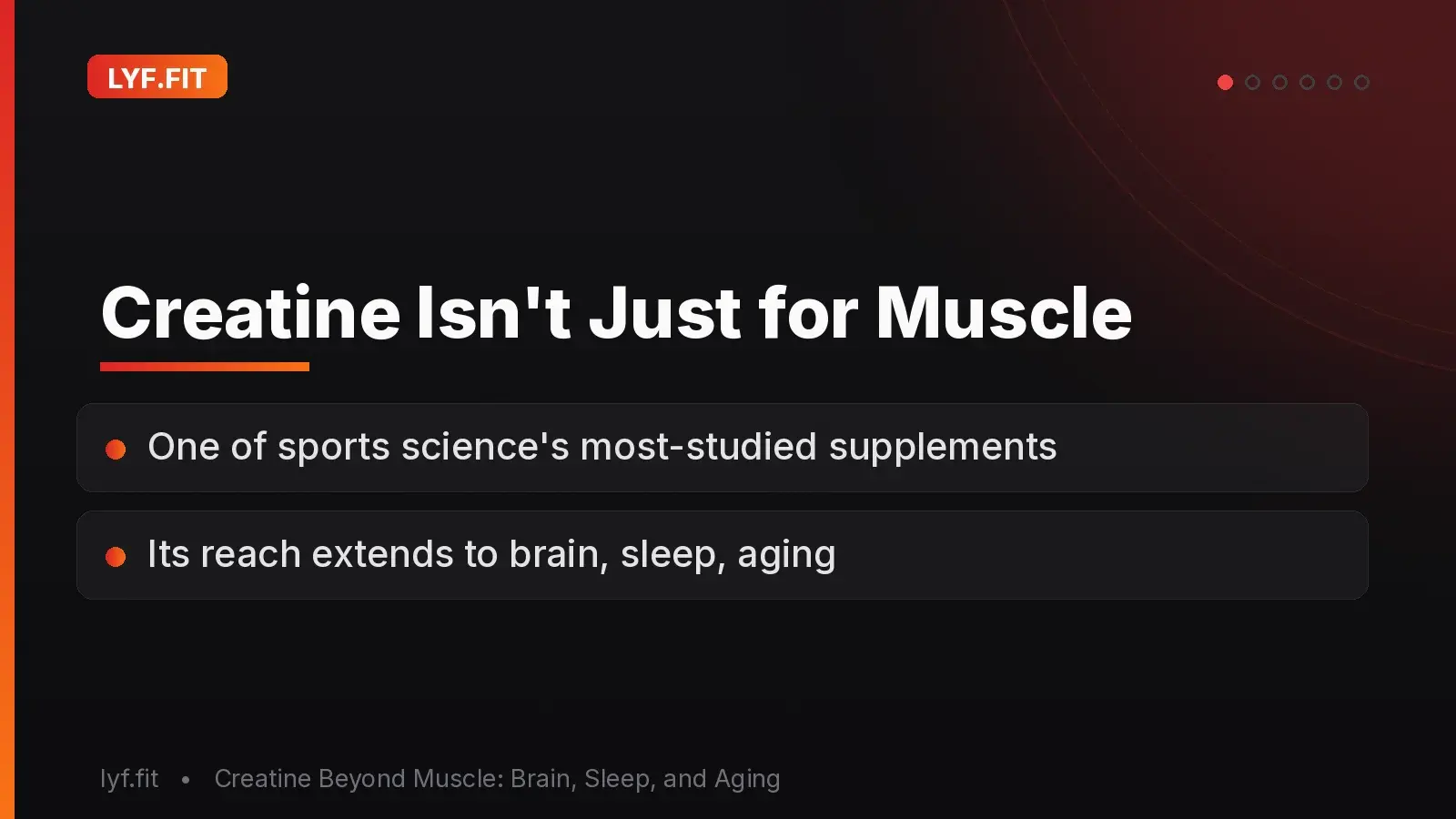
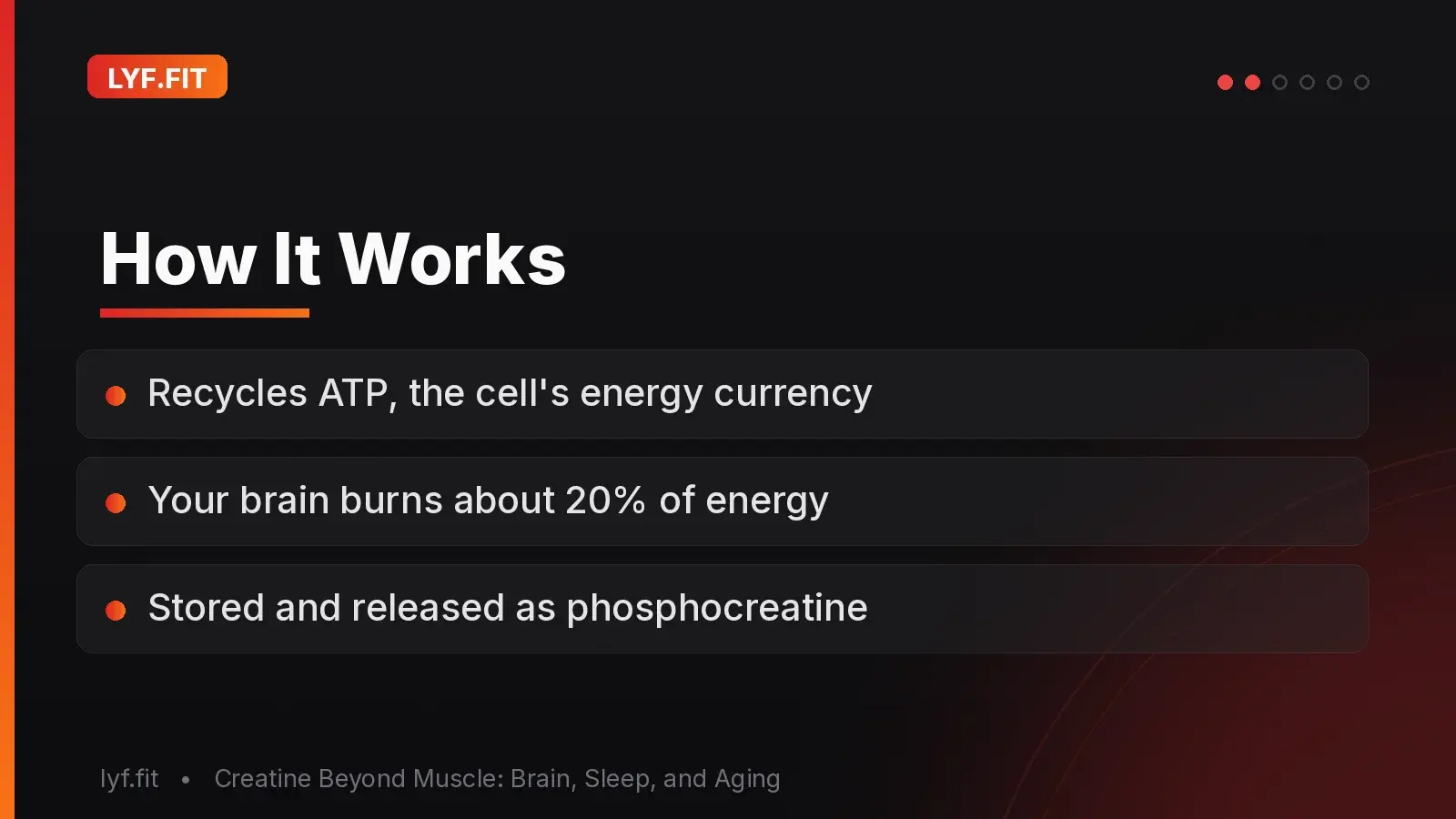
Yes, but with realistic expectations—and since we have covered it thoroughly elsewhere, here is the short version. Every fast-firing cell runs on the phosphocreatine system: creatine is stored as phosphocreatine, and when a cell burns through ATP (its energy currency), the enzyme creatine kinase rapidly rebuilds it. Your brain uses this exact system. It consumes about 20% of your daily energy despite being roughly 2% of your body weight, so a larger phosphocreatine reserve can buffer the moments when neurons outpace their fuel.
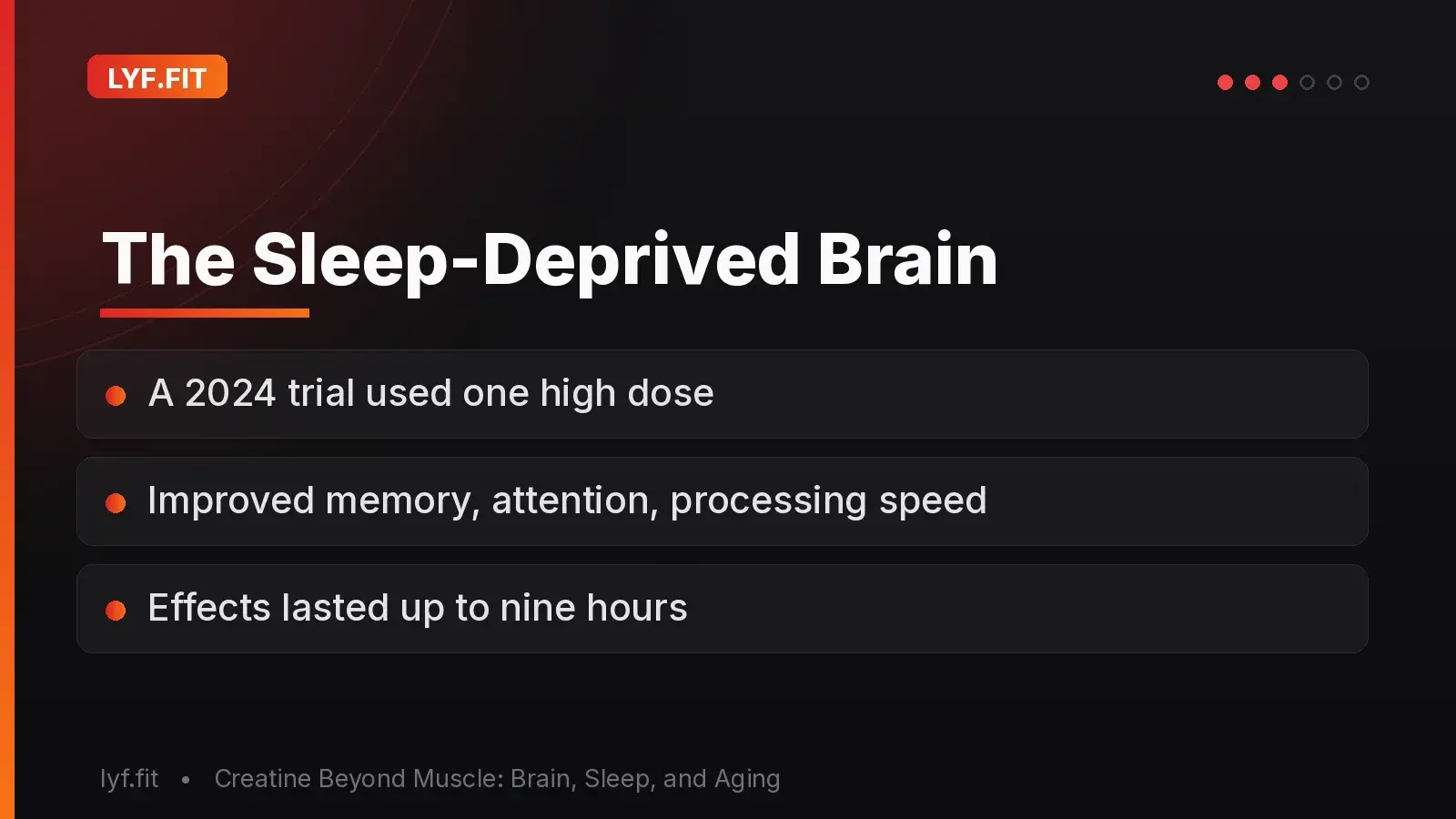
The catch is that the benefit is clearest when the brain is energy-stressed—during sleep loss, in older adults, or in people with low dietary intake—rather than as a general "nootropic" for a well-rested, meat-eating adult, where the day-to-day evidence is mixed. A 2024 sleep-deprivation trial made headlines by using a single large dose (about 0.35 g/kg, far above the daily 3–5 grams) to improve cognition during a night awake, but that was a proof of concept, not a protocol.
We covered the cognitive evidence—memory, processing speed, the vegetarian response, and what creatine probably will not do—in depth in Beyond the Biceps: Can Creatine Boost Your Brain?. For everyday use the takeaway is simple: the same 3–5 grams that support your muscles keep your brain's reserve topped up, and consistency matters more than any clever timing.
Slide 1 of 6
What does creatine do for aging muscle?
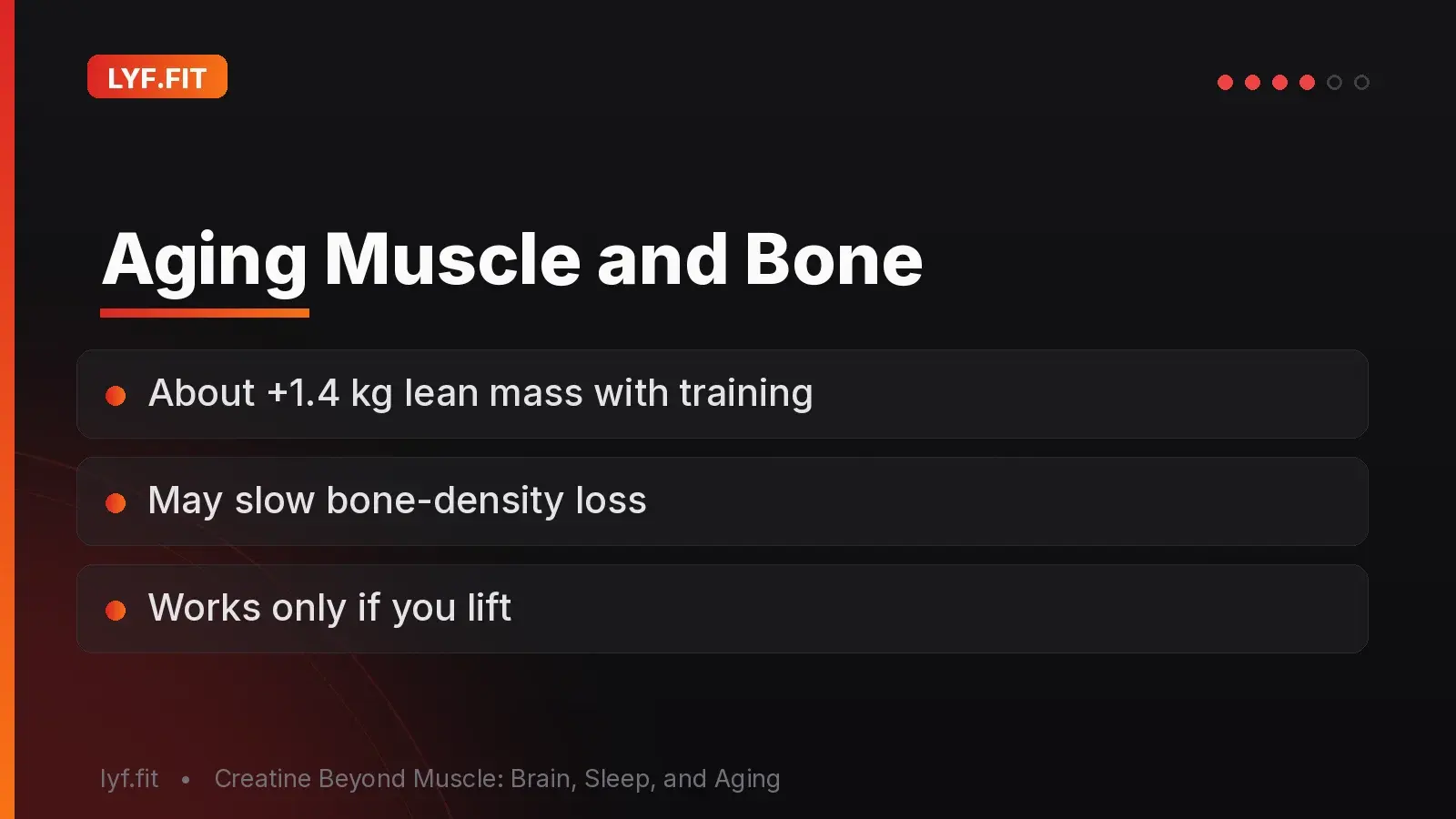
This is creatine's most underrated role. After about age 30, adults can lose roughly 3–8% of their muscle mass per decade, and the slide accelerates after 60—a process called sarcopenia that quietly chips away at strength, walking speed, and the ability to get up off the floor unassisted. Muscle is also metabolically active tissue, so losing it makes everything from glucose handling to balance harder. Creatine will not stop that clock on its own, but it can make the work you do to fight it pay off more.
The clearest evidence comes from older adults who lift. A meta-analysis pooling 22 studies and roughly 721 participants (mostly 57–70 years old) found that creatine paired with resistance training added about 1.4 kg of lean mass over placebo, along with greater chest-press and leg-press strength. The mechanism is refreshingly plain: a fuller phosphocreatine tank lets you squeeze out an extra rep or two at the same weight, and those extra hard reps, accumulated over months, are a bigger training stimulus. Creatine amplifies the signal your training sends—it does not send one by itself.
That "amplifier, not engine" framing is the whole game for aging muscle. Take creatine without lifting and you will gain a little water weight and not much else; pair it with two or three resistance sessions a week and you tilt the odds toward keeping the muscle that keeps you independent. For a broader plan, see training and nutrition after 40.
Does creatine protect aging bone?
The bone story is promising but not settled, and it is worth being candid about that. A 12-month trial in postmenopausal women taking 0.1 g/kg/day alongside resistance training slowed loss at the femoral neck—bone density fell 1.2% versus 3.9% on placebo—and improved a predictor of bone bending strength. That is encouraging, because a hip fracture is one of the events that most threaten independence later in life. But a separate meta-analysis pooling more trials found no overall bone-density advantage, so the honest read is "plausible and worth watching," not "proven." As with muscle, any bone benefit rides on the resistance training, not the powder alone.
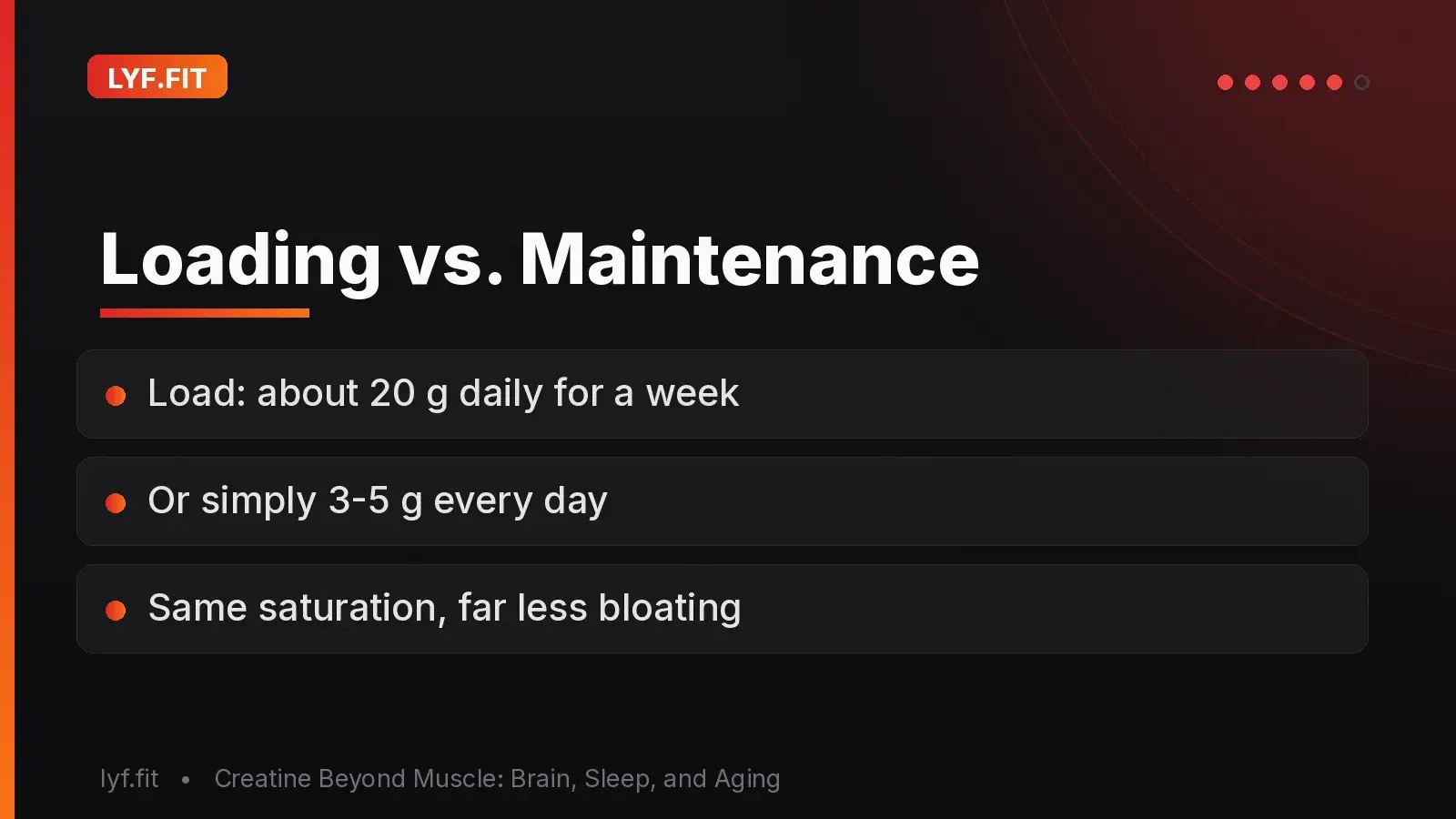
Loading vs. maintenance: does the protocol matter?
Both roads end in the same place—fully saturated muscle stores—so the only real questions are how fast you want to get there and how much bloating you will tolerate along the way.
| Approach | Daily dose | Time to full saturation | GI risk | Best for |
|---|---|---|---|---|
| Loading phase | ~20 g/day (4 × 5 g) for 5–7 days, then 3–5 g | ~1 week | Higher (cramping, bloating) | Wanting fast results before an event |
| Maintenance only | 3–5 g/day, every day | ~3–4 weeks | Minimal | Most people |
Loading is optional, not mandatory. A loading phase fills the tank in about a week, which is only worth the gastrointestinal trade-off if you have an event or a testing date on the calendar. Skip it and simply take 3–5 grams daily and you reach identical stores in three to four weeks with minimal stomach upset. The one non-negotiable, whichever path you choose, is consistency: creatine works by staying saturated day after day, not by being timed around your workout, so the best time to take it is whenever you will actually remember.
The Fittest Creatine Monohydrate Sponsored
Pure 100% micronized creatine monohydrate—unflavored, no fillers. A simple daily 3–5 g upgrade for muscle, brain, and healthy aging.
Who doesn't respond to creatine?
Not everyone tops up equally. People who already carry high baseline stores—often heavy red-meat eaters—have less room to fill and may notice little change. At the other end, vegetarians and vegans tend to respond most, because their baseline is low; studies in those groups often show the largest gains on memory and processing-speed tasks. Researchers commonly cite a "non-responder" rate of roughly 20–30% for performance measures.
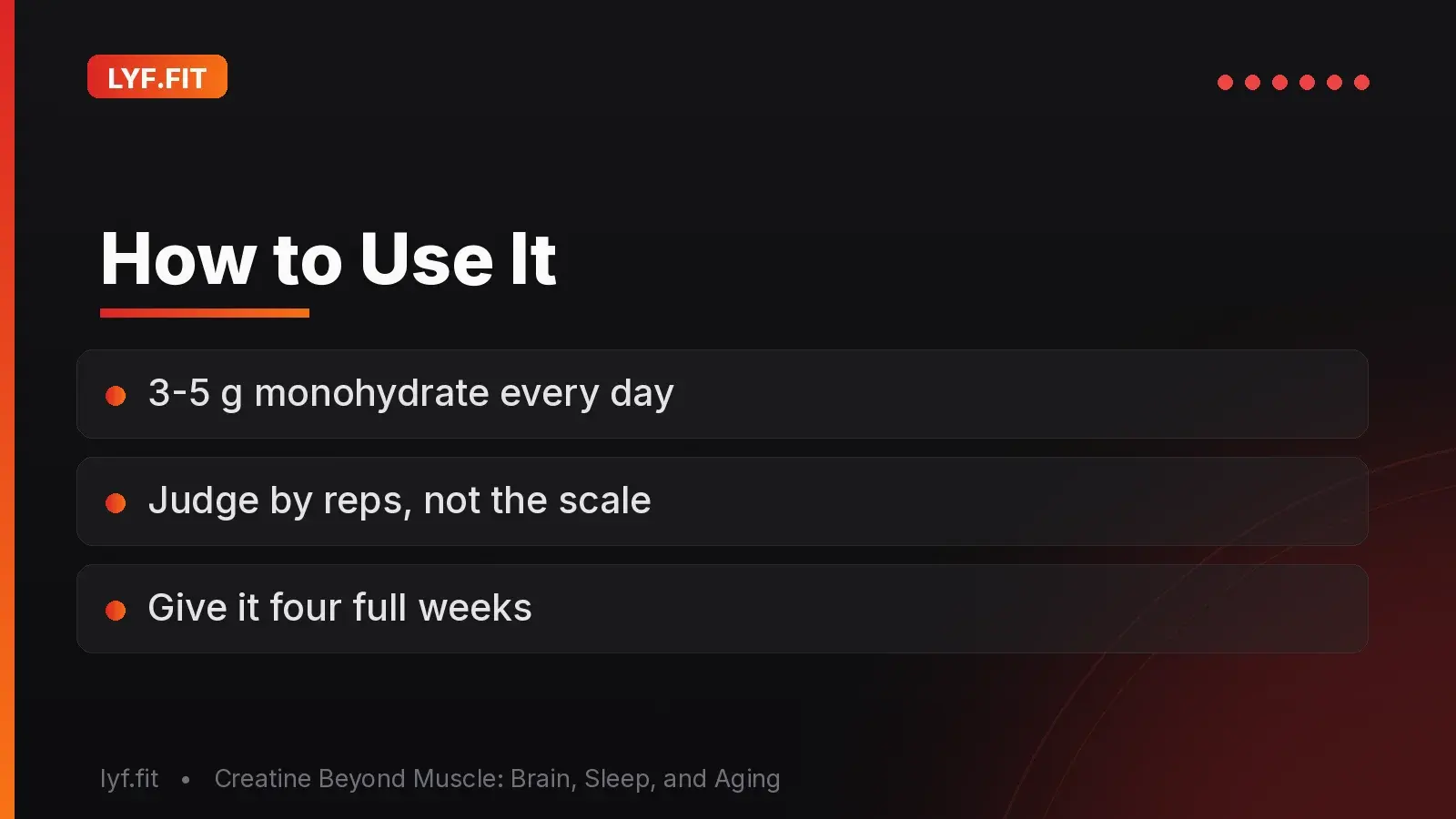
The practical test costs you a month: take 3–5 grams daily for four weeks and judge by the reps and loads in your lifting log, not the bathroom scale—creatine adds a pound or two of intracellular water early on that has nothing to do with fat or muscle. For a female-specific angle on baseline and response, our piece on creatine and cognitive healthspan digs deeper.

Is creatine safe? The kidney myth and water weight
Creatine's safety is one of the better-established facts in supplement science, yet the kidney myth refuses to die. It comes from a lab mix-up: your body converts a small amount of creatine into creatinine, a waste product doctors measure to estimate kidney function. Supplementing can nudge that number up slightly—not because your kidneys are struggling, but because there is simply more creatine in the system to convert. In healthy people, controlled trials and long-term follow-ups have not shown kidney harm at standard doses.
The early "weight gain" is water pulled into muscle cells, not fat, and it is part of how creatine works rather than a side effect. You also do not need to cycle it: creatine is not a stimulant, your body does not build tolerance, and continuous daily use has the strongest track record. The genuine caveat is narrow—if you have existing kidney disease or another medical condition, that is a conversation to have with your physician before starting, not a decision to make from a blog. To sanity-check any supplement's evidence before you buy, our supplement database is a good first stop.
Test Your Creatine Knowledge
1 / 4Creatine's cognitive benefit is clearest when…
Interactive Tools
Save these contextual tools to your profile for quick access.
Daily Lifting Log
A distraction-free tracker to log your exercises, sets, reps, and weights. Works offline; syncs to your account when you sign in.
Supplement Database
An evidence-based directory of dietary supplements. Find out what works and what is just snake oil.
Fitness Glossary
The ultimate reference dictionary for translating gym jargon, dietary terms, and training concepts.
Frequently asked questions
A daily 3–5 grams of monohydrate is the standard dose and saturates muscle over three to four weeks; older adults use the same amount. Brain stores rise more slowly and less completely, which is why some cognitive studies used higher amounts, but for everyday use consistency at 3–5 grams matters more than chasing a bigger number. Talk to a physician before starting any supplement if you have a medical condition.
No. Creatine is not a stimulant and your body does not build a tolerance to it, so cycling offers no known advantage. Continuous daily use is the standard approach and has a strong long-term safety record in healthy adults at studied doses.
Expect a small, early rise in body weight—usually a pound or two—from water drawn into the muscle cells, not fat. That intracellular water is part of how creatine works. Judge your progress by strength and reps rather than the scale during the first few weeks.
Not meaningfully. For muscle and bone, creatine works by amplifying the stimulus of resistance training—more quality reps, more accumulated stimulus—so taken on its own it does little beyond a small water-weight bump. Pair it with two or three lifting sessions a week to see the benefit the research describes.
Creatine earns its "beyond muscle" reputation most convincingly in the context of aging: paired with resistance training, it helps older adults defend the muscle—and possibly the bone—that underwrites independence, all on a forgettable 3–5 grams a day. Keep the plan simple, judge it by your training log rather than the scale, and give it a month before you decide. Start by checking the evidence in our supplement database and tracking your response in the daily lifting log.
Stop completely guessing.
Use our interactive PWA tools to calculate your exact macros, 1RM, and running pace offline.