

Disclaimer: Some of the links on this page are affiliate links. As an Amazon Associate and affiliate for other networks, we may earn a commission from qualifying purchases at no additional cost to you.
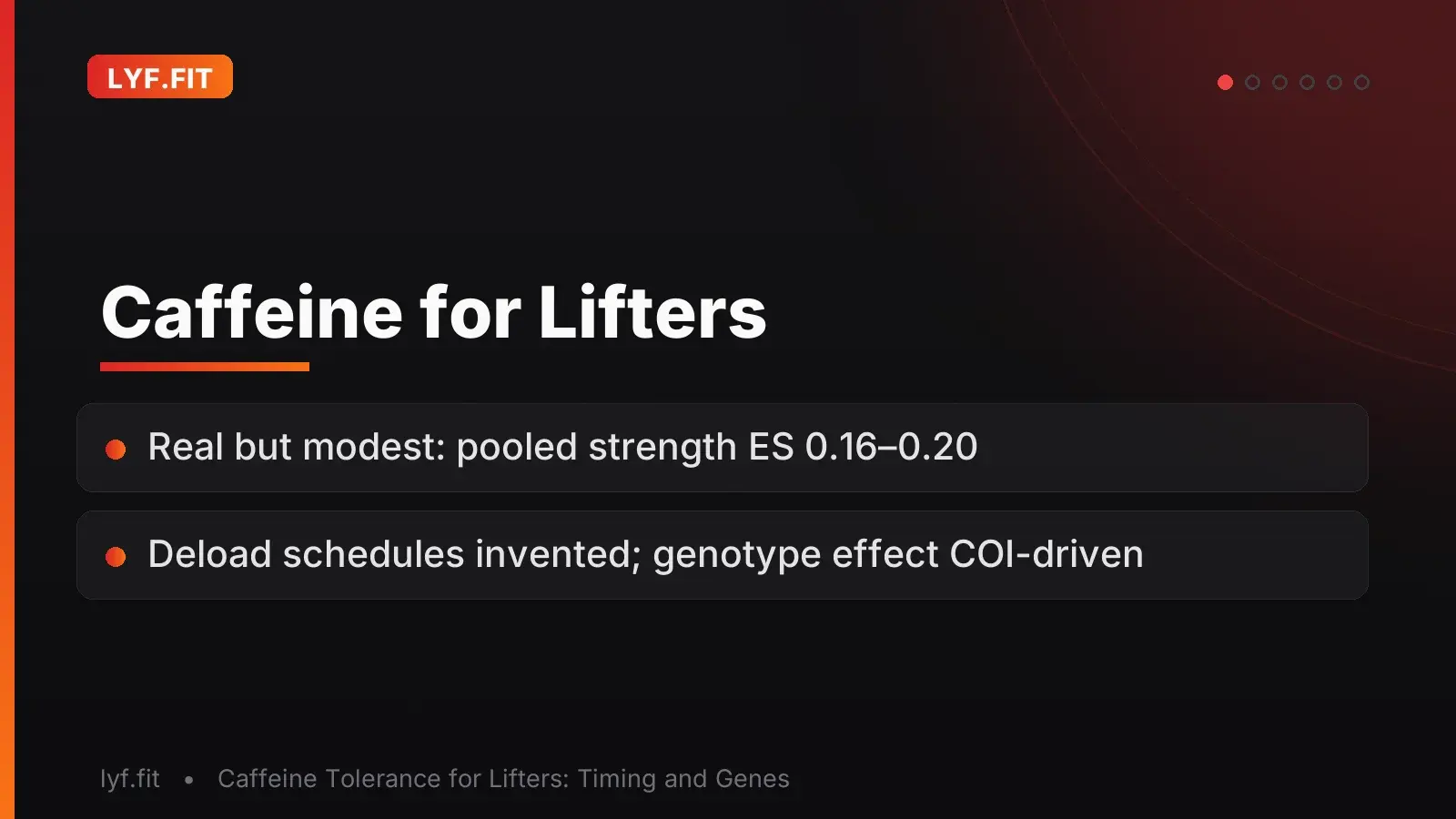
Caffeine works for lifters at 3–6 mg/kg of body mass, but the effect is smaller than the internet implies: pooled effect sizes are 0.16–0.20 for strength and 0.28–0.38 for muscular endurance. The famous CYP1A2 "fast vs. slow metabolizer" story largely evaporated when researchers controlled for industry funding, and the best-controlled lifting trial found genotype didn't change the response at all. And the "caffeine deload" — cycling off every 6–8 weeks — has exactly zero direct trial evidence behind it.
That leaves a narrower, more useful set of levers: dose, delivery form, and how late in the day you take it.
How much caffeine actually helps a lifter?
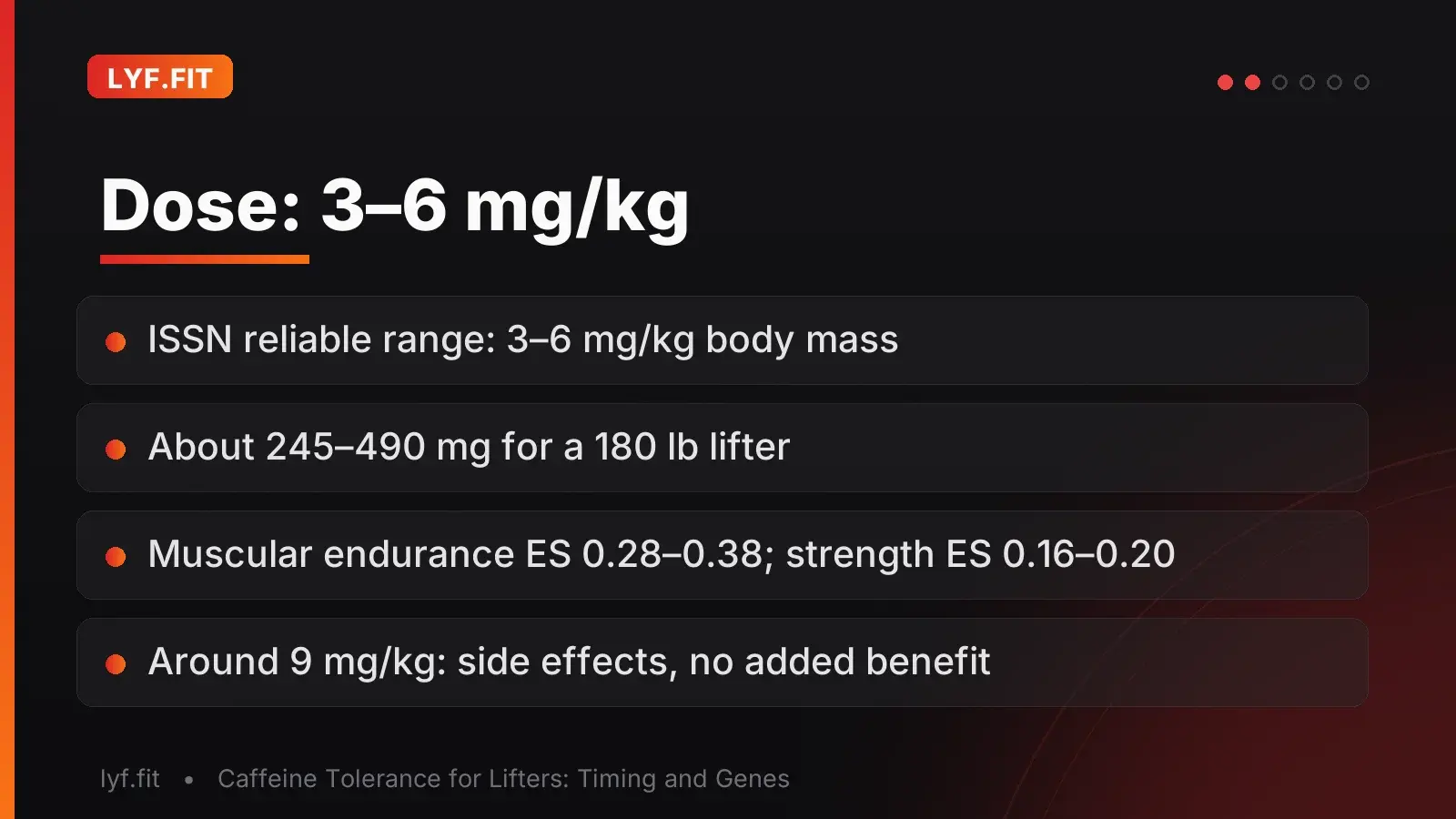
The 2021 International Society of Sports Nutrition position stand puts the reliable ergogenic range at 3–6 mg/kg body mass, taken roughly 60 minutes before training. For a 180 lb (82 kg) lifter that's about 245–490 mg. Doses as low as 2 mg/kg still work; around 9 mg/kg you get a high incidence of side effects with no additional benefit.
But be honest about the size of the win. The ISSN stand — summarizing the Grgic meta-analyses — reports strength effects of ES 0.16–0.20 (roughly 2–7%) and muscular endurance effects of ES 0.28–0.38 (roughly 6–7%). Aerobic endurance is where caffeine's benefit is largest and most consistent. Caffeine is not adding plates to your bar; it's making set four of five feel like set three.
Is more caffeine better? (No — the benefit plateaus)
The dose-response for lifting is not linear. The benefit arrives early and then flattens: a 2022 meta-analysis in Nutrition found doses as low as 0.9–2 mg/kg were already ergogenic, and the ISSN puts the reliable range at 3–6 mg/kg. Evidence above 6 mg/kg is thinner and less consistent, and the ISSN notes that very high doses (around 9 mg/kg) bring a high incidence of side effects without being required for an ergogenic effect. Side effects are dose-dependent — the higher the dose, the higher the reported odds of tachycardia, anxiety, and increased urine output.
Stacked pre-workouts push people past the point where added benefit is reliable and into the range where side effects climb. If a scoop plus coffee plus an energy drink puts you north of 500 mg, you are paying in jitters and sleep for performance the evidence doesn't reliably promise.
Does "60 minutes before" actually matter?
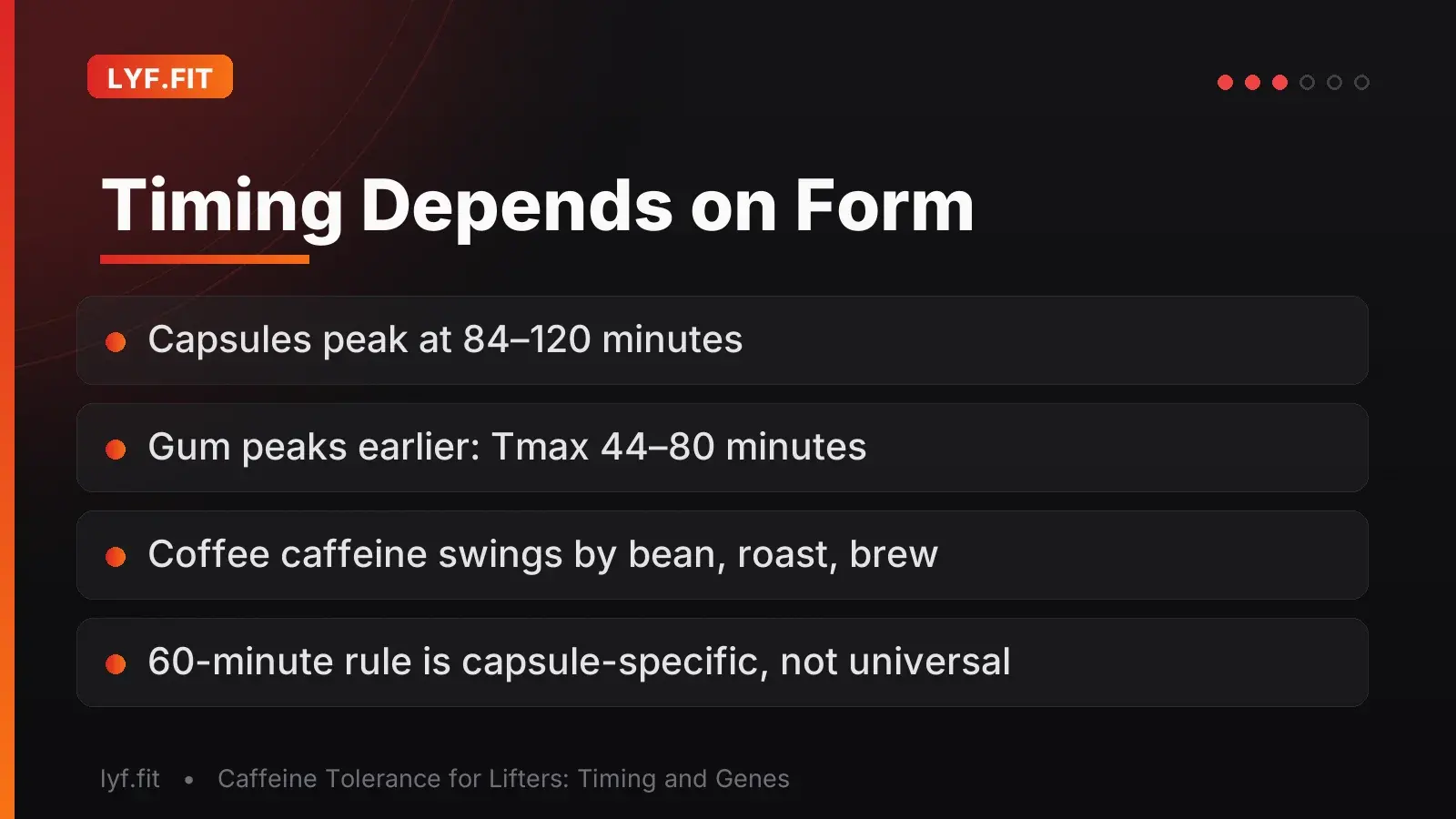
Sixty minutes is a research convention, not an optimized window. It comes from capsule pharmacokinetics: anhydrous caffeine capsules hit peak blood concentration (Tmax) at 84–120 minutes. Different delivery forms have genuinely different curves.
Caffeine gum peaks roughly 40 minutes earlier than capsules — Tmax 44–80 minutes, at effective doses of 200–300 mg. So the "take it an hour before" rule is capsule-specific and shouldn't be applied blindly to gum, coffee, or energy drinks. There's also a practical problem with coffee: caffeine content swings enormously by bean, roast, and brew, so you cannot reliably hit 3 mg/kg with "two cups." Research doses use weighed anhydrous caffeine for a reason. If you want a precise dose, you need a labeled one.
| Delivery form | Time to peak (Tmax) | Dose precision | Practical pre-lift timing |
|---|---|---|---|
| Anhydrous capsule | 84–120 min | High (labeled mg) | ~60 min before |
| Caffeine gum | 44–80 min | High (200–300 mg) | ~20–30 min before |
| Coffee | Variable | Low (brew-dependent) | ~45–60 min before |
| Pre-workout powder | Variable (often stacked) | Moderate (label mg, but check total) | ~45–60 min before |

Does CYP1A2 genotype decide whether caffeine works?
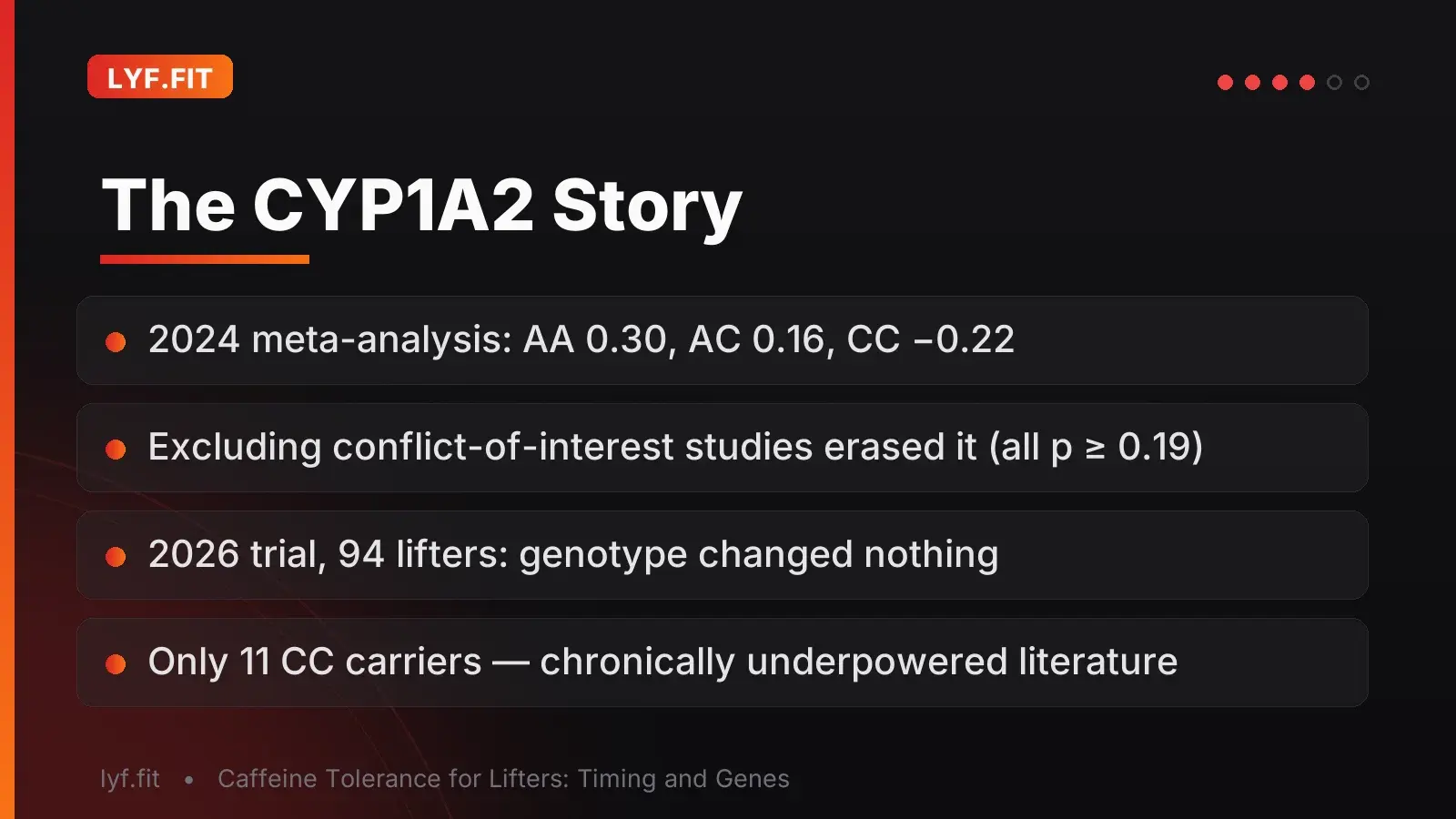
This is the claim that needs the most scrutiny. The rs762551 SNP sorts people into AA (fast), AC, and CC (slow) metabolizers, and a 2024 meta-analysis in Medicine & Science in Sports & Exercise did find a gradient: AA SMD 0.30, AC SMD 0.16, and CC SMD −0.22 — a small ergolytic effect in slow metabolizers across 13 studies and 440 participants.
Then the same authors ran a sensitivity analysis excluding studies with reported conflicts of interest. The entire genotype effect disappeared (all p ≥ 0.19). Several foundational genotype papers come from researchers with connections to genetic-testing interests. Any article presenting the AA/AC/CC framework without this caveat is repeating a finding that may be an artifact of who funded it.
Does the genotype story even apply to lifting?
Mostly, no. A 2024 meta-analysis in the Journal of Sport and Health Science (12 studies, 666 participants, 2–6 mg/kg at 60 minutes) found the A-allele advantage appeared only in cycling time trials: AA carriers improved by 0.90 minutes, AC/CC carriers by a non-significant 0.08. Caffeine did not significantly improve Wingate power (WMD 8.07 W, p=0.60) or countermovement jump (WMD 1.17 cm, p=0.05) in any genotype. Extrapolating a cycling time-trial interaction to your bench press is unsupported.
The best-controlled lifting trial to date agrees. A 2026 triple-blind crossover in Scandinavian Journal of Medicine & Science in Sports gave 3 mg/kg to 94 resistance-trained men and women and found genotype did not alter the overall effect. Everyone improved: mean velocity rose 4–12% in AA, 3–9% in AC, and up to 4% in CC — with no ergolytic effect in slow metabolizers at all.
Should you buy a caffeine genotype test?
Probably not, for three reasons. First, AA isn't rare — roughly 46% of people are fast metabolizers, which limits how much a test can personalize anything. Second, only 11 of the 94 participants in that 2026 trial were CC carriers; the slow-metabolizer literature is chronically underpowered. The dramatic "−13.7% performance" figure everyone quotes comes from a single 2018 endurance trial that has never replicated in resistance training.
Third, and most damning: rs762551 affects CYP1A2 inducibility, not baseline enzyme activity. Per PharmGKB, genotype differences in real caffeine clearance show up mainly in smokers and heavy coffee consumers — among non-smokers the differences are minimal. Smoking, oral contraceptives, pregnancy, liver health, and body mass plausibly swamp genotype for most readers.
Test Your Knowledge
1 / 4What happened to the CYP1A2 genotype effect when the 2024 meta-analysis excluded studies with reported conflicts of interest?
Does daily coffee blunt caffeine's benefit?
The two best meta-analyses flatly disagree, and honesty requires saying so. Carvalho et al. (Sports Medicine, 2022) found habitual intake did not moderate caffeine's ergogenic effect — not for endurance, power, or strength; not in men or women; not in trained or untrained people. It worked regardless of whether withdrawal was under 24 hours, 24–48 hours, or over 48 hours.
But a 2025 Frontiers in Nutrition meta-analysis of resistance exercise found the opposite: caffeine improved velocity and power in everyone, but the effect was roughly four times larger in low or naive consumers (mean velocity SMD 0.87) than in moderate-to-high consumers (SMD 0.21). That's the real state of the evidence — not settled, and not what either camp's headline claims.
Is a "caffeine deload" worth doing?
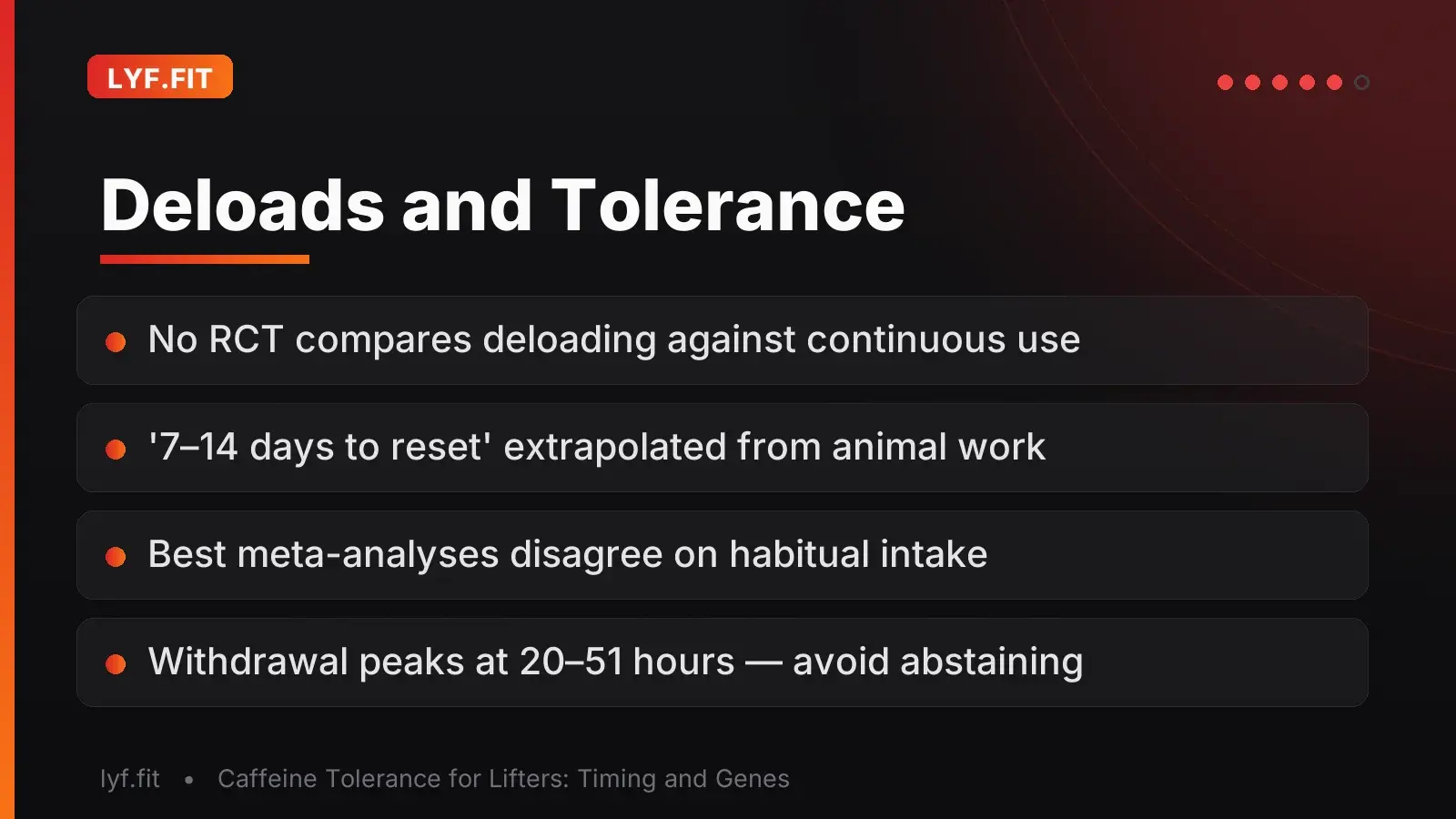
There is no trial evidence for it. Caffeine periodization (Pickering & Grgic, Nutrition, 2021) is a published conceptual framework — reduced-intake phases, reintroduction for key sessions, partly justified by expectancy effects — but no RCT has compared a caffeine deload against continuous use. Every specific schedule you've read ("two weeks off every eight") was invented. The "7–14 days to reset tolerance" figure is extrapolated from animal adenosine-receptor work, not athletic trials.
The limited direct data is mixed. A 20-day study (n=11, 3 mg/kg daily) found the benefit persisted but progressively shrank, with peak-power effects lasting ~15 days while VO2max benefits faded by day 4–6. A 2017 trial found the effect on submaximal cycling endurance was largely abolished after 28 days of daily low-dose intake. But Pickering & Kiely (Sports Medicine, 2018) concluded there is no advantage — and possibly a disadvantage — to short-term pre-competition withdrawal: withdrawal symptoms start at 12–24 hours and peak at 20–51 hours, precisely the window you'd be abstaining in. Their fix is to raise the acute dose, not abstain. If you experiment, use your lifting log to compare like-for-like sessions rather than trusting how you feel.
Should evening lifters cut caffeine off earlier?
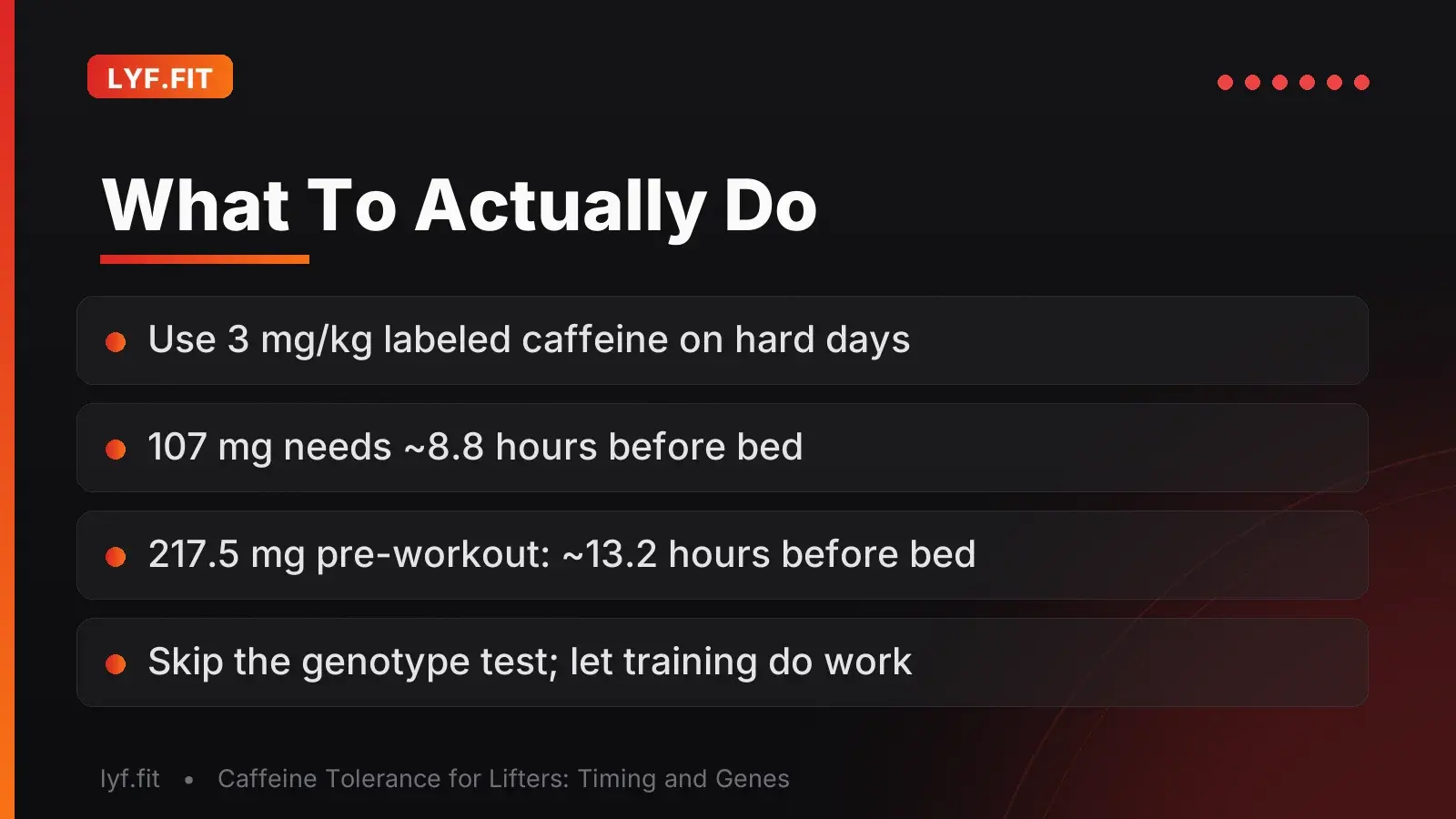
This is the constraint that actually matters, and it's dose-and-time dependent. A 2023 Sleep Medicine Reviews meta-analysis of 24 studies calculated that a coffee-sized 107 mg dose should stop about 8.8 hours before bed, and a typical 217.5 mg pre-workout serving about 13.2 hours before bed, to avoid measurable disruption. Pooled costs: 45 minutes less total sleep, 7% lower sleep efficiency.
Don't overstate it for athletes, though. A 2025 review of 10 studies (128 athletes, 3–6 mg/kg taken 16:00–19:45) found the total-sleep-time reduction was non-significant (−32 minutes, p=0.08), and the sleep-efficiency finding (−4.87%) didn't survive leave-one-out sensitivity analysis. The striking result was the disconnect: athletes felt their sleep was wrecked more than the objective measures showed. Still, given what deep sleep does for recovery, trading it for an ES-0.18 strength bump on a 7 p.m. session is a bad deal — and the sleep hygiene fundamentals matter more than the pre-workout does.
Interactive Tools
Save these contextual tools to your profile for quick access.
Frequently asked questions
Use 3 mg/kg of a labeled, weighed dose — about 245 mg for a 180 lb lifter — roughly 60 minutes before training if you're using capsules, or 20–30 minutes before if you're using gum. Don't chase higher: evidence above 6 mg/kg is inconsistent, while side effects climb with dose. Save the dose for sessions where it matters, and stop early enough that it doesn't cost you sleep. This is general education, not medical advice — talk to your physician if you have a cardiac condition, are pregnant, or take medications.
Probably not, and the claim is hard to test. Sample sizes throughout this literature are tiny — the day-by-day tolerance study everyone cites had 11 participants — and researchers have argued that most individual "non-response" is indistinguishable from measurement noise. Before concluding caffeine doesn't work for you, check the boring variables first: are you actually hitting 3 mg/kg, is your dose from a labeled source rather than guessed coffee, and are you comparing sessions with similar sleep and food behind them?
The evidence points against it. Pickering & Kiely's 2018 review concluded there's no advantage and some potential disadvantage to short-term withdrawal, because withdrawal symptoms start at 12–24 hours and peak at 20–51 hours — exactly when you'd be abstaining. Carvalho's 2022 meta-analysis found caffeine worked regardless of how long people had abstained. If you want a bigger effect on a key day, the literature suggests raising the acute dose within the 3–6 mg/kg range rather than going without.
No. Caffeine sits on the WADA Monitoring Program, not the Prohibited List — it was removed from the banned list in 2004. Monitoring means usage patterns are tracked, not that a positive result carries a sanction. Federation rules can differ, so check your specific governing body, but for the overwhelming majority of lifters caffeine is not a compliance issue.
Caffeine is a real but modest tool for lifters: worth 3 mg/kg on hard days, not worth a genotype test, a stacked scoop, or a schedule someone invented. Get the dose right, respect the sleep cutoff, and let the rest of your training do the work. Check the evidence grades in our supplement database, and use the rest timer to keep your work capacity honest — because how long you actually rest between sets will move your numbers more than any pre-workout will.
Stop completely guessing.
Use our interactive PWA tools to calculate your exact macros, 1RM, and running pace offline.