
Disclaimer: Some of the links on this page are affiliate links. As an Amazon Associate and affiliate for other networks, we may earn a commission from qualifying purchases at no additional cost to you.
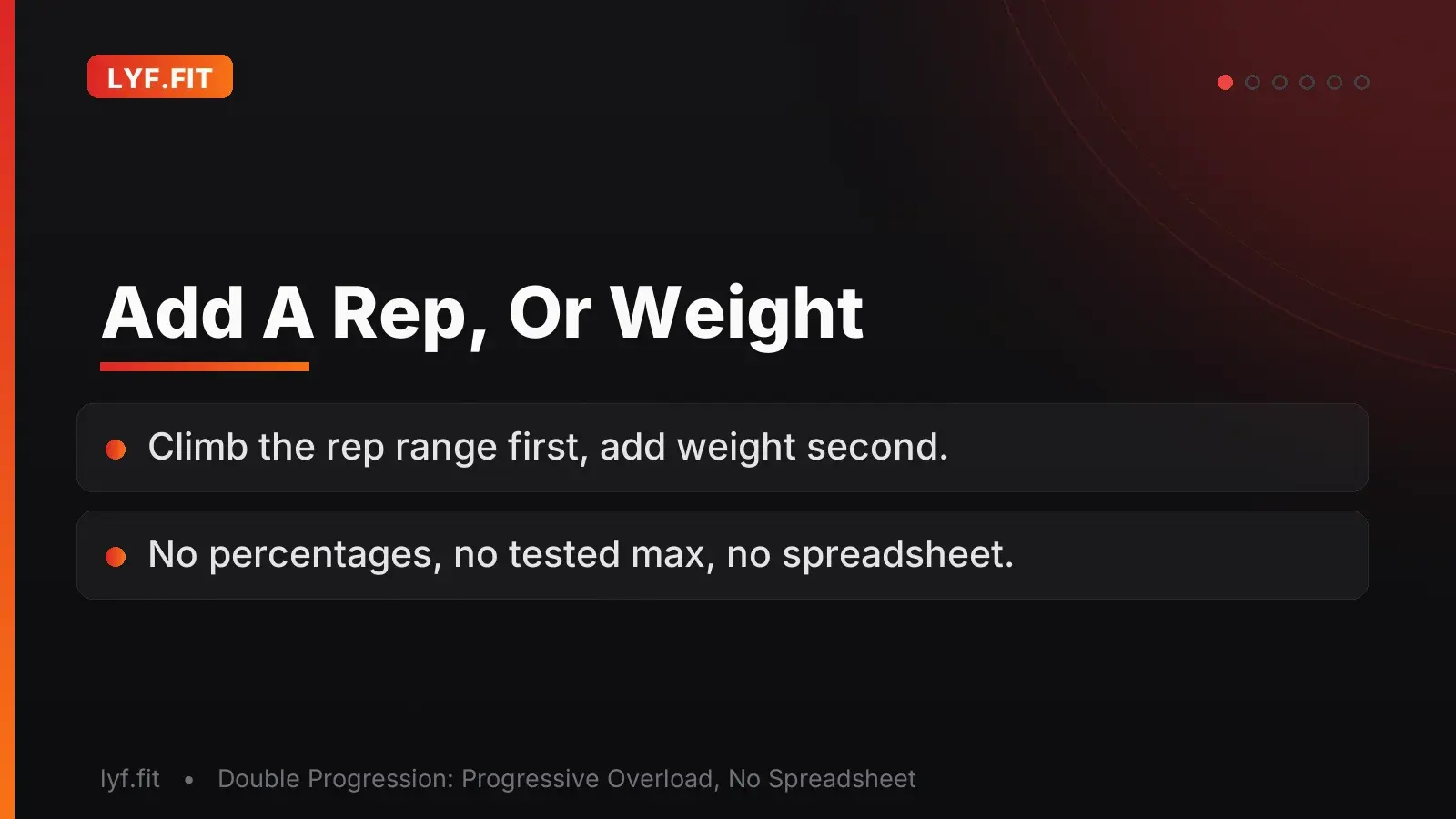
Double progression means you climb a rep range first and add weight second. You pick a range — say 8 to 12 — and stay at the same load until every prescribed set hits the top number, then you bump the weight and start again near the bottom. That's the whole method: two variables, one at a time, no percentages, no tested max, no spreadsheet.
It works because the two assumptions underneath it are both well-supported. Adding reps at a fixed load builds muscle about as well as adding weight, and rating your own effort works at least as well as running numbers off a max you tested six weeks ago. What double progression itself does not have is a trial proving it beats the alternatives — a point worth being honest about before you commit to it.
What is double progression, exactly?
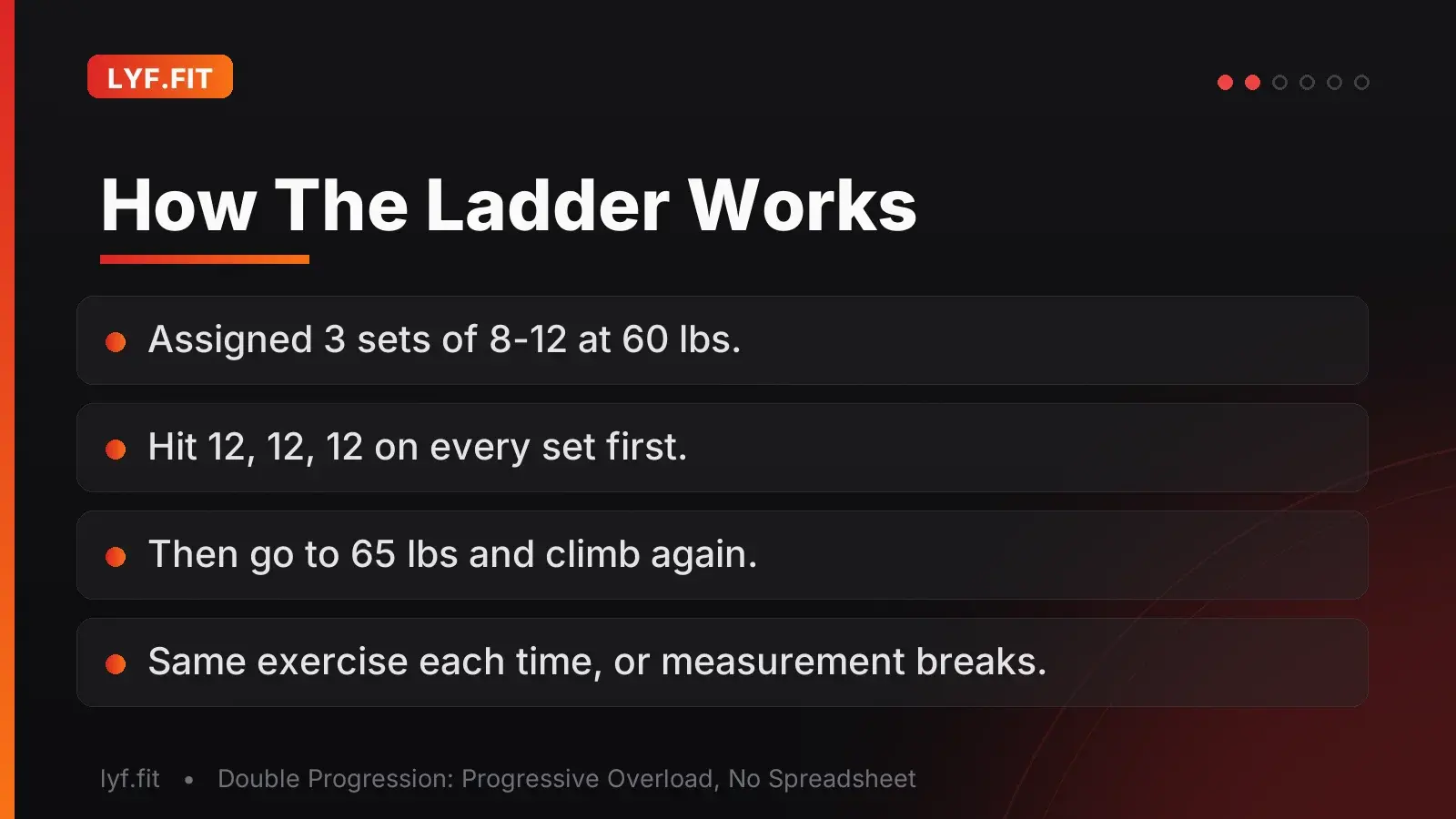
Two variables progress in sequence rather than in parallel. Variable one is repetitions; variable two is load. Suppose you're assigned 3 sets of 8–12 on the dumbbell row with 60 lbs. Session one you get 12, 10, 9. You do not touch the weight. Session two: 12, 11, 10. Still no change. Session four you finally hit 12, 12, 12 — now you go to 65 lbs, and you'll probably land back at 9, 8, 8. Then you climb again.
The "double" is the two-stage trigger. Single progression — add 5 lbs every session regardless — is what most beginner programs run, and it works right up until it doesn't. Double progression gives the ladder somewhere to go when weekly load jumps stop being physically possible, which for most lifters happens within the first year.
Does adding reps actually count as progressive overload?
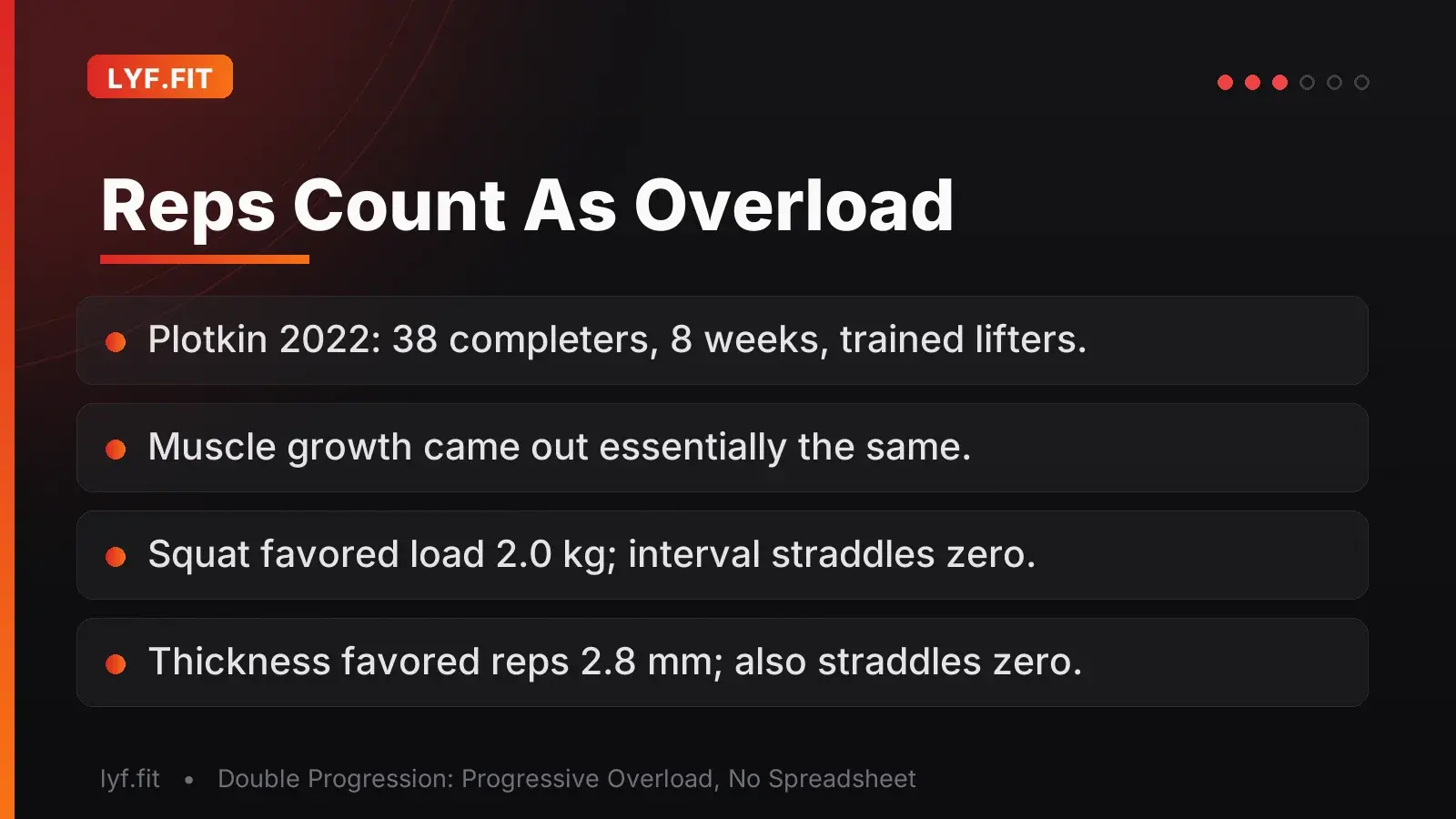
Yes, and this is the load-bearing evidence for the whole method. In a 2022 PeerJ trial, Plotkin and colleagues randomized 43 trained participants — 38 completed — to 8 weeks of either load progression or repetition progression at a fixed weight. Muscle growth came out essentially the same. Squat 1RM climbed 21.8 kg in the load group against 19.3 kg in the rep group, an adjusted effect of 2.0 kg favoring load with a 90% confidence interval spanning −7.8 to 2.4. Rectus femoris thickness went the other way, favoring rep progression by 2.8 mm (90% CI −0.5 to 5.8). Both intervals straddle zero.
So the popular framing — "progressive overload means putting more weight on the bar" — is wrong as stated. The overload lives in the effort and the accumulated stimulus, not the number on the plate. Our deeper dive on the neuroscience of progressive overload covers why the adaptation signal isn't load-specific.
Why do rep ranges work at all?
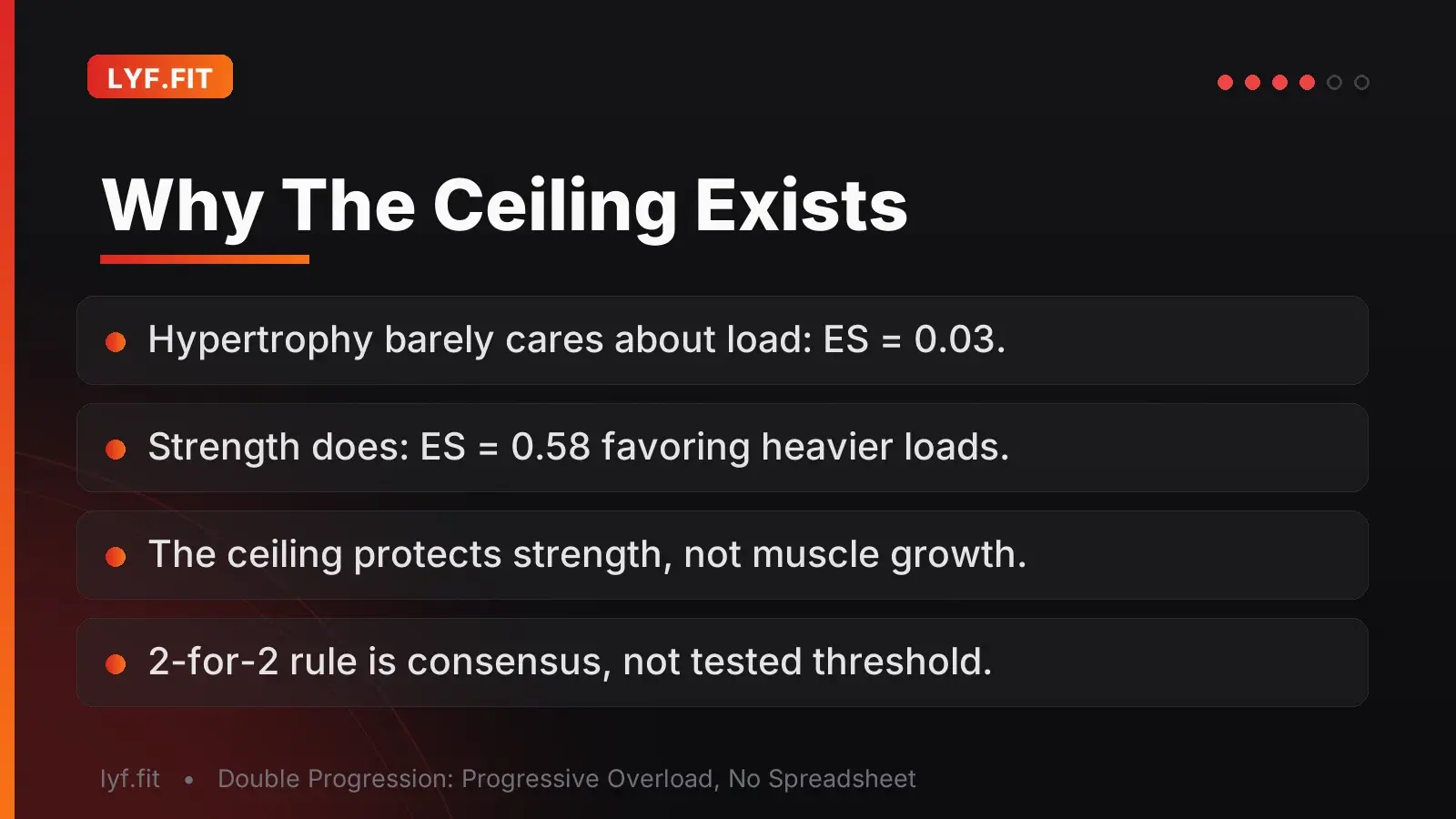
Because for hypertrophy, load magnitude barely matters. Schoenfeld and colleagues' 2017 meta-analysis in the Journal of Strength and Conditioning Research found a trivial and precisely estimated difference in whole-muscle growth between heavy loads (>60% 1RM) and lighter ones (≤60% 1RM) — ES = 0.03, with a 95% confidence interval of −0.08 to 0.14. That interval is tight enough to say the effect is genuinely near zero rather than merely unmeasured.
That's the permission slip for the range. A lifter grinding 8s with heavier weight and a lifter cruising 12s with lighter weight are both growing, which is exactly why you can spend three weeks anywhere inside 8–12 without leaking gains. The range isn't a compromise. It's a corridor where the outcome is flat.
Then why add weight at all?
Because strength is the exception. The same meta-analytic dataset showed a moderate advantage for heavier loads on 1RM — ES = 0.58 (95% CI 0.28–0.89, p = 0.002) favoring >60% 1RM across 14 studies. Growth doesn't care much about load; maximal force production does.
This reframes the rep ceiling. The top of your range isn't there because 13 reps stops building muscle — it's there to stop you from drifting so light that the strength stimulus erodes. The ceiling protects strength, not hypertrophy. Practically: if you're at 20+ reps on a movement you meant to train heavy, the range failed its job, and it's time to load up regardless of how the sets felt. Save this scheme for the handful of compound lifts that cover most of your strength — the squat, hinge, press, pull, and carry — where chasing load actually pays.
| Add reps (fixed load) | Add load (fixed reps) | Double progression | |
|---|---|---|---|
| Hypertrophy | Comparable | Comparable | Comparable |
| Strength | Slightly weaker | Slightly stronger | Both, in sequence |
| Needs a tested 1RM | No | Usually yes | No |
| Session-to-session admin | Log reps | Recalculate % | Log reps |
| Fails when | Reps drift very high | Load jump too big | — |
| Direct RCT support | Yes (Plotkin 2022) | Yes (Plotkin 2022) | None — untested |

When exactly should you add weight?
The standard answer is the NSCA's 2-for-2 rule: when you exceed your rep target by two or more on two consecutive sessions, increase the load. The ACSM's 2009 position stand on progression models suggests increments of roughly 2–10% when a bump is warranted.
Be clear about what those are. They're expert-consensus heuristics from certification texts and a position stand — not findings from trials that tested those thresholds against others. No study has established that 2-for-2 beats 3-for-1, or that 5% beats 8%. They're reasonable defaults, and the honest reason to use them is that they're specific enough to act on, not that research validated the specific numbers.
Practically, smaller is better than bigger. A 5-lb jump on a row costs you two or three reps; a 20-lb jump costs you the range entirely. Adjustable dumbbells with tight increments make the ladder considerably smoother than a rack that jumps in 10s.
Bowflex SelectTech 552 Adjustable Dumbbells Sponsored
Adjusts in 2.5-lb increments through the lower range, which is exactly the granularity double progression needs at home.
Do you have to train to failure for the reps to count?
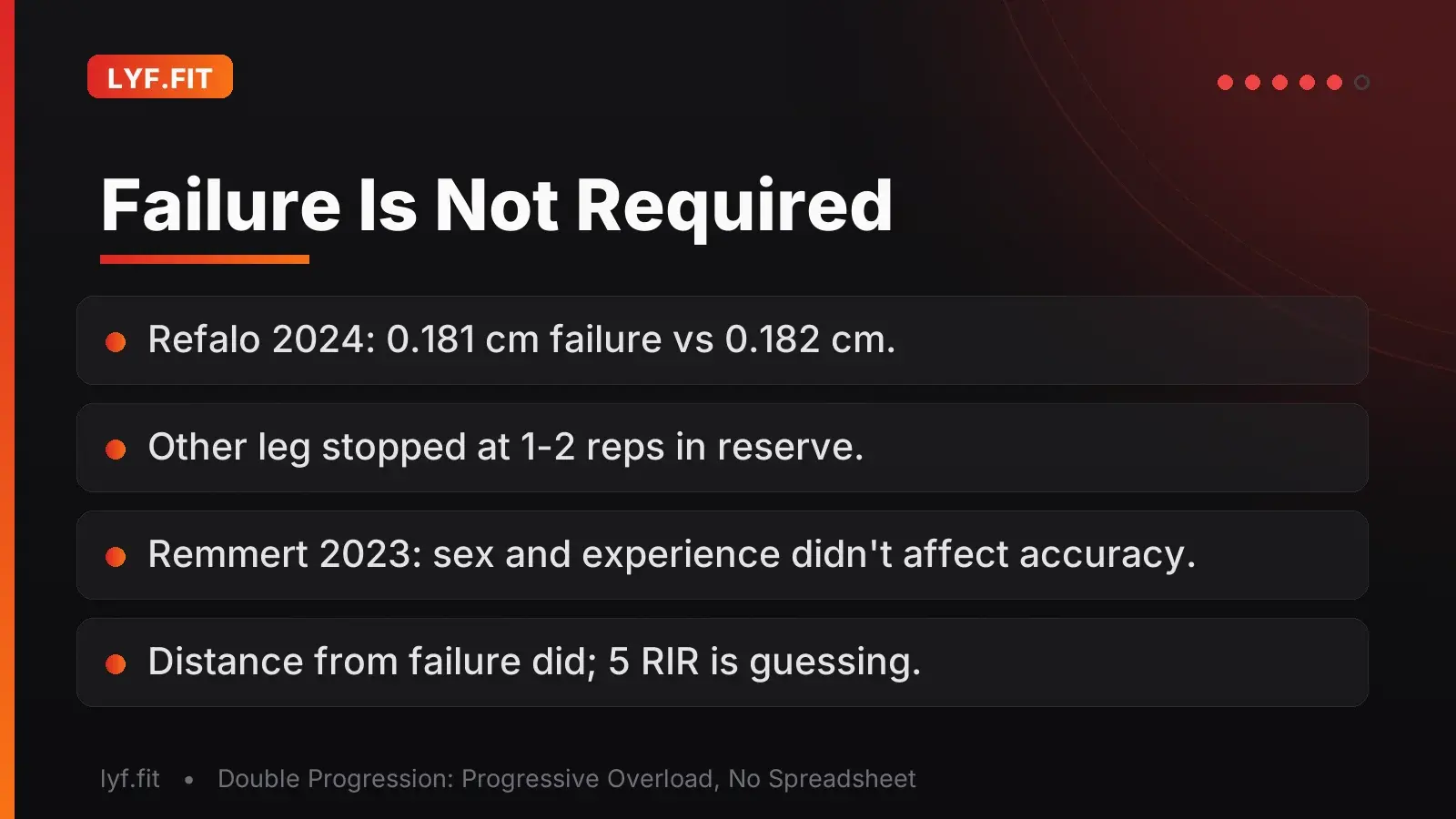
No. Refalo and colleagues (2024, Journal of Sports Sciences) ran a within-participant design in 18 resistance-trained adults: one leg trained the leg press and leg extension to momentary failure, the other stopped at 1–2 reps in reserve. Over 8 weeks, quadriceps thickness increased near-identically — 0.181 cm on the failure side against 0.182 cm on the reps-in-reserve side — with training volume similar between conditions.
The broader picture agrees, with nuance. Robinson and colleagues' 2024 meta-regressions in Sports Medicine — 55 hypertrophy studies, 67 strength studies — found a real but modest dose-response between proximity to failure and growth, and a negligible one for strength (confidence intervals contained the null). The hypertrophy slope flattened rather than climbing steeply, so the payoff for pushing ever closer to failure tapers off. The authors explicitly call the analysis exploratory with modest overall model fit, so "exactly 2 RIR is optimal" is not a claim anyone can make. Stopping a rep or two shy and letting the count climb across sessions is entirely defensible.
Can you actually judge reps in reserve?
Better than the folklore suggests, and worse where it matters least. Remmert and colleagues (2023, Perceptual and Motor Skills) had 58 lifters — 27 men averaging 66 months of training, 31 women averaging 22 months — estimate RIR across single- and multi-joint lifts. Accuracy improved closer to failure: 5 RIR was meaningfully less accurate than 3 or 1 RIR. Set number mattered too (both p<0.01).
Here's the surprise: sex, training experience, and prior RIR-rating experience showed no significant effect (p = 0.462–0.917). The common line that beginners can't autoregulate doesn't hold up in this data. The real caveat isn't inexperience — it's distance from failure. Guessing you have 5 left is a guess. Guessing you have 1 left is close to a measurement. Double progression conveniently operates near the accurate end.
Test Your Knowledge
1 / 5In Plotkin et al. (2022), what happened when trained lifters progressed by adding reps instead of load?
What double progression does not solve
It governs how you load a single set. It does not tell you how many sets to do, and volume still has a dose-response. Pelland and colleagues' meta-regression (Sports Medicine, 2026; 67 studies, 2,058 participants) found both muscle size and strength rise with weekly set volume, with diminishing returns — more pronounced for strength than for hypertrophy. A perfectly executed rep ladder across two weekly sets per muscle is still an underdosed program.
It also doesn't obligate you to deload on a schedule. In Coleman and colleagues' 2024 PeerJ trial, 39 completers ran 9 weeks; the group taking a full week off at the midpoint gained less squat strength on the raw numbers (92.8 → 105.8 kg) than the group training through (95.9 → 112.3 kg), with no muscle-size difference. Read that carefully, though: the authors call the squat comparison equivocal, with the interval around the difference running from −3.0 to 12.1 kg. It leans toward training through without settling the question. Deloads may still help fatigued or advanced lifters — but inserting one because the calendar says week five isn't well supported either.
One more constraint: the method requires repeating the same exercise. You cannot detect a rep change on a lift you rotate out every three weeks. Constant variation defeats the measurement double progression runs on.
Is autoregulation better than running percentages?
The evidence disagrees with itself, and that's worth saying plainly. Hickmott and colleagues' 2022 meta-analysis in Sports Medicine – Open pooled 6 studies and 133 participants and found no significant strength advantage for autoregulation: MD = 2.07 kg (95% CI −0.32 to 4.46), p = 0.09, SMD = 0.21. The subjective RPE/RIR subgroup nudged higher — MD = 3.15 kg — but still crossed zero.
A 2025 network meta-analysis (Huang et al., Journal of Exercise Science & Fitness) ranked autoregulated methods above percentage-based training, with APRE — a rep-target method mechanically similar to double progression — first on back squat (SUCRA 93.0%) and bench (97.1%). Treat that as directionally supportive and low-certainty; network meta-analyses on thin literatures produce unstable rankings.
The takeaway is modest and useful: a busy lifter loses nothing by autoregulating instead of running percentages off a tested one-rep max. If you want the number anyway, estimate it with our 1RM calculator rather than grinding a true single.
Interactive Tools
Save these contextual tools to your profile for quick access.
Frequently asked questions
No, and anyone claiming otherwise is overstating. As of mid-2026, no controlled trial has directly compared double progression to linear loading or any other model — searches turn up zero on-topic RCTs. What we have is strong support for its component assumptions: rep progression matches load progression for hypertrophy (Plotkin 2022), load matters for strength (ES = 0.58), and autoregulation is at worst equivalent to percentages. The honest claim is that it's a sensible default nobody has beaten, because nobody has run the comparison.
Almost any range in the ~5–20 window will grow muscle, since hypertrophy is near-indifferent to load (ES = 0.03). Choose by exercise, not by dogma: 5–8 on compounds where load progression is meaningful and the setup is stable, 8–12 on most machine and dumbbell work, 12–20 on lateral raises, curls, and anything where heavy loading is more of a joint problem than a muscle stimulus. Wider ranges mean fewer load bumps; narrower ranges mean more. Keep the range fixed once you pick it — moving the goalposts breaks the measurement. Our primer on how hypertrophy works goes deeper on why the corridor is that wide.
First, check the boring inputs before touching the program: sleep, protein, and whether weekly set volume is actually adequate — Pelland's 2026 meta-regression across 67 studies shows a real dose-response for sets per week. If those are fine, try a smaller load increment (2.5 lbs instead of 5), or hold the load and grind out one more rep on one set only rather than all three. Don't reflexively schedule a deload; in Coleman's 2024 trial a calendar-timed week off produced less squat strength gain than training through, though that particular comparison was equivocal. A stall of two sessions is normal variance, not a plateau. See our piece on what rest actually does for the recovery side.
No — that's the point. Double progression needs exactly two data points per exercise: the load, and the reps you got on each set. No percentages, no tested max, no e1RM math, no weekly wave. A notebook works. The only non-negotiable is that you record it, because the method is a comparison against last session, and memory is a bad instrument for that. Log the same exercises consistently and the decision writes itself: everything hit the ceiling, so add weight.
Double progression isn't magic and it isn't proven superior — it's a low-admin heuristic built from well-supported parts, which is about the best any progression scheme can honestly claim right now. Its only real requirement is that you write down what you lifted, session after session, on the same movements. Start logging your sets and reps in the Daily Lifting Log and the "add a rep or add weight?" question stops being a judgment call and becomes a lookup.
Stop completely guessing.
Use our interactive PWA tools to calculate your exact macros, 1RM, and running pace offline.